


Fishing Trip Power Planning: From Day Trips to Tournaments
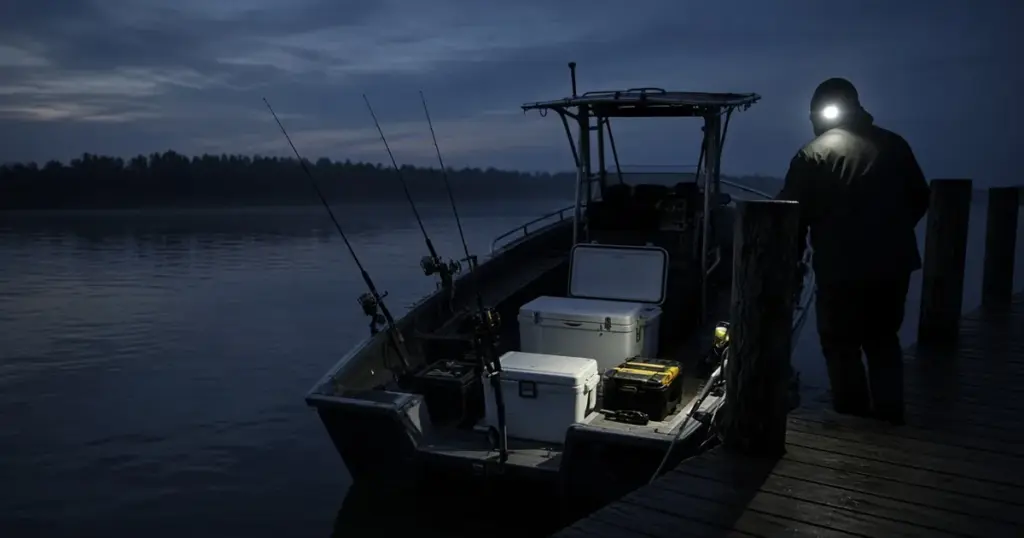
Every angler has a story about a trip cut short by a dead battery. The trolling motor slows to a crawl in the afternoon wind, the livewell pump stops, or the engine won’t crank after a long drift. Most of these failures come from the same cause: the boat’s batteries weren’t sized for the way it was actually used that day.
Power planning isn’t complicated. You list what uses electricity, estimate how long each item runs, add it up and compare the total to the energy your batteries can deliver. This guide walks through that process for any kind of fishing trip, from a morning on a lake to several days offshore, and links to detailed guides for specific types of fishing.
Step 1: Separate your battery jobs
Most fishing boats have up to three battery jobs:
- Starting: cranking the outboard or inboard. This needs a short burst of high current and must always be available.
- House: electronics, livewells, lights, bilge pumps, stereo and chargers. These are smaller loads that run for hours.
- Trolling: the trolling motor, usually on its own 12V, 24V or 36V bank.
On small boats, one battery may handle starting and house loads. That works for short trips, but on longer days it risks draining the battery you need to get home. Separating starting from everything else, with a second battery and a switch or charging relay, is the most important reliability upgrade for most fishing boats.
Step 2: List your loads
Write down everything that uses power and estimate how long it runs in a typical day. Check device manuals or labels for current draw; the table below gives rough ranges.
| Load | Typical draw (12V) | Typical hours per day |
|---|---|---|
| Fishfinder/chartplotter (7–9 in) | 1–2A | 6–10 |
| Large multifunction display (12 in+) | 2–4A | 6–10 |
| Livewell pump | 2–5A | 2–10 |
| Aerator | 1–2A | 4–10 |
| Bilge pump | 2–8A | Minutes |
| LED navigation/anchor lights | Under 1–2A | 0–10 |
| Underwater or green fishing lights | 2–10A | 0–8 |
| Stereo | 3–10A | 0–8 |
| VHF radio (receive) | Under 1A | 6–10 |
| Fridge or powered cooler | 3–5A while running | Cycles |
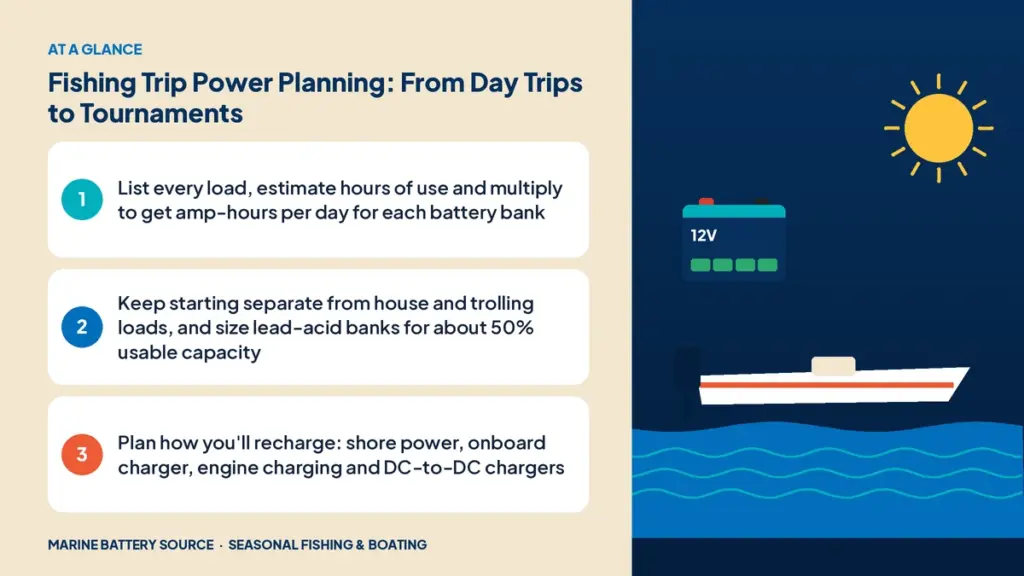
Multiply each item’s current by hours to get amp-hours (Ah). Add them up for the daily house load.
Step 3: Estimate the trolling motor
Trolling motors are harder to estimate because draw changes with speed, wind and current. Use the maker’s maximum current as an upper limit and estimate your average. Many anglers run at low to medium speed most of the day, with bursts at high speed. Spot-lock modes run the motor in short pulses that can add up in wind or current.
A simple method: estimate average amps × hours of use. For example, a 24V motor averaging 12A for six hours uses about 72Ah at 24V. If you’ve used a battery monitor or a Bluetooth lithium battery, check your history for real numbers; it’s far more accurate than guessing.
Step 4: Convert to battery size
Battery capacity is listed in amp-hours, but not all of it is usable:
- Flooded and AGM lead-acid: plan to use about 50% regularly for good battery life. A 100Ah lead-acid battery gives about 50Ah usable.
- LiFePO4 lithium: most can use 80–100% of rated capacity. A 100Ah lithium battery gives about 80–100Ah usable.
Add a margin of 20–30% for wind, cold, aging batteries and the unexpected. Then pick a battery or bank that covers the result.
Example: A house load of 40Ah per day with a 25% margin needs about 50Ah usable. That’s roughly a 100Ah lead-acid battery or a 60Ah lithium battery.
Step 5: Plan recharging
How you recharge determines whether you can repeat the trip the next day:
- Shore power and onboard chargers. A multi-bank onboard charger refills every bank overnight at the dock or in the garage.
- Engine charging. The outboard’s charging system refills the start battery during runs. Its output for house batteries is limited, and lithium banks often need a DC-to-DC charger to charge properly and protect the alternator.
- Portable chargers. Useful for boats without onboard chargers, but make sure the profile matches the chemistry.
For multiple days away from power, charging becomes the main design question. See multi-day fishing trip batteries and boat camping power.
Planning by type of fishing
Each style of fishing stresses batteries differently. These guides cover the details:
- Bass tournaments: long days on the trolling motor and big electronics. See bass tournament battery planning.
- Night fishing: lights become the main house load. See night fishing lights and batteries.
- Crappie spider rigging: slow trolling with several rods and electronics for hours. See crappie spider rigging.
- Offshore: large displays, radar, autopilot and livewells. See offshore electronics and batteries.
- Live bait: livewells are a steady drain worth calculating. See livewell pump batteries.
- Kicker motors: small outboards for trolling need their own starting plan. See kicker motor batteries.
Step 6: Check before every trip
Even a well-planned system fails if a battery isn’t charged or a connection is loose. A short check before you leave covers state of charge, terminals, switches and fuses. See the pre-trip battery check.
Common planning mistakes
- Ignoring the start battery. Running electronics and livewells from the start battery all day is the most common reason boats won’t start.
- Using rated capacity for lead-acid. Planning to use 100% of a lead-acid battery’s rating leads to short life and dead batteries.
- Forgetting temperature. Cold reduces lead-acid capacity and cranking power; heat speeds aging. Unheated lithium shouldn’t be charged below freezing.
- Underestimating wind. A windy day can double trolling motor use.
- Not measuring. A battery monitor turns estimates into real data.
Seasonal changes
Your power needs change through the year. Summer means more livewell and aerator use; winter means shorter days, more lighting and cold-weather capacity loss. Use the seasonal battery calendar to plan maintenance and upgrades around your fishing year.
Products that help
- EPOCH 12V 105Ah lithium battery
- EPOCH 4-bank 12V charger
- EPOCH dual-output DC-to-DC charger
- Browse house batteries and trolling motor batteries.
Frequently asked questions
How do I calculate how much battery I need for fishing?
List each load’s current draw, multiply by hours of use, add them up and add a 20–30% margin. Then size for usable capacity: about 50% for lead-acid, 80–100% for lithium.
Should my fishfinder run off the starting battery?
On short trips it’s fine, but on long days a separate house battery keeps starting power in reserve.
How many amp-hours does a trolling motor use in a day?
It depends on speed, wind and hours. Multiply average current by hours; a battery monitor gives real numbers.
Can my outboard charge my batteries?
It recharges the start battery during runs. House and lithium banks often need a DC-to-DC charger or shore power to charge fully.
Is lithium better for fishing boats?
For deep-cycle use, often yes: more usable capacity, less weight and faster charging. Starting batteries can be lead-acid or dual-purpose lithium.