


Multi-Day Fishing Trips Without Shore Power
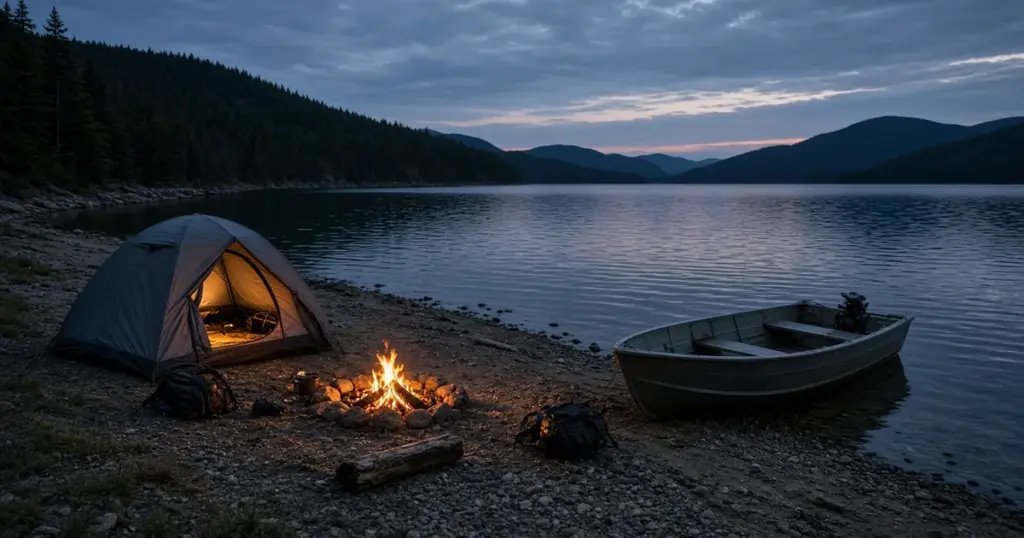
A day trip only has to make it back to the ramp. A multi-day trip has to start every morning with enough power for another full day. Whether you’re fishing a series of days from a lake campground, running to the Keys or the Dry Tortugas, or living aboard during a tournament week, the batteries have to recover overnight or you’ll run short by day two or three.
This guide covers how to plan battery power for fishing trips that last several days: sizing, recharging and the habits that keep you from running out.
The core idea: daily balance
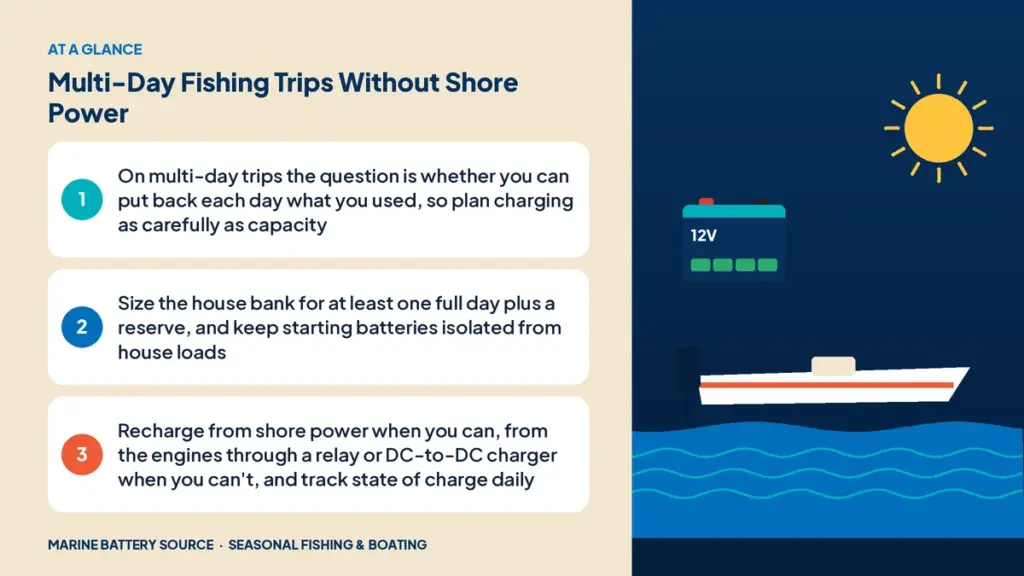
On a single day, you can draw a battery down and recharge it at home. On a multi-day trip, every day must roughly balance:
Energy used each day ≤ energy put back each day + reserve
If you use 80Ah a day and can put back only 50Ah, you lose 30Ah daily. A bank with 150Ah usable lasts about five days before it’s empty; a smaller bank fails sooner. Knowing this balance tells you whether you need more capacity, more charging, or less consumption.
Start by estimating daily use with the method in fishing trip power planning.
Sizing the house bank
For multi-day trips:
- Cover at least one full day of house loads with usable capacity.
- Add a reserve of a half day or more for bad weather days, when you might sit at anchor with the bilge pump and electronics running.
- Remember that lead-acid batteries give about 50% of their rating for regular use and need long charges to reach full. Lithium gives most of its rating and accepts charge quickly, which matters a lot when charging time is limited.
Lithium’s fast charging is often the biggest advantage on multi-day trips. A lead-acid battery spends hours in the absorption stage before it’s truly full, so a short engine run or a few hours on shore power often leaves it partly charged. Day after day, that partial charging reduces capacity and life. Lithium can take most of its charge at high current until it’s nearly full.
Recharging options
| Source | Pros | Cons |
|---|---|---|
| Shore power at marina or campground | Full, reliable charge overnight | Needs a slip or site with power |
| Engine alternator via relay | No extra equipment | Limited output; lithium often needs a DC-to-DC charger |
| DC-to-DC charger from engine | Correct profile for lithium; protects alternator | Only charges while engine runs |
| Portable generator with shore charger | Works anywhere | Noise, fuel, safety; check marina rules |
| Solar panels | Silent, no fuel | Output depends on panel size and sun; space needed |
We don’t sell solar products, but many anglers add a small panel and controller from another supplier for long trips. Make sure any controller has a profile for your battery chemistry.
Protecting starting power
On multi-day trips, a dead start battery can strand you far from help. Keep starting separate:
- Use a battery switch, automatic charging relay or battery isolator so house loads can’t drain the start battery.
- Check the start battery’s state of charge every morning.
- Carry a jump pack, charged before the trip.
- On boats with a kicker motor, make sure its battery is charged too; see kicker motor batteries.
Livewells and bait over several days
Keeping bait alive for days means pumps running for long periods. Livewells and aerators are often the largest house load on multi-day fishing trips. See livewell pump batteries for how to estimate and reduce this load.
Trolling motor over several days
Trolling motor banks need nightly charging too. A 24V or 36V bank may need a multi-bank onboard charger plugged into shore power, or a DC-to-DC charger that can charge it from the engine. Lithium trolling batteries with Bluetooth let you check exactly how much you used each day. Spider riggers and others who troll all day should plan for nightly recharging; see crappie spider rigging.
Offshore and island trips
Long runs to remote fishing grounds give the engines plenty of time to charge, but nights at anchor without shore power mean the house bank must cover lights, pumps, electronics and perhaps a fridge until morning. Plan for the worst case, such as a weather day stuck at anchor. See offshore electronics for the loads involved.
Daily routine on the trip
- Morning: check every battery’s state of charge before leaving.
- During the day: turn off loads you don’t need, and run the engine long enough to recharge between spots.
- Evening: plug in to shore power if available; otherwise, note how much the house bank recovered.
- Before bed: turn off unneeded loads, check the bilge pump, and confirm the anchor light is on if you’re anchored out.
A battery monitor makes this routine easy, especially for lead-acid banks, where voltage alone is misleading under load.
Choosing your setup
Small boats doing two or three days on a lake with campground power may need only a good onboard charger. Bigger boats spending nights away from power need a larger house bank, engine charging and perhaps solar. See battery setup by boat type for typical layouts. Before a long trip, schedule maintenance using the seasonal battery calendar so you start with healthy batteries.
Products that help
- EPOCH 12V 300Ah lithium battery
- EPOCH dual-output DC-to-DC charger
- EPOCH 4-bank 12V charger
- Browse house batteries.
Frequently asked questions
How big should my battery be for a multi-day fishing trip?
Cover at least one full day of house loads with usable capacity plus a reserve, and make sure you can put back each day what you use.
Can my outboard recharge my batteries on a long trip?
It can help, especially on long runs. Lithium house banks often need a DC-to-DC charger, and slow trolling or drifting puts back little.
Is lithium better for multi-day trips?
Often yes. It gives more usable capacity and charges faster, so limited charging time does more.
How do I keep my start battery from dying on a long trip?
Isolate it from house loads with a switch or charging relay, check it every morning and carry a jump pack.
Do I need solar for a multi-day fishing trip?
Not always. Shore power or engine charging may be enough. Solar helps when you’ll spend several nights away from power.