


A Year of Boating: Seasonal Battery Calendar

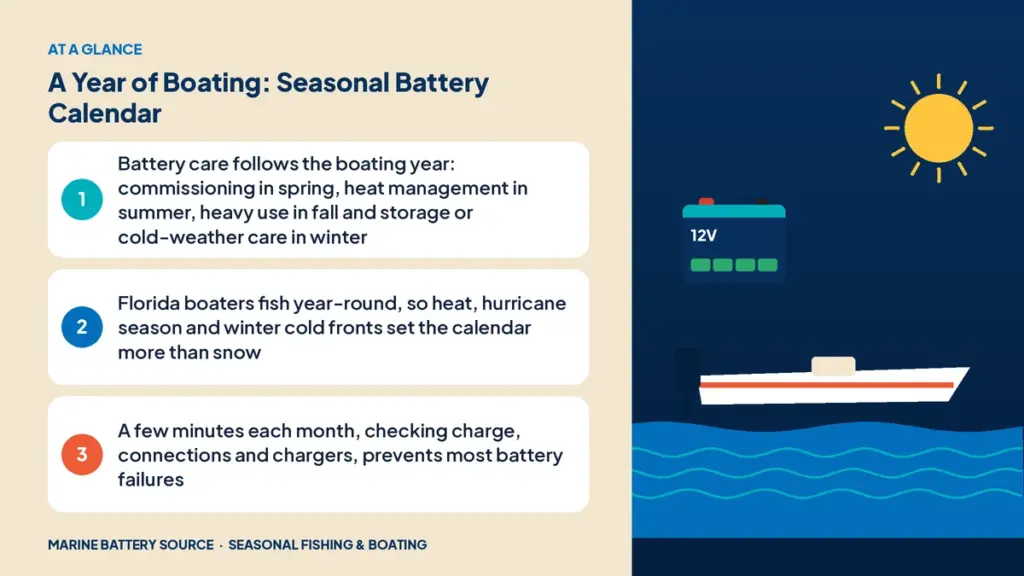
Batteries fail most often at predictable times: the first trip of spring after a neglected winter, the hottest weeks of summer, and the busiest holiday weekends. A simple calendar keeps your batteries ready. This hub lays out what to do through the year, with links to detailed seasonal guides. Northern boaters will follow the seasons closely; Florida boaters fish all year, so heat and storms shape the plan more than snow.
Every month
- Check resting voltage or state of charge.
- Look at terminals for corrosion and tightness.
- Make sure chargers and maintainers are working and set to the right chemistry.
- Check flooded battery water levels, more often in hot weather, and top up with distilled water after charging.
- Confirm batteries are secure and terminal covers are on.
January and February
North: batteries are in storage. Check stored lead-acid batteries monthly and recharge, or keep them on a smart maintainer. Don’t charge unheated lithium batteries below freezing.
Florida: winter is prime fishing for many species, but cold fronts bring chilly mornings. Keep batteries fully charged, because cold reduces cranking power and capacity. See winter fishing in Florida.
March and April: commissioning
- Fully charge every battery and test it before the first trip.
- Clean terminals and apply protectant.
- Check cables for chafe and corrosion.
- Test the charger, the alternator charging voltage and the battery switch.
- Replace batteries that fail load tests.
- For bass anglers, get the trolling bank ready before the first tournament. See tournament season battery prep.
May: the season opener
Memorial Day weekend is the unofficial start of boating season for many. Run a full electrical check a week ahead. See the Memorial Day boating checklist.
June through August: heat
Heat is hard on batteries. It speeds water loss in flooded batteries, accelerates aging and can push batteries in hot compartments toward overheating.
- Check flooded water levels every couple of weeks.
- Make sure chargers have temperature compensation, if available.
- Keep compartments ventilated.
- Watch for swelling or heat after charging.
See summer boat battery tips. For holiday weekends with stereos, lights and long days at anchor, see Fourth of July boat power. Florida’s scallop season falls in summer in many Gulf zones; see scallop season boat prep.
June through November: hurricane season
In Florida and along the Gulf and Atlantic coasts, have a storm plan for your boat. Charge batteries before a storm so bilge pumps can run, secure them, and know how you’ll disconnect or remove them if the boat is hauled. After a storm, inspect batteries that may have been submerged or damaged.
September through November: fall fishing
Fall brings some of the best fishing of the year, and long days on the trolling motor. Check capacity before the fall run, and plan charging for multi-day trips. See fall fishing battery tips and, for inshore anglers, redfish and snook season power.
November and December: storage or keep going
North: prepare for winter storage. Fully charge batteries, disconnect loads, and either keep them on a maintainer or bring them home to a cool, dry, ventilated spot. Check stored lead-acid batteries monthly.
Florida: keep fishing, but don’t neglect maintenance just because the season never ends. Holiday gift ideas for the boater in your life are in gifts for boaters.
Before every trip
Whatever the month, a quick check before you leave the dock saves trouble:
- State of charge for each battery.
- Battery switch in the right position.
- Electronics powering up normally.
- A plan for how much power the trip will use. See fishing trip power planning.
Spring commissioning, step by step
- Charge fully. Use the correct profile for each chemistry, and let lead-acid batteries finish their absorption stage.
- Rest and measure. After several hours off the charger, a healthy 12V flooded battery reads about 12.6–12.7V, AGM about 12.8V and LiFePO4 about 13.3–13.4V.
- Load test starting batteries. A healthy 12V battery stays above about 9.6V at half its CCA rating for 15 seconds.
- Clean and tighten. Brush corrosion off terminals, tighten connections and refit terminal boots.
- Inspect cables and fuses. Replace cracked insulation, corroded lugs and blown or heat-damaged fuse holders.
- Check engine charging. With the engine running, charging voltage on a 12V system typically reads about 13.8–14.6V at the battery.
- Test on the water. Take a short local trip before the first long day or tournament.
Signs your calendar is slipping
- You can’t remember when the batteries were last fully charged.
- The trolling motor slows earlier in the day than it used to.
- Terminals are crusty with corrosion.
- The charger shows fault lights you’ve been ignoring.
Any of these means it’s time for a full check, whatever the month.
Calendar at a glance
| Month | North | Florida |
|---|---|---|
| Jan–Feb | Storage checks | Winter fishing; cold-front prep |
| Mar–Apr | Commissioning | Spring tune-up, tournament prep |
| May | Season opener | Pre-summer checks |
| Jun–Aug | Heat care | Heat care, scallops, hurricane prep |
| Sep–Oct | Fall fishing | Fall fishing, hurricane watch |
| Nov–Dec | Storage prep | Year-round fishing, holiday trips |
Lithium owners
Lithium batteries need less routine care: no watering, no equalizing and slow self-discharge, so they handle long gaps between trips well. Still check state of charge, connections and charger settings, store them partly charged if laid up for months, and don’t charge unheated lithium below freezing.
Shop seasonal essentials
Browse chargers and maintainers, trolling motor batteries and battery accessories, or see the EPOCH 4-bank 12V charger.
Frequently asked questions
How often should I check my boat battery?
Monthly, plus before every trip.
When should I replace my boat battery?
When it fails a load test after a full charge, won’t hold a charge, or shows swelling or leaks.
Do Florida boaters need to winterize batteries?
Not usually, but keep them charged and maintained year-round, and prepare for cold fronts and hurricane season.
What’s the best time to buy a new battery?
Before you need it, ideally during spring commissioning or before a big trip.
Do lithium batteries need seasonal maintenance?
Less than lead-acid, but check charge, connections and charger settings, and store them partly charged.