


July 4th on the Water: Power for Sandbar Days and Fireworks

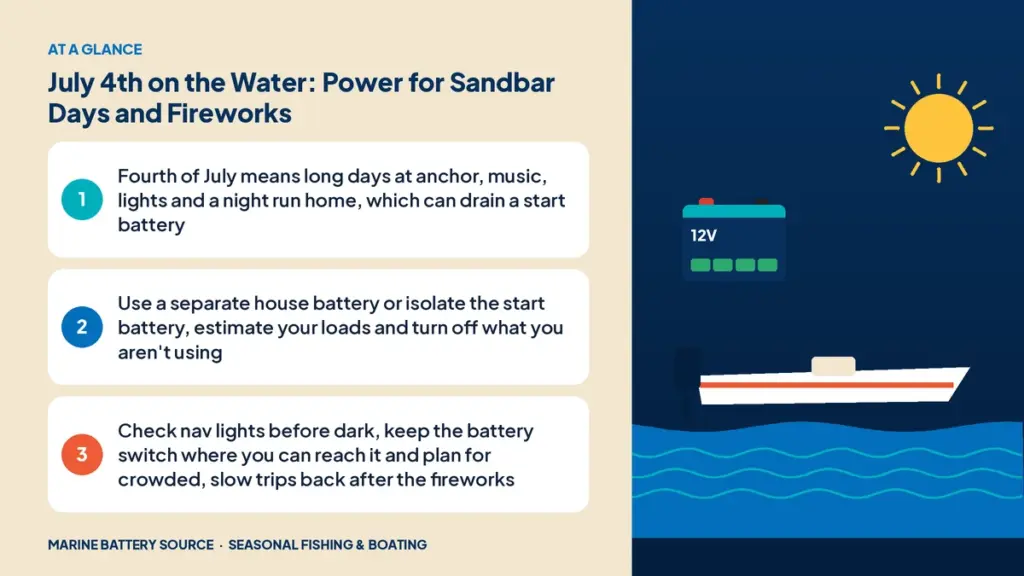
The Fourth of July is one of the biggest boating days of the year. Boaters raft up at sandbars, anchor for fireworks and run home after dark in crowded water. It’s a great day on the water, but it’s also a day when stereos, lights and long hours at anchor can leave you with a battery that won’t start the engine. This guide helps you plan your power so the day ends well.
Why holiday days drain batteries
- Long hours at anchor with the engine off, so nothing is charging.
- Stereo and amplifiers playing for hours.
- Lights: courtesy lights, underwater lights, anchor light and nav lights.
- Fridges, coolers with fans, phone chargers and blenders on inverters.
- Crowded ramps and slow returns that add engine-off time.
Estimate your loads
| Load | Typical draw (12V) | Hours | Amp-hours |
|---|---|---|---|
| Stereo, moderate volume | 5A | 6 | 30Ah |
| Amplified stereo, loud | 15A | 4 | 60Ah |
| Courtesy and underwater lights | 3A | 4 | 12Ah |
| Anchor light | 1A | 4 | 4Ah |
| Phone and device charging | 2A | 4 | 8Ah |
| 12V cooler or fridge | 3A (cycling, ~50%) | 8 | 12Ah |
A moderate setup might use 50–60Ah by fireworks time; a loud one, 100Ah or more. A single lead-acid start battery should stay well above half charge to start reliably, so it can’t safely supply that much.
The best setup: a separate house battery
A dedicated house battery for the stereo and accessories, with a battery switch or automatic charging relay, keeps your start battery untouched. A lithium house battery is ideal: lots of usable capacity, steady voltage for the stereo and light weight. A 100Ah lithium battery delivers about 80–100Ah; a group 24 lithium like the EPOCH 12V 105Ah or the Dakota DL+ 135Ah is a popular choice.
If you have only one battery
- Set the battery switch so you can isolate it, if possible.
- Watch the voltage. If a lead-acid start battery drops toward 12.2V at rest, you’re near half charge; stop and run the engine.
- Run the engine periodically to recharge, but be considerate of neighbors and exhaust at a raft-up.
- Turn off what you aren’t using.
- Bring a jump pack as a backup.
How low is too low?
For a lead-acid start battery, resting voltage is a rough guide: about 12.6–12.7V is full, about 12.4V is three-quarters and about 12.2V is half. Below half, cranking gets less reliable, especially on a battery that’s a few seasons old. Readings taken while loads are running will be lower, so turn things off for a few minutes before you check. Lithium batteries hold a flatter voltage, so use the app or a battery monitor rather than voltage alone.
Inverters and blenders
A small inverter running a blender or coffee maker can draw a lot of current from a 12V battery, often 80–120A or more while it’s running. Short bursts are fine on a healthy house bank, but repeated use on a single start battery can drain it quickly. If you plan to run AC appliances, use a house battery sized for the inverter, keep the cables short and fused, and check the inverter maker’s battery recommendations.
Before you leave the dock
- ☐ Every battery fully charged
- ☐ Start battery tested
- ☐ Battery switch working
- ☐ Nav lights and anchor light working
- ☐ Horn and VHF working
- ☐ Bilge pump working
- ☐ Spare fuses aboard
- ☐ Life jackets for everyone, especially kids
- ☐ Fire extinguisher charged
See the Memorial Day checklist for a full pre-season review.
Fireworks and the night run
- Check nav lights before dark. Turn them on early to confirm they work.
- Keep your start battery ready. You don’t want to be stuck when everyone leaves at once.
- Go slow. Crowded water at night means wakes, unlit boats and fatigue.
- Keep the anchor light on while anchored.
- Designate a sober operator. Boating under the influence is illegal and dangerous.
Rafting up
When boats raft together, people sometimes share power or jump-start a neighbor. Use proper jumper cables or a jump pack, connect in the right order, and never connect batteries of different voltages. If a neighbor’s battery is dead, a jump pack is safer than running cables between rocking boats, where cables can pull loose or pinch between hulls.
Florida summer heat
In Florida, the Fourth falls in peak heat. Batteries in hot consoles and compartments age faster, and flooded batteries lose water quickly. Check water levels before the holiday and keep batteries ventilated. See summer battery tips.
Keep kids and guests clear of the battery area
With lots of people aboard, gear gets stowed wherever it fits. Keep coolers, bags and wet towels off battery boxes and away from the battery switch, so vents stay clear and you can reach the switch quickly if something goes wrong.
After the holiday
- Recharge every battery fully as soon as you’re home.
- Check flooded water levels after heavy use.
- If your battery struggled, test it; a holiday is often when weak batteries reveal themselves.
More holiday and seasonal planning
The seasonal battery calendar covers the year. For summer scalloping trips on the Gulf Coast, see scallop season boat prep, and inshore anglers should read redfish and snook season power. Florida’s cooler months are covered in winter fishing in Florida. Planning a long fishing day instead? See fishing trip power planning.
Products that help
- EPOCH 12V 105Ah lithium house battery
- Dakota DL+ 12V 135Ah
- EPOCH 12V 15A lithium charger
- Browse house bank batteries.
Frequently asked questions
Will my stereo kill my boat battery?
It can, over several hours at anchor. A separate house battery prevents that.
How long can I play music on my boat battery?
Divide usable amp-hours by the stereo’s draw. A 5A stereo on 50Ah usable runs about 10 hours.
Should I run my engine to charge the battery at a sandbar?
Periodically, if you have only one battery, but a separate house battery is better.
What should I check before the fireworks run home?
Nav lights, anchor light, start battery charge and the battery switch position.
Is a lithium house battery worth it for parties?
Yes. It gives lots of usable capacity and steady voltage for audio and lights.