


Lithium Cranking Batteries and Outboard Charging Systems
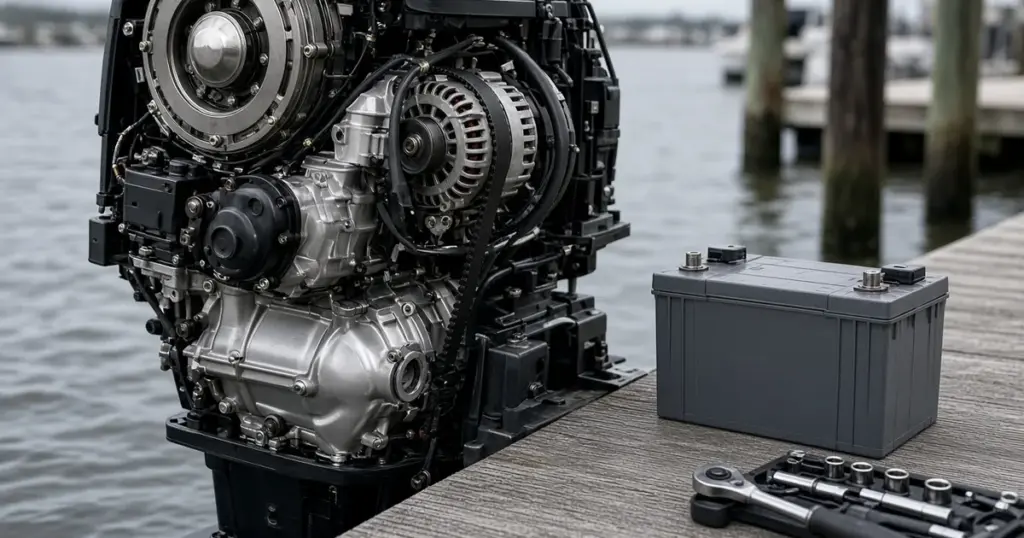
A cranking-rated lithium battery can save a lot of weight and handle engine-off electronics better than lead-acid. But the battery is only half of the system. The other half is the outboard’s charging system, and understanding how a lithium cranking battery interacts with your alternator or stator is the key to a reliable setup. This guide explains the issues in plain terms.
How outboards charge batteries
Outboards generate charging power in one of two ways:
- Stator and regulator/rectifier. Common on many outboards. Magnets on the flywheel pass coils (the stator), producing AC that the regulator/rectifier converts to DC and limits to a set voltage.
- Belt-driven alternator. Common on larger four-stroke outboards. Works much like a car alternator, with an internal regulator.
Both deliver a regulated voltage designed with lead-acid batteries in mind, and both have a maximum output current that depends on engine RPM.
What’s different about lithium
Charge acceptance
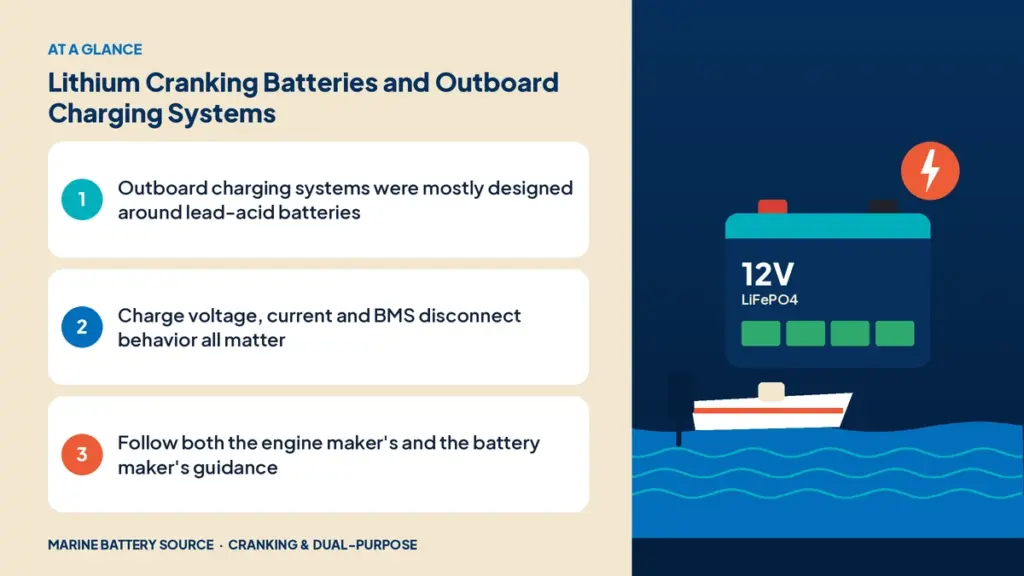
Lead-acid batteries accept less current as they approach full charge. Lithium batteries accept high current almost until full. That means a depleted lithium battery can ask the charging system for its maximum output for a long time. On a small starting battery that’s usually brief, but on a large lithium battery it can keep the charging system at full output for an extended period.
Charge voltage
LiFePO4 batteries have a recommended charge voltage that’s often similar to, but not always identical with, lead-acid charging voltages. If the engine’s regulated voltage is lower than ideal, the battery may never fully charge. If it’s higher than the battery maker’s limit, the BMS may disconnect the battery to protect it.
BMS disconnects
Every lithium battery has a battery management system that can disconnect the cells if voltage, current or temperature goes out of range. If that happens while the engine is charging, the charging system suddenly loses its load. The resulting voltage spike, sometimes called a load dump, can damage some regulators or electronics. Battery makers handle this with different designs and guidance, and some engine makers have specific recommendations.
What engine makers say
Engine manufacturers differ. Some publish guidance for lithium starting batteries, some approve specific battery types or require isolation devices, and some advise against lithium for starting. Always check your engine’s manual, service bulletins and warranty terms before switching. Your dealer can help.
Cranking-rated lithium options
If your engine maker allows it, these store options are designed to start engines:
- EPOCH 12V 172Ah dual purpose: 1000 CCA listed, Group 31, 40 lb, with Bluetooth.
- Dakota Lithium DL 12V 135Ah heated: 1000 CCA listed, Group 24 size, 27.2 lb, with heating for cold charging.
- The EPOCH 12V 300Ah Pro Series, a large cranking and deep-cycle battery in an 8D footprint.
Read the battery maker’s installation notes about charging systems, minimum charge voltage, and any recommended accessories.
The DC-DC charger approach
Many boaters keep a lead-acid or AGM battery for starting and put lithium only on the house side. The engine charges the starting battery directly, and a DC-DC charger feeds the lithium house bank with a controlled current and profile. That avoids most compatibility issues. EPOCH’s 12V-to-36V DC-DC charger does this for 36V trolling banks, and similar devices exist for 12V house banks. Our guide to charging on the water covers the options in depth, and separating starting and house batteries explains the layout.
Cold weather
Most lithium batteries shouldn’t be charged below about 32°F. If the engine starts on a cold morning and immediately tries to charge an unheated lithium battery, the BMS may block charging. Heated batteries warm the cells before accepting charge. Read cold-weather cranking for more.
Checking your charging system
Before switching to lithium, measure what your charging system actually does:
- With the engine running at cruising RPM and the battery partly discharged, measure battery voltage.
- Compare it with the lithium battery maker’s recommended charge voltage.
- Check the engine’s rated charging output at idle and cruise.
If voltage is too low, the battery won’t fully charge from the engine and will rely on shore charging. If it’s too high, you’ll need guidance from the battery and engine makers before proceeding.
Emergency starting with lithium
A lithium starting battery has one extra failure mode: a protective BMS shutdown. Carry a backup, such as a jump pack or a parallel switch to a house battery. See emergency starting options.
One battery vs two
On a single-battery boat, a cranking-rated lithium battery does everything. That’s appealing, but it puts all the load and charging on one battery. Read running a small boat on one battery for the trade-offs.
Summary table
| Issue | Why it matters | What to do |
|---|---|---|
| Charge acceptance | Lithium can draw full charging output for a long time | Check charging system rating; consider DC-DC |
| Charge voltage | May under- or over-charge | Compare engine output with battery spec |
| BMS disconnect | Possible voltage spike | Follow battery and engine maker guidance |
| Cold charging | Charging blocked or harmful below freezing | Choose heated battery or keep lead-acid starter |
| Warranty | Engine warranty may depend on battery type | Check the manual and service bulletins |
Practical recommendations
- If your engine maker approves lithium starting and your charging voltage suits the battery, a cranking-rated lithium battery is a strong upgrade.
- If you’re unsure, keep a lead-acid or AGM starting battery and use lithium for the house bank with a DC-DC charger.
- Always keep a backup starting option.
For the full starting battery picture, see choosing a boat starting battery and cranking vs dual-purpose vs deep-cycle batteries. Browse dual-purpose batteries and EPOCH batteries in the store.
Frequently asked questions
Can my outboard charge a lithium battery?
Often yes, but compatibility depends on the engine’s charging voltage and design and on the battery’s BMS. Check both makers’ guidance.
What is a load dump?
A voltage spike that occurs when a charging system suddenly loses its load, such as when a battery disconnects. Some electronics and regulators can be damaged by it.
Do I need a DC-DC charger for a lithium starting battery?
Not necessarily for a starting battery, if the engine and battery makers approve direct charging. DC-DC chargers are commonly used for lithium house banks.
Will lithium damage my alternator?
A large lithium bank can keep an alternator at full output for long periods, which can cause heat stress. Limit current with a DC-DC charger or follow the maker’s guidance.