


Running a Small Boat on One Battery: Is It a Good Idea?
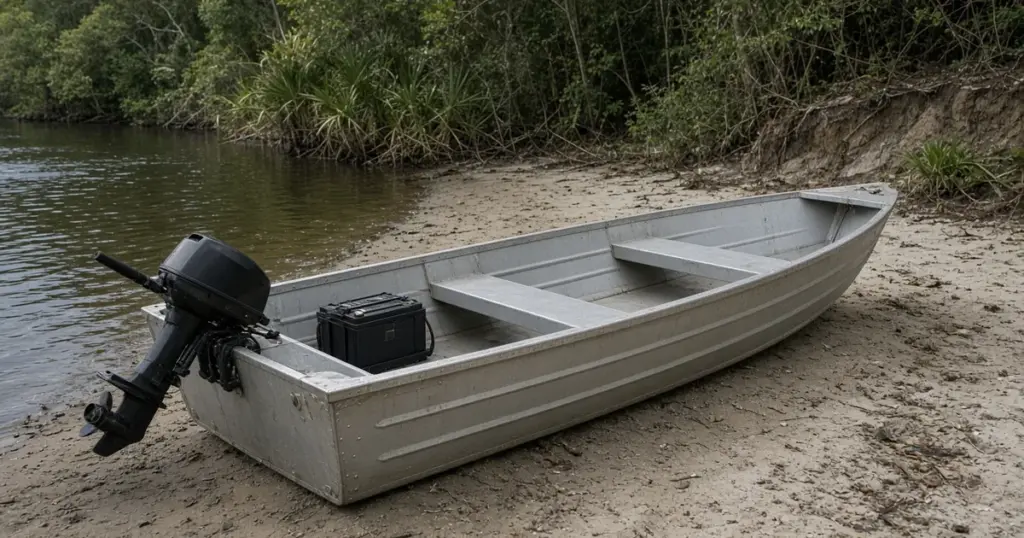
Plenty of small boats run on a single battery: skiffs, small center consoles, runabouts and aluminum fishing boats. It’s simple, light, and cheap. But one battery means one point of failure, and if you drain it running electronics with the engine off, you won’t start. This guide explains when a one-battery boat setup works, how to choose the battery and how to reduce the risk.
When one battery is enough
A single battery can work well when:
- The engine is small to mid-size with modest cranking needs.
- Electronics are limited: a fish finder, a radio, navigation lights and a bilge pump.
- You don’t spend long periods with the engine off and electronics running.
- The boat has no trolling motor, or the trolling motor has its own battery.
- You carry a backup starting method.
When it isn’t
- You fish for hours at anchor with electronics on.
- You run a stereo, livewell pumps or lights for extended periods.
- You boat offshore or far from help.
- Your engine has high cranking requirements.
In those cases, a second battery is a real safety improvement. Our guide to separating starting and house batteries explains the options.
Choosing the right single battery
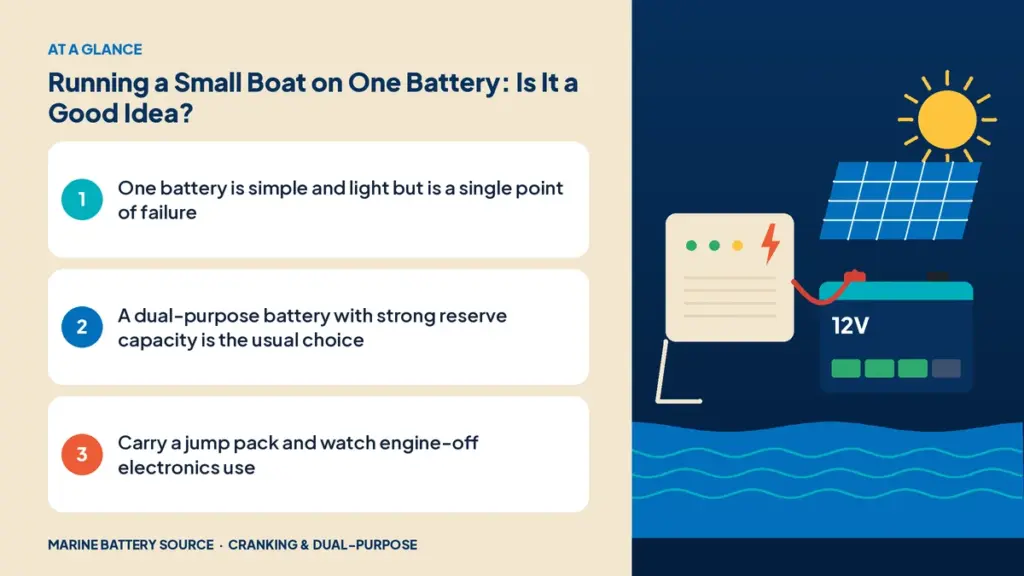
A single battery has to start the engine and run accessories, so a dual-purpose battery is the usual choice. It must:
- Meet or exceed the engine’s minimum cranking rating and reserve capacity.
- Provide enough energy for your accessories with plenty left for starting.
- Fit the tray and match the terminals.
Lead-acid options
- Interstate HD24-DP: flooded dual purpose, 405 CCA, 505 MCA, 100 minutes RC.
- Interstate 27M-AGM-A: AGM dual purpose, 750 CCA, 900 MCA, 175 minutes RC.
An AGM dual-purpose battery handles vibration well and is sealed, a plus on small boats where spray reaches the battery. See AGM starting batteries for boats.
Lithium options
Cranking-rated lithium batteries can start the engine and run electronics far longer without damage:
- Dakota Lithium DL 12V 60Ah: 1000 CCA listed, 720 Wh, 16.5 lb.
- Dakota Lithium DL 12V 135Ah heated: 1000 CCA listed, 1,620 Wh, 27.2 lb.
Before using lithium to start an engine, check the engine maker’s guidance and charging compatibility. Our guide on lithium cranking batteries and outboard charging explains what to check.
Budgeting energy with one battery
Add up your accessories’ current draw and the hours they run with the engine off. Then make sure the battery can supply that and still start the engine.
Example: a fish finder (1A), VHF on standby (0.5A) and livewell pump (3A, cycling half the time) draw roughly 3A on average. Over 4 hours at anchor that’s 12Ah. A healthy lead-acid dual-purpose battery handles it, but if the battery is older or the morning was cold, starting margin shrinks. A larger battery or lithium gives more cushion.
Charging a single battery
The outboard recharges the battery while running, but small outboards often have modest charging output, especially at idle. Short runs between spots may not replace what you used. Recharge at home or at the dock after every trip with a marine charger set to the correct profile. For more on charging while underway, see charging on the water.
Backup starting options
With one battery, always have a plan B:
- Jump pack: a portable lithium jump starter rated for your engine. Keep it charged.
- Manual start: many small outboards have a pull-start option or an emergency rope.
- A small spare battery: less common but possible.
Using a battery switch
Even with one battery, an on/off battery switch is valuable. It isolates the battery when the boat sits, protecting it from parasitic drains, and gives a quick disconnect in an emergency.
Signs you’ve outgrown one battery
- You’ve needed a jump more than once.
- You routinely see low voltage warnings at the end of the day.
- You’ve added electronics or accessories.
- You want to add a trolling motor.
When that happens, a second battery with a switch or automatic charging relay is the logical step. Generators and bigger boats need more planning; see generator starting batteries if your boat has one.
Wiring a one-battery boat
- Use a fused distribution panel for accessories rather than connecting each one directly to the battery.
- Fuse every positive circuit near the battery.
- Size cables for current and length.
- Keep connections clean, tight and protected.
Watching the battery on the water
On a one-battery boat, knowing your state of charge matters. Many engines and chartplotters display system voltage. Learn what normal looks like:
- Engine running: the charging system typically holds voltage noticeably above the battery’s resting level, often in the high 13V to low 14V range for lead-acid systems.
- Engine off, light loads: a healthy, well-charged lead-acid battery reads somewhere in the mid-12V range under small loads.
- Engine off, voltage falling toward the low 12s or below: you’re using a lot of the battery. Consider starting the engine to recharge, or turning off non-essential loads.
These are general guides; your battery and engine documentation give the exact figures. Lithium batteries hold a flatter voltage curve, so a Bluetooth app or shunt monitor gives a better state-of-charge reading than voltage alone.
Saltwater and spray
Small boats often keep the battery in a console or under a seat where spray and rain reach it. Use a battery box or a well-sealed compartment, coat terminals with a protectant, and inspect connections more often in salt water. Corrosion on the terminals of your only battery is one of the most common causes of a no-start on small boats.
Simple upgrade path
- Start with one dual-purpose battery that comfortably meets the engine spec.
- Add an on/off switch and a jump pack.
- When loads grow, add a second battery with a 1-2-Both switch or an automatic charging relay.
- If you want to cut weight or extend accessory time, consider lithium for the house role.
For the full background, read choosing a boat starting battery and cranking vs dual-purpose vs deep-cycle batteries. Browse dual-purpose batteries in the store.
Frequently asked questions
Can a boat run on one battery?
Yes, many small boats do. Use a dual-purpose battery that meets the engine’s cranking spec, watch engine-off accessory use, and carry a backup like a jump pack.
What type of battery is best for a single-battery boat?
A dual-purpose marine battery, either AGM or lithium if the engine maker allows, sized to start the engine and run your accessories.
How do I avoid draining my only boat battery?
Limit engine-off accessory time, use a battery monitor or voltage readout, recharge after every trip, and switch off the battery when the boat sits.
When should I add a second battery?
When you run electronics for long periods with the engine off, add a trolling motor, boat far from help, or have needed a jump.