


Generator Starting Batteries on Boats
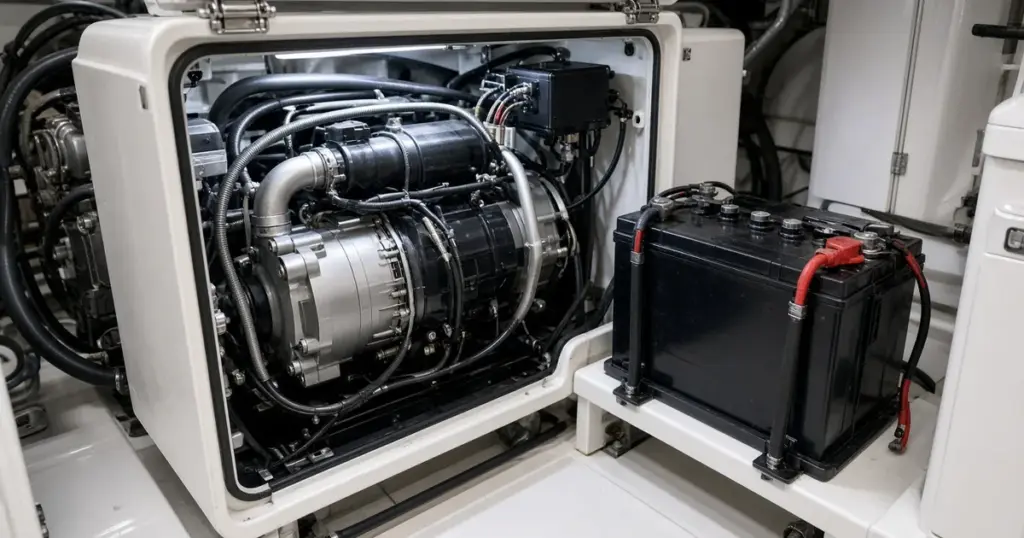
Cruisers, sportfish boats and larger center consoles often carry a marine generator. The generator needs its own way to start, and on most well-designed boats that means a dedicated generator starting battery. This guide explains why, how to size the battery, how it gets charged, and how to keep it reliable.
Why a dedicated generator battery?
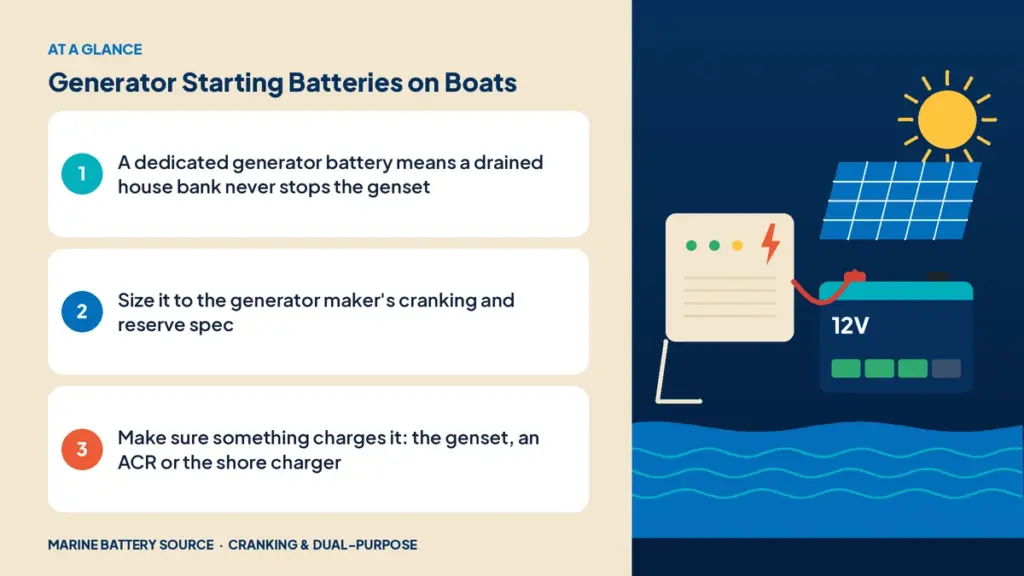
Imagine you’ve been at anchor all night and the house bank is low. You want to start the generator to run the charger and air conditioning. If the generator starts from the house bank, it may not have enough left to crank. A dedicated generator starting battery solves that: it isn’t touched by house loads, so it’s ready when the house bank needs help.
The same logic applies to main engines. Many boats keep separate batteries for each engine, the generator and the house. Our guide to choosing a boat starting battery explains the general approach.
Sizing to the generator maker’s spec
Generator manufacturers list battery requirements in the installation or operator’s manual, typically including:
- Minimum cranking rating (CCA or MCA).
- Sometimes a minimum reserve capacity or amp-hour rating.
- System voltage. Most marine gensets start on 12V, though some larger units use 24V.
Diesel generators may draw extra current at start for glow plugs or preheat, which affects battery choice. Always follow the generator maker’s requirements, and add margin for cold mornings and aging. Our guide to battery types explains the ratings.
Typical battery choices
Generator starting batteries are often Group 24 or 27 starting or dual-purpose batteries, though requirements vary. Examples from the store:
- Interstate 24M-XHD: 800 CCA, 1000 MCA, 135 minutes RC.
- Interstate 24M-AGM-A: AGM, 750 CCA, 940 MCA, 140 minutes RC.
- Interstate 27M-AGM: AGM, 850 CCA, 975 MCA, 182 minutes RC.
AGM is common for generator batteries because it’s sealed and handles vibration well. See AGM starting batteries for boats for the pros and cons.
How the generator battery gets charged
A generator battery must be kept charged, but how depends on the installation:
- Generator’s own charging circuit. Many marine generators include a battery-charging winding or alternator that charges the starting battery while running.
- Shore power charger. A multi-bank onboard charger can include a bank for the generator battery.
- Automatic charging relay or combiner from the main engine or house charging system.
If none of these is in place, the generator battery can slowly discharge, especially if the generator isn’t run often. Check your system and make sure the battery is on a charger bank or otherwise maintained.
Location
The generator battery is usually mounted near the generator to keep starting cables short. That often puts it in a warm engine room, which accelerates aging. Keep the battery away from exhaust components and other heat sources, ensure ventilation, and secure it firmly.
Wiring essentials
- Use cable sized for the generator’s starter current and the cable length.
- Include a battery switch so the generator battery can be isolated for service.
- Fuse positive conductors as required by ABYC, with appropriate allowances for starter cables.
- Keep the generator negative tied to the boat’s common ground as designed.
Emergency use of the generator battery
Some boats include a parallel or combine switch so the generator battery can help start a main engine, or vice versa. That’s useful in an emergency but shouldn’t become routine. See running on one battery for why keeping batteries independent matters.
Maintenance
- Test before each season with a load or conductance tester.
- Check terminals for corrosion and tightness.
- Check electrolyte levels if the battery is flooded.
- Run the generator periodically. Regular exercise keeps the generator healthy and gives its charging circuit a chance to top up the battery.
- Keep the battery on a charger when the boat sits at the dock.
When to replace
Replace the generator battery when it no longer meets the generator maker’s spec with margin, or shows warning signs like slow cranking. Because it often sits in a hot space and may go weeks without being used, it can age faster than you expect. Our guide on when to replace a marine starting battery has the details.
Lithium for generator starting?
Cranking-rated lithium batteries exist, but generator charging circuits are generally designed for lead-acid, and engine rooms are hot. Check both the generator maker’s and the battery maker’s guidance before using lithium. Many owners stick with AGM or flooded for the generator and use lithium on the house side.
Generator vs a large lithium house bank
Some owners now use large lithium banks and inverters to reduce generator run time, or to eliminate the generator on smaller boats. If you’re weighing that, the generator battery question may disappear entirely. Large-format batteries like the EPOCH 12V 460Ah Essential, listed at 5.89 kWh, are the kind of house battery such systems use.
Sizing for electronics on the generator battery
Some generators include remote panels or monitoring electronics that draw small standby currents. Over weeks, that can drain a battery. If your generator battery seems to go flat between uses, measure the standby draw and make sure the battery is on a charger. See sizing a battery for starting and electronics for how to budget small loads.
Quick checklist
- Read the generator maker’s battery spec.
- Choose a starting or dual-purpose battery that meets it with margin.
- Confirm how the battery is charged.
- Mount it securely near the generator, away from heat.
- Test it every season.
Browse cranking batteries and Interstate marine batteries in the store.
Frequently asked questions
Does a boat generator need its own battery?
It’s strongly recommended. A dedicated battery means the generator can start even when the house bank is drained.
What size battery does a marine generator need?
Check the generator maker’s specifications for minimum cranking rating and any reserve or amp-hour requirement.
How is a generator starting battery charged?
Usually by the generator’s own charging circuit while it runs, a shore charger bank, or a combiner from the main charging system.
Can I use an AGM battery for my generator?
Yes. AGM is a common choice because it is sealed and vibration-resistant. Make sure it meets the generator’s spec.