


Cranking vs Dual Purpose vs Deep Cycle: Which Marine Battery Do You Need?
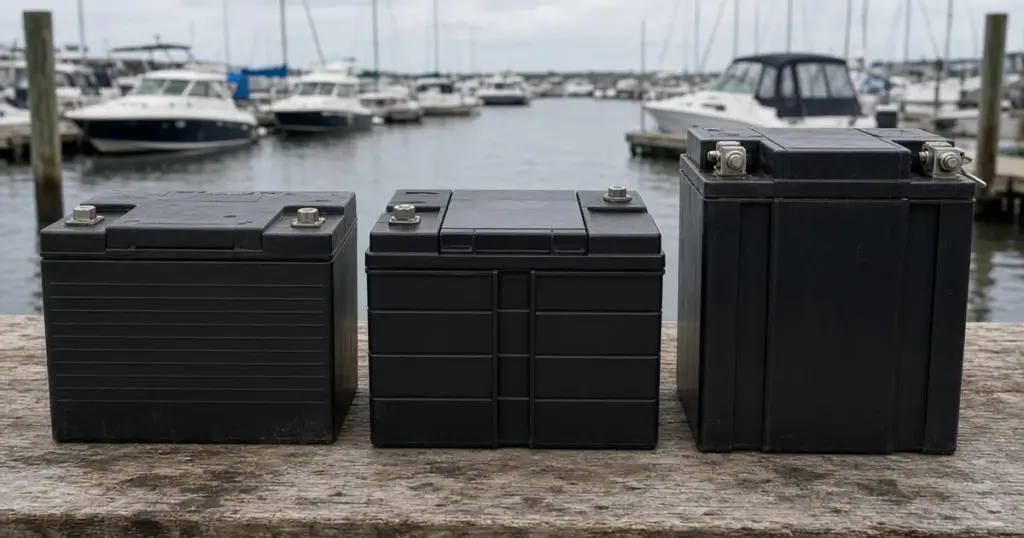
Walk down the marine battery aisle and you’ll see three labels over and over: starting (cranking), dual purpose and deep cycle. They can look almost identical from the outside, but they’re built for different jobs. Choosing the wrong one is one of the most common reasons marine batteries fail early. Here’s how cranking vs dual purpose vs deep cycle batteries differ, and how to pick the right one for every position on your boat.
The short answer
- Cranking (starting) battery: delivers a short, powerful burst to start an engine, then gets recharged by the alternator. It isn’t meant to be drained deeply.
- Deep cycle battery: delivers steady power over hours and tolerates repeated deep discharge. It’s for trolling motors and house loads.
- Dual purpose battery: a compromise that can start an engine and handle moderate cycling. It’s ideal when you only have room for one or two batteries.
How they’re built (lead-acid)
In lead-acid batteries, flooded and AGM alike, the difference comes down to the plates.
- Cranking batteries use many thin plates. That gives a large surface area for releasing a lot of current quickly. Thin plates don’t hold up well to being discharged deeply again and again.
- Deep cycle batteries use thicker, denser plates that release energy more slowly but survive repeated deep discharges.
- Dual purpose batteries fall in between. Their plates are thicker than a starting battery’s but not as heavy-duty as a dedicated deep-cycle battery’s.
What about lithium?
Lithium iron phosphate (LiFePO4) batteries don’t use lead plates. Every LiFePO4 battery is inherently good at deep cycling. The difference between a lithium deep-cycle battery and a lithium dual-purpose or cranking battery is mainly how much current the cells and battery management system (BMS) are designed to deliver in a burst. A lithium battery is only suitable for starting if the manufacturer rates it for cranking, with a CCA or MCA figure. Examples include the Dakota Lithium DL+ 12V 60Ah dual purpose and the EPOCH 12V 300Ah Pro Series dual purpose.
Understanding the ratings
CCA and MCA
Cold cranking amps (CCA) is the current a battery can deliver for 30 seconds at 0°F while staying above a minimum voltage. Marine cranking amps (MCA) is the same test at 32°F. Because batteries perform better when warmer, the MCA number is always higher than the CCA number for the same battery. Your engine manual lists the minimum rating it needs. Meet or exceed it, and compare like with like.
Reserve capacity (RC)
Reserve capacity is the number of minutes a battery can deliver a steady 25 amps before it drops to a cut-off voltage. It’s a useful way to compare how long a starting or dual-purpose battery can run accessories with the engine off.
Amp-hours (Ah)
Amp-hours measure total stored charge. They’re the main rating for deep-cycle and lithium batteries. Multiply by voltage to get watt-hours.
A deep-cycle battery may still list a CCA rating, as many marine deep-cycle batteries do. That doesn’t make it a great starting battery, and a high CCA rating doesn’t make a starting battery good at deep cycling.
Which battery goes where?
Single-battery boats
If your boat has one battery that starts the outboard and runs a fish finder, lights and a livewell, choose a dual purpose battery. Pick one that meets your engine’s cranking requirement and has enough reserve capacity or amp-hours for your accessories. Good examples are AGM models like the Interstate 27M-AGM and the Interstate 31M-AGM. Browse Dual Purpose.
Two-battery boats
Many runabouts and center consoles carry two batteries on a switch. You have two options:
- a dedicated starting battery plus a deep cycle house battery; or
- two dual purpose batteries, so either one can start the engine in a pinch.
A battery switch or automatic charging relay manages charging and isolation. See battery switch basics.
Boats with trolling motors
Your trolling motor bank should be deep cycle, whether that’s lead-acid deep cycle or lithium, at the motor’s voltage. The engine gets its own starting or dual purpose battery. Read choosing a trolling motor battery and browse Trolling Motor.
Cruisers and liveaboards
Larger boats separate duties completely. One or more starting batteries serve the engines and generator, and a deep-cycle house bank handles everything else. See house bank sizing for overnights and House Bank.
Common mistakes
- Using a starting battery for a trolling motor. Repeated deep discharge wears it out quickly.
- Using a deep-cycle battery that isn’t rated for cranking to start a big engine. It may not deliver enough current, especially when it’s cold or partly discharged.
- Running a single dual-purpose battery flat with accessories. Then you can’t start. A battery monitor or a second battery solves this.
- Ignoring the engine maker’s requirement. Always check the minimum CCA or MCA in your manual.
- Mixing battery types in one bank. Keep each bank uniform.
Flooded, AGM or lithium for each job?
| Job | Flooded | AGM | Lithium |
|---|---|---|---|
| Starting | Economical and proven | Sealed and vibration-resistant | Only cranking-rated models; check alternator guidance |
| Dual purpose | Budget option | Popular all-rounder | Lightweight; deep usable capacity |
| Deep cycle | Traditional, needs watering | Maintenance-free | Lightest; steady voltage; long cycle life |
For upkeep differences, see AGM vs flooded maintenance. For lithium, see converting a boat to lithium.
Sizing tips
Match the BCI group size to your tray, and check terminal type. Our BCI group size guide explains codes like 24M and 31M. When you replace a battery, the easiest starting point is the one you have: note its group size, rating and terminals, then compare.
Shop by job
- Cranking batteries, such as the Interstate 24M-XHD
- Dual purpose batteries
- Deep cycle trolling motor batteries, such as the Interstate SRM-27
- House bank batteries
Still unsure whether you need cranking, dual purpose or deep cycle? Contact us with your boat, engine and accessories. If you’re between Venice and Gainesville, FL, we can install it for you.