


AGM vs Flooded Marine Batteries: Maintenance Compared
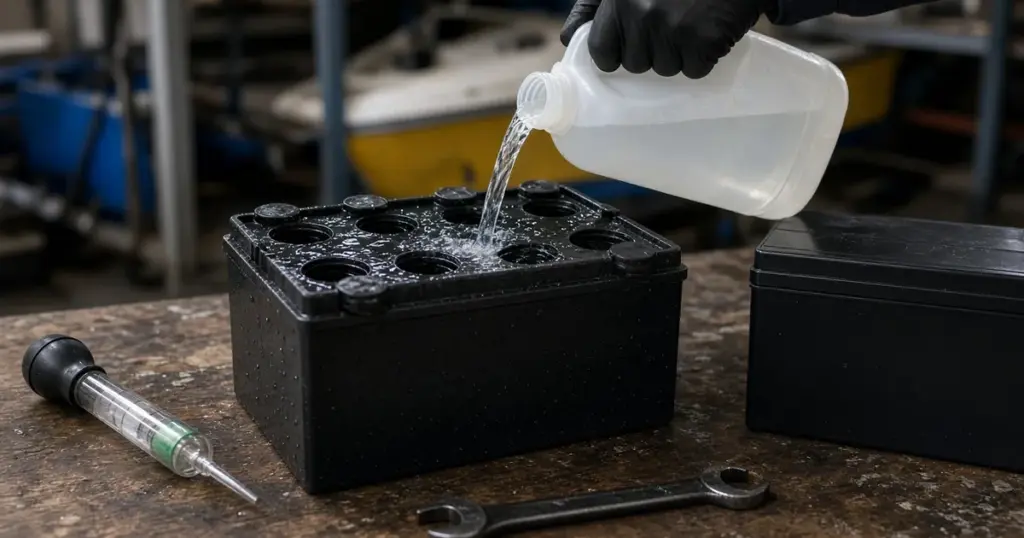
Both AGM and flooded lead-acid batteries can give you years of reliable service on a boat. They just ask different things of you. Flooded batteries reward regular hands-on care. AGM batteries are largely maintenance-free, but they’re less forgiving of charging mistakes. Here’s a practical AGM vs flooded maintenance comparison, with a routine for each, so you can decide which suits your boat and how you use it.
How they differ
- Flooded (wet cell): the plates sit in liquid electrolyte. During charging, some water is lost as gas, so you top up with distilled water. Flooded batteries vent gas, so they need upright mounting and ventilation.
- AGM (absorbed glass mat): the electrolyte is held in fiberglass mats between the plates. The battery is sealed and valve-regulated, and gases recombine internally under normal charging. There’s no watering, and it’s spill-proof.
Both are lead-acid. They share the same basic needs: keep them charged, don’t leave them discharged, keep them cool, and keep connections clean.
Flooded battery maintenance routine
Check and top up electrolyte
Check electrolyte levels regularly. How often depends on use and climate; batteries that are charged often, or that live in hot conditions, lose water faster. Use distilled water only, since tap water contains minerals that harm the plates. Add water after charging, to the level the manufacturer specifies. If the plates are exposed before charging, add just enough to cover them, charge, then top up. Don’t overfill, because electrolyte expands during charging and can overflow.
Keep it clean and dry
Acid residue and moisture on the battery top can cause corrosion and slow self-discharge. Clean with a baking soda and water solution, keeping it out of the vent caps, then rinse and dry.
Check state of charge
A hydrometer measures the electrolyte’s specific gravity in each cell. It’s a reliable way to check state of charge and spot a weak cell. A resting voltage reading with a multimeter is quicker. Compare readings against the manufacturer’s chart.
Equalize when recommended
Some flooded deep-cycle batteries benefit from a periodic equalizing charge, a controlled overcharge that helps balance cells and reduce stratification. Only equalize if the battery manufacturer recommends it, with a charger that supports it, and with good ventilation. Never equalize AGM or lithium batteries.
Ventilate
Flooded batteries release hydrogen while charging. Keep battery compartments ventilated, and keep sparks and flames away.
AGM battery maintenance routine
Use the right charge profile
This is the most important part of AGM care. AGM batteries are sensitive to over-voltage. Use a charger with an AGM setting, and make sure any adjustable alternator regulator or solar controller is set correctly too. Over-charging can dry out an AGM battery permanently, because you can’t add water.
Keep it charged
AGM self-discharges more slowly than flooded, but it still needs regular charging. Recharge promptly after use, and use a smart maintainer during storage.
Inspect
Check for case swelling, which can be a sign of over-charging or heat, along with cracks and loose or corroded terminals. Don’t open the valves.
Clean terminals
AGM tops stay cleaner because there’s no venting under normal use, but terminals still corrode in a marine environment. Clean and protect them.
Shared best practices for both
- Recharge promptly. A lead-acid battery left partly discharged forms sulfate crystals on its plates, which permanently reduces capacity.
- Avoid deep discharges where you can. Shallower cycles generally mean longer life.
- Keep them cool. Heat speeds up aging in both types. Read Florida heat and battery life.
- Secure them. Use a tray or hold-down. Vibration and impacts damage plates.
- Tight, clean connections: loose terminals create heat and voltage drop. Torque to spec, and protect against corrosion. See saltwater corrosion prevention.
- Replace banks as sets. Don’t mix new and old, or AGM and flooded, in one bank.
- Store properly. Follow our winter storage guide.
AGM vs flooded: side by side
| Flooded | AGM | |
|---|---|---|
| Watering | Yes, with distilled water | No |
| Spill-proof | No | Yes |
| Mounting | Upright only | More flexible (check the manufacturer) |
| Ventilation | Required | Recommended; vents only under fault or over-charge |
| Self-discharge | Faster | Slower |
| Charging sensitivity | Forgiving | Needs the correct AGM profile |
| Equalizing | Sometimes recommended | No |
| Upfront cost | Lower | Higher |
Which should you choose?
Choose flooded if you want the lowest upfront cost, your batteries are easy to reach for watering, and you’re happy with a regular routine. Trojan’s flooded deep-cycle batteries, like the SCS200 and the 6V T-105, and Interstate’s flooded SRM-27 are common choices.
Choose AGM if batteries are hard to reach, you want spill-proof and maintenance-free, or the boat sees a lot of pounding. Examples include the Interstate 31M-AGM and the Trojan 31-AES.
Consider lithium if you cycle batteries heavily, such as trolling motors or house banks, and want to cut weight and maintenance even further. See converting a boat to lithium.
Switching from flooded to AGM
If the group size and terminals fit, swapping a flooded battery for an AGM is usually straightforward. The key step is changing every charging source to an AGM profile: the onboard charger, and any adjustable regulator or solar controller. Our BCI group size guide helps you match size.
A simple maintenance calendar
- After every trip: recharge fully with the correct profile.
- Monthly in season: check flooded electrolyte levels, look for corrosion, and check that hold-downs and terminals are tight. For AGM, inspect for swelling and clean terminals.
- Every few months: check state of charge with a hydrometer (flooded) or a resting voltage reading (both), and compare cells or batteries in a bank.
- End of season: follow the storage steps in our winter guide.
Write the dates down. A simple log makes it easy to see when a battery starts needing more water, or more frequent charging, than its bank-mates. That’s often the first sign it’s wearing out.
When to replace
Signs a lead-acid battery is near the end include struggling to hold a charge, slow cranking, a flooded cell that reads much lower than the others on a hydrometer, a swollen case, and needing far more water than usual. A load test at a battery shop can confirm it.
Shop AGM & lead-acid marine batteries and matching chargers. Anywhere from Venice to Gainesville, FL, our team can test and install replacements.