


Marine Battery Switch Basics: 1-2-Both, On-Off and ACRs
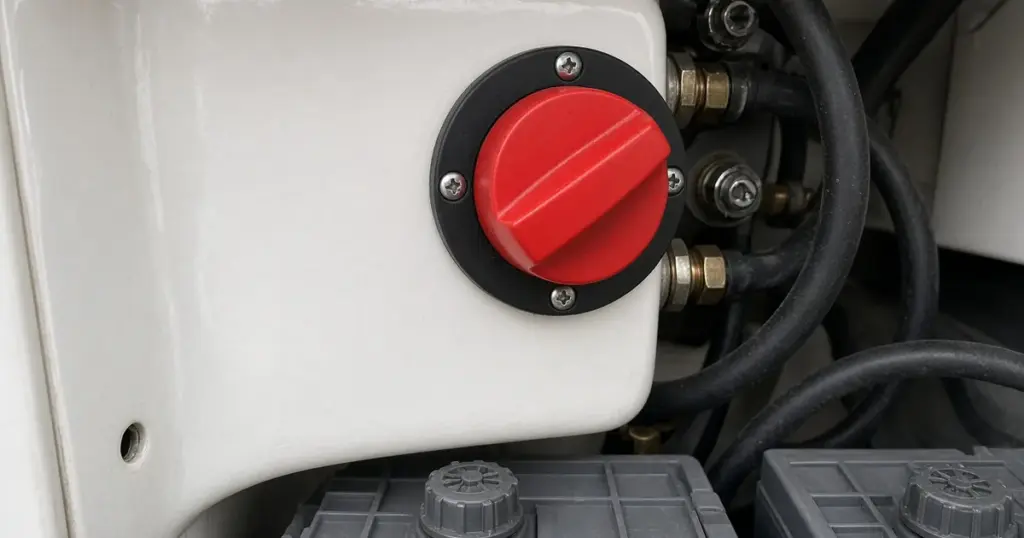
A marine battery switch is one of the simplest parts of a boat’s electrical system, and one of the most misunderstood. Used well, it protects your starting battery, lets you isolate the boat when you leave, and gives you a backup if a battery fails. Used badly, it can leave you with two flat batteries, or damage electronics. Here’s how the common switch types work, and how to use them.
Note: this is a general overview. Wiring a switch involves high-current circuits. Follow the switch and engine manufacturers’ instructions and ABYC guidelines, or have a qualified marine electrician do the work.
What a battery switch does
A battery switch sits between your batteries and the boat’s main loads, and it lets you:
- Disconnect the batteries from the boat when you’re not aboard, which reduces parasitic drain and fire risk;
- Select which battery powers the engine and accessories;
- Combine batteries for an emergency start; and
- Isolate circuits for safe maintenance.
Common switch types
On/off (single circuit)
The simplest switch. It connects or disconnects one battery or bank. You’ll find it on single-battery boats, and as separate disconnects for each bank on larger boats. Many owners use one on/off switch per bank, such as starting, house and trolling, for clarity.
1-2-Both-Off (selector)
The classic two-battery switch. Positions:
- Off: both batteries disconnected.
- 1: battery 1 only.
- 2: battery 2 only.
- Both: batteries combined in parallel.
It’s flexible, but it relies on you to manage it. A common routine is to start on one battery, run on that battery, and switch to “Both” only when you need to charge both from the engine, or for an emergency start. Then go back to a single battery when the engine is off, so accessories can’t drain both. Leaving it on “Both” at anchor is how many boaters end up with two flat batteries.
Dual-circuit switches
Dual-circuit switches keep the engine (starting) circuit and house circuit separate, with a separate “combine” or “parallel” function for emergencies. Paired with an automatic charging relay, they make two-battery management nearly automatic.
Automatic charging relays (ACRs) and isolators
An ACR senses charging voltage. When the engine is running and charging the starting battery, it connects the house battery so both charge. When charging stops, it separates them, so house loads can’t drain the starting battery. Battery isolators do a similar job with diodes or electronic switching.
With an ACR or isolator, you can leave the switches on each battery “on” while you’re aboard and let the system manage charging. The Dakota Lithium outboard dual battery isolator/ACR kit is one example built for outboard boats.
ACRs and lithium
If your house or trolling battery is lithium, a plain ACR may let it draw too much current from the alternator, and it won’t apply a lithium charge profile. Many lithium setups use a DC-DC charger instead, or alongside. Read charging lithium on a boat, and check the battery maker’s guidance.
Typical setups
Single-battery boat
One dual-purpose battery with an on/off switch. Turn it off when you leave the boat.
Two batteries, outboard
Either a 1-2-Both-Off selector, or two on/off switches plus an ACR. One battery is dedicated to starting, and the other runs accessories. Many owners use two dual-purpose batteries so either can start the engine.
Boats with a trolling motor
The trolling motor bank usually has its own breaker and disconnect, and its own onboard charger. It isn’t connected to the engine’s switch. If you want to charge it from the engine, use a DC-DC charger such as the EPOCH 12V to 36V DC-DC charger. See wiring a 24V or 36V setup.
Cruisers
Separate switches for each engine’s starting battery and for the house bank, plus a combine or parallel switch for emergencies, and charging managed by ACRs or DC-DC chargers. See house bank sizing.
Wiring concepts (high level)
- Positive side: battery switches are typically installed in the positive cables, between the batteries and the loads.
- Fuse near the battery: overcurrent protection belongs close to the battery’s positive terminal, ahead of the switch. See marine-rated battery fuses and fuse blocks.
- Common negative: battery negatives connect to a common negative bus, often through a shunt if you have a battery monitor.
- Always-on circuits: some loads, like automatic bilge pumps, are usually wired so they stay powered even when the main switch is off, with their own fuse. Follow ABYC guidance and the pump manufacturer’s instructions.
- Cable size: switches and cables must be rated for the engine’s cranking current and the boat’s total loads.
- Distribution: a power distribution block or bus bar keeps multiple connections organized.
Safe habits
- Never switch to “Off” while the engine is running. Interrupting the alternator’s connection to the battery can cause a voltage spike that damages the alternator or electronics. Some switches include protection, but don’t count on it.
- Don’t leave “Both” selected at anchor. Choose one battery, so the other stays ready to start.
- Turn switches off when you leave the boat, but check that bilge pumps are wired to stay powered.
- Label everything clearly: which switch, which battery, which circuit.
- Check connections on the back of the switch during routine maintenance. Loose or corroded studs cause heat and voltage drop. See saltwater corrosion prevention.
Emergency starting
If your starting battery is flat, select the other battery, or use “Both” or the emergency combine switch, start the engine, and then return the switch to normal operation once the engine is running and charging. With a 1-2-Both selector, move between “1”, “Both” and “2” without passing through “Off” while the engine runs.
Troubleshooting
- Batteries keep going flat: the switch may be left on “Both”, there may be a parasitic load, or an ACR may not be separating the banks. Check with a multimeter.
- House battery doesn’t charge: check the ACR or isolator, its fuse, and its wiring. With lithium, a DC-DC charger may be needed.
- Switch gets warm: look for loose connections or an undersized switch, and fix them right away.
Get the right parts
Browse isolators, fuses, distribution blocks and wiring kits in Accessories, and choose the right batteries for each job in cranking vs dual purpose vs deep cycle. If you’d like a marine battery switch and two-battery system installed, our local installation team serves boaters anywhere from Venice to Gainesville, FL.