


How to Size a House Battery Bank for Overnights on Your Boat
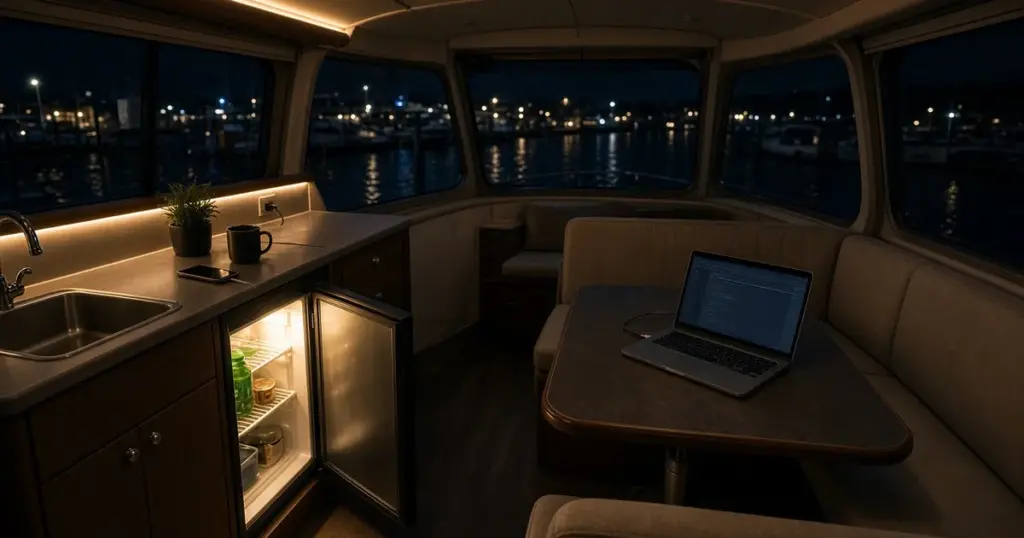
Spending the night on the hook is one of the best parts of boating. Waking up to a dead house bank is one of the worst. Whether you’re on a cuddy cabin, a cruiser, a sailboat or a pontoon with a camper enclosure, sizing your house battery bank correctly is what keeps the fridge cold, the anchor light on and the bilge pump ready until morning.
This guide walks you through a simple, repeatable way to size a house bank. All you need is a list of your loads and a calculator.
Step 1: List every load
Walk through the boat and write down everything that runs from the house bank while you’re away from the dock. Common items include:
- anchor light and cabin lights;
- refrigerator or cooler-fridge;
- freshwater pump, plus shower and sump pumps;
- bilge pumps, which usually draw little but can cycle;
- VHF radio, chartplotter, AIS and stereo;
- fans;
- phone and device charging;
- an inverter and whatever it powers, such as a coffee maker, microwave or laptop.
Step 2: Find each load’s current draw
For each item, find its current draw in amps at 12V. You’ll find it on the device label, in the manual or on the manufacturer’s website. If only watts are listed, divide watts by system voltage. On a 12V system, amps = watts ÷ 12.
Inverter loads: for AC devices, take the AC wattage, divide by 12 for DC amps, and add a margin for inverter losses. Inverters also draw some current just by being switched on, so turn them off when you don’t need them.
The most accurate numbers come from measurement. A battery monitor with a shunt, or a lithium battery’s Bluetooth app, shows real-time current, so you can switch loads on one at a time and watch.
Step 3: Estimate hours of use per day
Next, estimate how many hours each load runs in a 24-hour period at anchor. Some run continuously, such as the anchor light overnight. Some cycle, such as a fridge compressor, which runs only part of the time and more often in hot weather. Some run briefly, such as a water pump.
Step 4: Calculate daily amp-hours
For each load, multiply amps by hours to get amp-hours (Ah). Add them all up. Here’s an illustrative worksheet with round numbers. Substitute your own.
| Load | Amps | Hours/day | Ah/day |
|---|---|---|---|
| Anchor light (LED) | 0.5 | 10 | 5 |
| Cabin lights (LED) | 2 | 4 | 8 |
| Fridge (average while cycling) | 2.5 | 24 | 60 |
| Water pump | 5 | 0.5 | 2.5 |
| Electronics and VHF on standby | 1.5 | 6 | 9 |
| Fans | 1 | 8 | 8 |
| Device charging | 2 | 3 | 6 |
| Total | 98.5 |
In this example, the boat uses roughly 100Ah per day. Your total could be much lower on a simple boat or much higher with air conditioning, an electric galley or a big inverter.
Step 5: Decide how long between charges
How many days do you want to go without plugging in or running the engine? One night at anchor? A long weekend? Multiply your daily use by that number. For the example above, a two-night weekend without charging needs about 200Ah of usable energy.
Step 6: Convert usable capacity to rated capacity
This is where chemistry matters most.
Lead-acid (flooded and AGM)
Lead-acid batteries last longest when they aren’t discharged deeply. A common rule of thumb is to plan on using about half of the rated capacity on a regular basis. So for 200Ah usable, you’d plan on roughly 400Ah of rated lead-acid capacity. Lead-acid also charges slowly near the top, which means it often isn’t fully recharged on a short engine run.
Lithium (LiFePO4)
Lithium tolerates much deeper discharge, and it accepts charge quickly all the way up, so far more of its rated capacity is usable. Check the manufacturer’s recommendation for depth of discharge. For a given usable target, a lithium bank can usually be smaller and much lighter than a lead-acid bank.
Add a margin
Add some reserve for cloudy days, a hotter-than-expected night (more fridge runtime) and battery aging. A bank sized right at your calculated number will feel tight.
Step 7: Choose a bank configuration
- 6V pairs in series make 12V. Golf-cart-size deep-cycle batteries, like the Trojan T-105 (flooded) or Trojan T105-AES (AGM), are a classic house bank. Add pairs in parallel for more capacity.
- 12V batteries in parallel, such as the Trojan 31-AES or a 12V lithium battery.
- A large single lithium battery, like the EPOCH 12V 460Ah V2-T Elite, the Lithium Rhino 12V 392Ah kit or the Battle Born 270Ah GC3, reduces connections and weight.
Use identical batteries in a bank, and stay within the manufacturer’s series and parallel limits. Browse House Bank to compare.
Step 8: Make sure you can recharge it
A bigger bank is only useful if you can refill it. Look at each charging source:
- Shore power charger: its amp rating sets how fast the bank recharges at the dock.
- Engine alternator: how many hours do you typically run each day? Lithium banks usually charge from the alternator through a DC-DC charger.
- Solar: output depends on panel size, sun and shading.
- Generator: combined with a good charger, it can refill a bank quickly.
If your daily charging can’t replace your daily use, the bank will slowly run down over a long trip, no matter how big it is. Read charging lithium on a boat, and shop Chargers.
Step 9: Protect and monitor
- Keep the starting battery separate from the house bank, so house loads can’t prevent an engine start. A battery switch or ACR handles charging both.
- Fuse the house bank close to the battery. See marine-rated battery fuses, and use a power distribution block to organize connections.
- Monitor state of charge with a shunt-based monitor or the battery’s app, rather than relying on voltage alone.
- Ventilate, especially in hot climates. See Florida heat and battery life.
Ways to shrink the bank you need
Sometimes the cheapest amp-hour is the one you don’t use. Switch to LED lighting, turn the inverter off when you’re not using it, pre-chill the fridge on shore power, and add a fan instead of running AC loads. Small changes can make a real difference to your daily total.
Need a hand?
Send us your load list and we’ll help you size the house battery bank. If you’re between Venice and Gainesville, FL, our local installation team can design and install the complete system. Otherwise, we ship nationwide.