


Why Tinned Copper Wire Matters on a Boat
Walk through a boatyard and you’ll see the results of cheap wire: green, crumbling copper hidden under intact insulation, connections that crumble when touched, and circuits that fail mysteriously. The fix is simple and inexpensive compared with the cost of tracking down failures: tinned copper marine wire. This guide explains why tinned marine wire matters, how it differs from automotive and household wire, and how to use it.
What tinned copper is
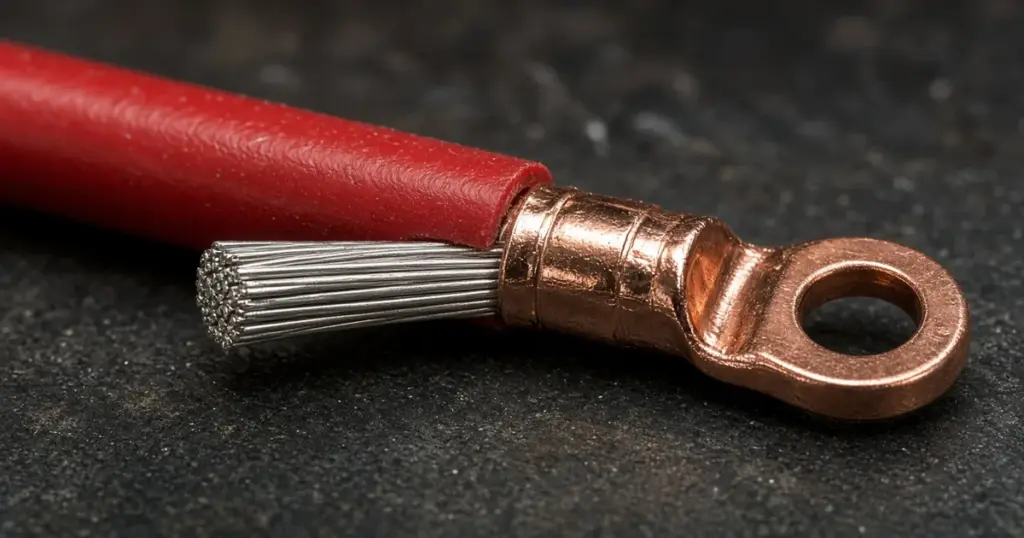
Tinned copper wire has each fine strand coated with a thin layer of tin. Tin resists corrosion far better than bare copper. When moisture and salt get into a cable, which they eventually do through ends, nicks and connectors, bare copper oxidizes and the corrosion wicks along inside the insulation. Tinned strands resist that process.
How corrosion damages wire
- Moisture and salt enter at cable ends and through damaged insulation.
- Bare copper strands oxidize, turning green or black.
- Corrosion travels along the strands, sometimes feet from the entry point.
- Resistance rises, causing voltage drop and heat.
- Eventually strands break and the circuit fails.
Corroded wire looks fine from outside, which makes the problem hard to find. See voltage drop in boat wiring for how to measure the effects.
Stranding and flexibility
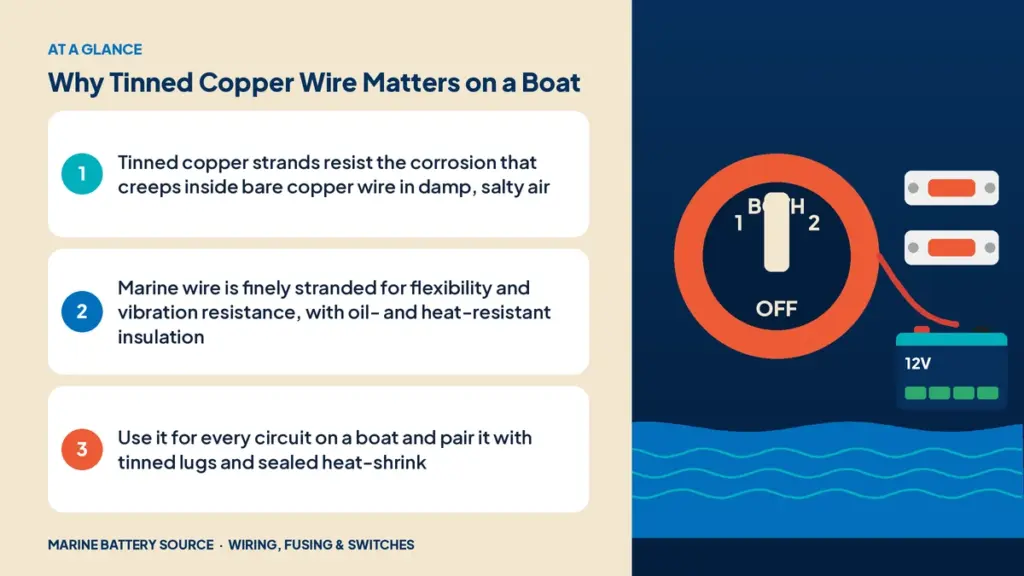
Marine wire uses many fine strands, making it flexible and resistant to vibration fatigue. Boats flex, pound and vibrate; solid or coarse-stranded wire can crack at terminals over time. Household solid-core wire should never be used for boat DC wiring.
Insulation
Quality marine wire has insulation rated for:
- Temperature, commonly 105°C, important in engine spaces.
- Oil, fuel and moisture resistance.
- Abrasion resistance.
Marine battery cable and primary wire are usually marked with gauge, temperature rating and a marine or boat-cable standard.
Marine wire vs automotive and household wire
| Feature | Tinned marine wire | Automotive wire | Household wire |
|---|---|---|---|
| Strand coating | Tinned | Usually bare | Bare |
| Stranding | Very fine | Moderate | Often solid |
| Corrosion resistance | High | Low | Low |
| Vibration resistance | High | Moderate | Low |
| Typical gauge sizing | True AWG | Sometimes smaller than labeled | Not for DC boat use |
Some automotive wire is sized to the SAE standard, which can have less copper than the same AWG number in marine wire. That’s another reason to use marine wire for accurate cable sizing. See marine battery cable sizing.
Colors and duplex cable
Marine primary wire comes in standard colors so circuits can be identified: red for DC positive, black or yellow for DC negative, and other colors for specific functions. Duplex and triplex cables bundle conductors in a single jacket for electronics and lighting. Use consistent colors and label circuits.
Terminals and connections
Tinned wire works best with tinned copper lugs and connectors, crimped with the right tool and sealed with adhesive-lined heat-shrink tubing. The heat-shrink keeps moisture out of the cable end, the most common entry point for corrosion. See marine battery terminal types and how to crimp battery lugs.
Where to use tinned wire
Everywhere on a boat’s DC system:
- Battery cables and interconnects.
- Trolling motor feeds.
- Electronics power and data power leads.
- Lights, pumps and accessories.
- Charging circuits from chargers, DC-DC chargers and solar.
Connection kits for trolling motors and batteries, such as the Dakota Lithium 12V trolling motor connection kit, save time on common circuits; check that any kit’s cables suit your length and current.
Saltwater and freshwater
Saltwater is far more corrosive, but freshwater boats also suffer from humidity, condensation and bilge water. Tinned wire is worthwhile on any boat.
Cost
Tinned marine wire costs more than bare automotive wire, but the difference is small compared with the labor of tracing and replacing corroded circuits later. For heavy battery cables, the price premium is a small share of a battery installation.
Inspecting existing wire
On older boats, check for:
- Green or black discoloration at cable ends.
- Stiff, brittle cables.
- Swollen insulation near terminals.
- Heat marks or melted insulation.
Cut back to clean, bright strands or replace the cable. If corrosion has wicked far along the conductor, replace the entire run.
Upgrading during a battery swap
A battery replacement or lithium upgrade is a good time to replace old battery cables with tinned marine cable. New batteries, especially lithium batteries like the EPOCH 12V 100Ah Eco, deliver their best performance only through low-resistance wiring.
Protecting cable runs
Even tinned wire needs physical protection. Use split loom or convoluted tubing where cables pass near sharp edges, grommets where they pass through bulkheads, and cable clamps every 18 inches or so. Keep runs above the bilge and away from heat sources. Physical damage to insulation is what lets water in, and protecting cables extends their life as much as tinning does.
Soldering vs crimping
Some boaters solder wire connections, but solder alone isn’t recommended for marine circuits. Solder wicks up the strands and creates a stiff section that can crack under vibration, right at the point where the wire leaves the terminal. A properly crimped tinned lug, sealed with adhesive heat-shrink, is the standard approach. If you do solder, do it in addition to a good crimp, never instead of one, and support the wire so it doesn’t flex at the joint.
Wire for lithium upgrades
Lithium batteries can deliver very high current, which makes cable quality even more important. When you upgrade, replace any undersized, corroded or automotive-grade cables in high-current circuits with tinned marine cable sized for the new loads.
Buying tips
- Look for clear printing of gauge, temperature rating and marine standard on the jacket.
- Buy from marine suppliers to avoid mislabeled or undersized wire.
- Choose the correct color for each circuit.
- Buy enough length for the full route plus service loops.
Read the marine battery wiring guide and battery switch basics for the rest of the system, and browse battery accessories in the store.
Frequently asked questions
Why is tinned copper wire used on boats?
Tinned strands resist corrosion from moisture and salt far better than bare copper.
Can I use automotive wire on my boat?
It’s not recommended. Automotive wire is usually bare copper and may be smaller than its labeled gauge.
Do I need tinned wire on a freshwater boat?
It’s still recommended because humidity and bilge water cause corrosion too.
How do I keep moisture out of wire ends?
Use tinned lugs crimped properly and sealed with adhesive-lined heat-shrink tubing.