


Marine Battery Terminal Types: Studs, Posts and Wing Nuts
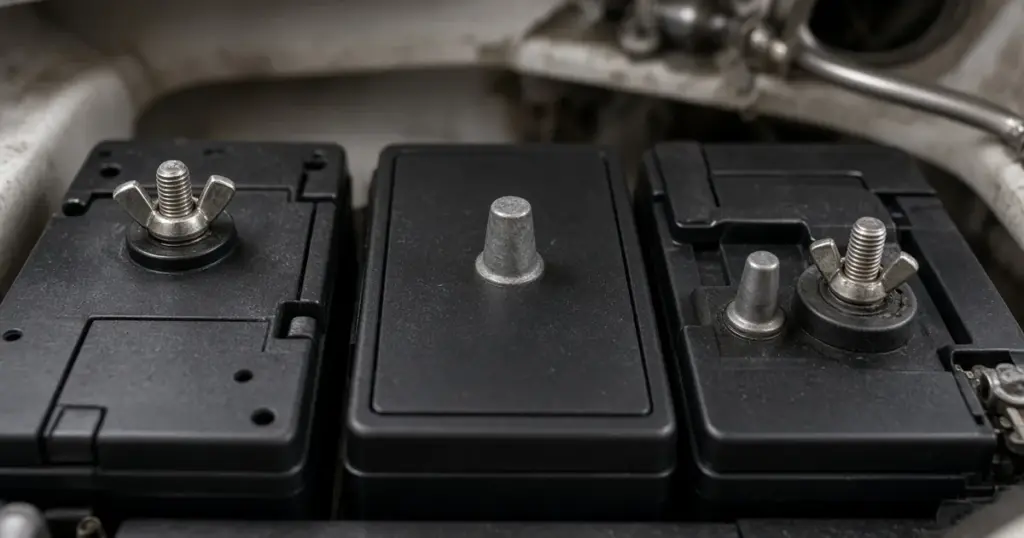
Battery terminals look simple, but they carry every amp your boat uses. A loose, corroded or poorly stacked terminal can cause slow cranking, weak trolling motors, electronics resets and even melted cables. This guide explains marine battery terminal types, how to connect to each, and how to keep them clean and safe.
SAE tapered posts
SAE posts are the round, tapered lead posts found on car batteries and many marine batteries. The positive post is slightly larger than the negative to help prevent reverse connection.
Connections: clamp-style terminals tighten around the post. Marine-grade clamps with threaded studs allow ring lugs to be attached.
Pros: universal, quick to connect. Cons: clamps can loosen with vibration; many accessory wires don’t attach neatly.
Threaded studs
Many marine and lithium batteries have threaded studs, often 5/16 inch or 3/8 inch on lead-acid batteries, or M6, M8 and M10 bolts on lithium batteries. Ring lugs slip over the stud and are secured with a nut.
Pros: secure, low-resistance connections; ideal for multiple ring lugs. Cons: need correctly sized ring lugs and proper torque.
Dual-terminal batteries
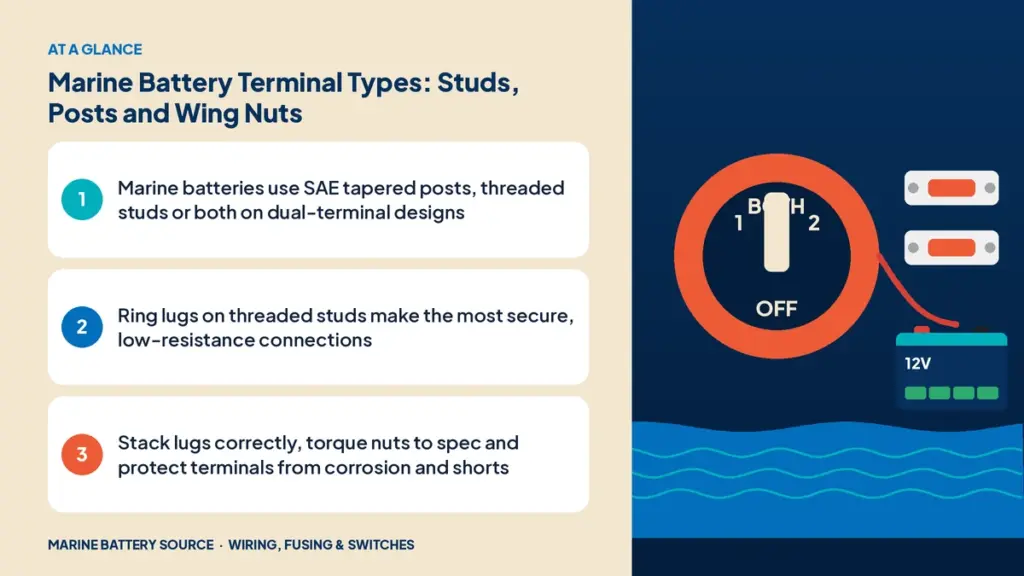
Dual-terminal marine batteries have both SAE posts and threaded studs. They’re versatile, letting you use SAE clamps for main cables and studs for accessories, or vice versa.
Wing nuts
Many marine batteries ship with wing nuts for the threaded studs. They’re convenient for removing batteries, but hand-tightened wing nuts may not reach adequate torque for high-current cables. Many installers replace them with stainless or brass hex nuts and lock washers for main connections.
Lithium battery terminals
Lithium batteries commonly use threaded inserts or bolts, such as M8, rather than SAE posts. Use the bolt supplied by the maker, at the correct length so it doesn’t bottom out, and torque to specification. Check whether the lithium battery’s terminal limits how many lugs can be stacked. Lithium batteries like the EPOCH 12V 300Ah Essential deliver high current, so terminal quality matters even more.
Ring lugs
Copper ring lugs, ideally tinned, crimped onto the cable and sealed with adhesive heat-shrink, are the gold standard. Match the lug’s hole size to the stud and its barrel to the cable gauge. See how to crimp battery lugs and tinned copper marine wire.
Stacking lugs correctly
When several lugs share a terminal:
- Put the heaviest current cable directly against the battery terminal.
- Stack lighter lugs on top.
- Don’t put washers between lugs; they add resistance.
- Limit the stack to a few lugs, often four or fewer.
- Torque the nut to the battery maker’s specification.
For more than a few connections, use a busbar or distribution block instead of stacking. See busbars and power distribution.
Terminal-mounted fuses
Terminal-mounted fuse blocks bolt directly onto the battery positive stud and hold an MRBF-style fuse, providing protection right at the battery. The Battle Born MRBF fuse block is an example. Check that the stud length accommodates the fuse block and lugs.
Torque matters
Under-tightened terminals loosen and heat up; over-tightened ones can strip threads or crack lead posts. Use a torque wrench and the battery maker’s specification. Recheck after the first few trips, because new connections can settle.
Corrosion protection
- Clean terminals with a wire brush and a baking soda solution for lead-acid batteries.
- Apply dielectric grease or a terminal protector spray after tightening, not between lug and post.
- Fit terminal covers or boots.
- Inspect regularly, especially on saltwater boats.
Covers and boots
Exposed positive terminals can short against metal tools, hull parts or other batteries. Red boots on positives and black on negatives prevent accidental contact and help identify polarity. Recognized marine guidelines call for battery terminals to be protected against accidental shorting.
Removing and reinstalling batteries
When you remove a battery, disconnect the negative first, then the positive, so a wrench touching metal while loosening the positive can’t create a short. When reinstalling, connect the positive first and the negative last. Label cables before removing them on boats with several batteries, and photograph the connections so you can reassemble them correctly. Inspect each lug as it comes off; it’s the easiest time to spot corrosion or a cracked crimp.
Terminal adapters
Adapters convert between terminal types, for example SAE post adapters for lithium batteries with threaded inserts, or stud-to-post converters. They’re useful when swapping battery types, but every adapter adds a connection and some resistance. For high-current circuits, it’s usually better to fit new ring lugs that match the battery’s terminals directly.
Matching lugs to studs
A 3/8-inch stud needs a lug with a 3/8-inch hole. A lug with a larger hole contacts the stud and nut over a smaller area, which raises resistance and lets it shift. Check both numbers when buying lugs: the cable gauge and the stud size.
Common mistakes
- Using undersized ring lugs that fit loosely on studs.
- Stacking washers between lugs.
- Leaving wing nuts finger-tight on high-current cables.
- Crimping with pliers instead of a proper tool.
- Leaving positive terminals uncovered.
Diagnosing terminal problems
A warm terminal after heavy use, discoloration, or a measurable voltage drop across the connection under load all point to terminal problems. See voltage drop in boat wiring for testing steps.
Choosing replacement hardware
When replacing terminal hardware, use stainless steel or tinned brass nuts and lock washers sized to the stud, adhesive-lined heat-shrink for every lug, and terminal covers that fit your battery. Avoid mixing dissimilar metals where possible, and never use plain steel hardware that will rust in a marine environment.
Installation steps
For a complete battery installation, including terminals, hold-downs and fuses, see how to install a marine battery, the marine battery wiring guide and battery switch basics. Browse battery accessories in the store.
Frequently asked questions
What’s the difference between SAE posts and threaded studs?
SAE posts are tapered lead posts for clamp terminals; threaded studs accept ring lugs secured with nuts.
Should I replace wing nuts with hex nuts?
For high-current connections, many installers do, because hex nuts can be torqued properly.
How many lugs can I stack on a battery terminal?
Generally no more than a few, with the heaviest current lug closest to the battery. Use a busbar for more.
Should I put grease on battery terminals?
Apply dielectric grease or terminal protector after tightening the connection, not between the lug and the post.