


Voltage Drop on Boats: The 3% and 10% Rules

Your batteries can be fully charged and your trolling motor still feel weak, or your electronics reboot every time you start the engine. Often the culprit isn’t the battery at all, but voltage drop in the wiring. This guide explains voltage drop in boat wiring, how to measure it, and how to fix it.
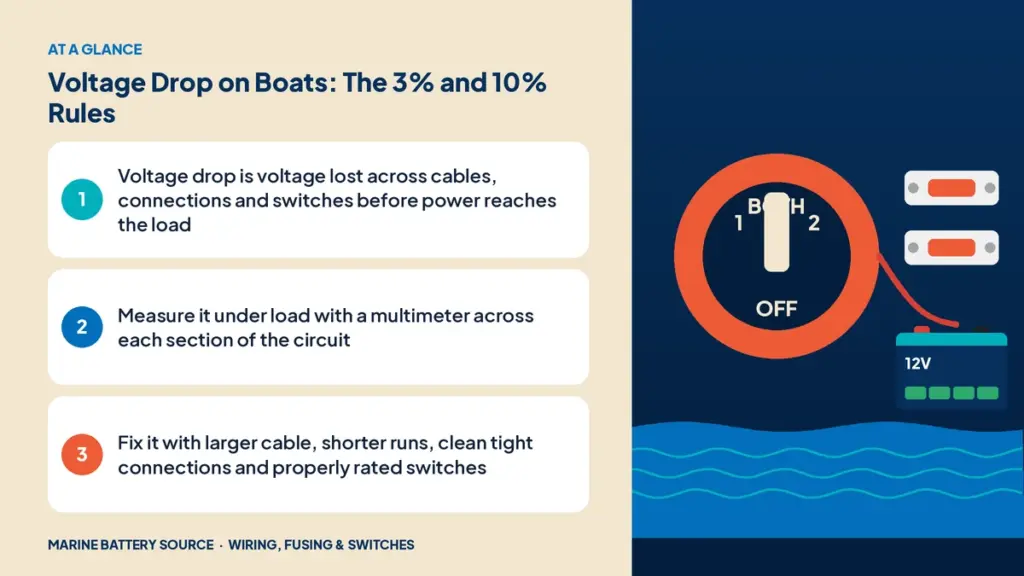
What voltage drop is
Every cable, connection, fuse and switch has some resistance. When current flows, a small amount of voltage is lost across each. The more current and resistance, the more voltage is lost:
Voltage drop = current × resistance
A battery at 12.8V might deliver only 11.8V at a trolling motor if a full volt is lost along the way. That’s nearly 8% of the voltage, and the motor runs noticeably slower.
Common causes
- Undersized cables for the current and length.
- Long cable runs, such as batteries in the stern powering a bow trolling motor.
- Corroded or loose connections at terminals, lugs, plugs and busbars.
- Poor crimps or soldered-only joints that have cracked.
- Undersized switches, plugs or breakers.
- Too many connections in series along a circuit.
Why it matters
- Trolling motors lose speed and thrust.
- Electronics reset or behave erratically when voltage dips.
- Starting circuits crank slowly.
- Charging is less effective because the battery sees less voltage than the charger produces.
- Heat builds at high-resistance points, risking damage or fire.
How much drop is acceptable
Common targets are 3% for critical circuits like electronics, navigation, charging and often trolling motors, and up to 10% for less critical loads like interior lights. At 12V, 3% is only about 0.36V.
How to measure voltage drop
You need a digital multimeter and a load running at normal current.
- Turn on the load, such as a trolling motor at high speed in the water or on a test stand.
- Measure battery voltage directly at the battery posts.
- Measure voltage at the load’s terminals.
- The difference is the total voltage drop.
To find where the drop occurs, measure across each section under load:
- Positive post to the end of the positive cable at the load.
- Each side of a fuse, breaker or switch.
- Negative post to the load’s negative terminal.
A good connection should show only a few hundredths of a volt across it under load. A tenth of a volt or more across a single connection points to a problem.
Fixing voltage drop
- Clean and tighten connections. Remove corrosion, apply dielectric grease and torque terminal nuts.
- Replace poor crimps with properly crimped, heat-shrink-sealed lugs. See marine battery terminal types.
- Upsize cables using the formula in marine battery cable sizing.
- Shorten runs by relocating batteries closer to the load where possible.
- Upgrade switches, plugs and breakers to models rated for the current.
- Use tinned copper cable that resists corrosion over time. See tinned copper marine wire.
Trolling motor example
A 36V trolling motor with batteries in the stern and a 30-foot round-trip cable run. Under load at 45A, the owner measures 37.5V at the batteries and 35.4V at the motor: a 2.1V drop, about 5.6%. Measurements show 0.6V across a corroded plug and 1.2V across undersized cable. Replacing the plug and upsizing the cable reduces the total drop to about 0.9V, and the motor regains noticeable speed.
Connection kits like the Dakota Lithium 36V connection kit can simplify replacing worn plugs and cables.
Lithium and voltage drop
Lithium batteries hold a steadier voltage under load than lead-acid, so they often reveal wiring problems that were hidden by battery sag. If a lithium upgrade doesn’t deliver the expected performance, measure voltage drop. A high-current lithium battery like the EPOCH 12V 105Ah Essential can only deliver what the wiring allows.
Electronics and voltage dips
Electronics reboot when voltage dips below their minimum, often during engine starts. Solutions include a dedicated electronics battery, heavier supply wiring and avoiding shared circuits with high-current loads. See series vs parallel wiring for battery layout options.
Switches and plugs are common culprits
Battery switches and trolling motor plugs carry full current through small contact areas. Worn, corroded or undersized units create surprisingly large drops. See battery switch basics.
Testing at the dock vs on the water
Voltage drop only shows up under load, so testing a quiet boat at the dock with nothing running tells you little. For trolling motors, test with the motor in the water at high speed, ideally with a helper reading the meter while the motor runs. For starting circuits, measure across cables while someone cranks the engine. For electronics, measure at the unit’s power connector with the trolling motor or engine running to see whether dips coincide with resets.
Preventive maintenance
- Inspect and clean terminals each season.
- Check that cable lugs are tight and not discolored.
- Look for melted insulation or heat marks.
- Re-measure voltage drop after any change to the system.
Installation tips to prevent drop
When installing new circuits, follow the marine battery wiring guide and battery installation guide: size cables generously, keep runs short, minimize connections, and use quality lugs, fuses and switches.
Heat is a warning sign
Every volt lost in wiring becomes heat. At 50A, a 1V drop produces 50W of heat at the point of resistance, enough to make a terminal or plug too hot to touch and, over time, to melt insulation or damage the plug. If you feel heat at a connection after running a high-current load, measure the voltage drop across it and fix it promptly. An infrared thermometer is a quick way to find hot spots after a run.
Browse battery accessories in the store.
Frequently asked questions
What causes voltage drop on a boat?
Undersized or long cables, corroded or loose connections, poor crimps and undersized switches or plugs.
How much voltage drop is acceptable?
Commonly 3% for critical circuits and up to 10% for non-critical loads like lighting.
How do I measure voltage drop?
With the load running, measure voltage at the battery and at the load. Then measure across each connection to find the source.
Will lithium batteries fix voltage drop?
No. Lithium holds voltage better at the battery, but wiring losses still need to be fixed.