


Storing Trolling Motor Batteries Between Seasons
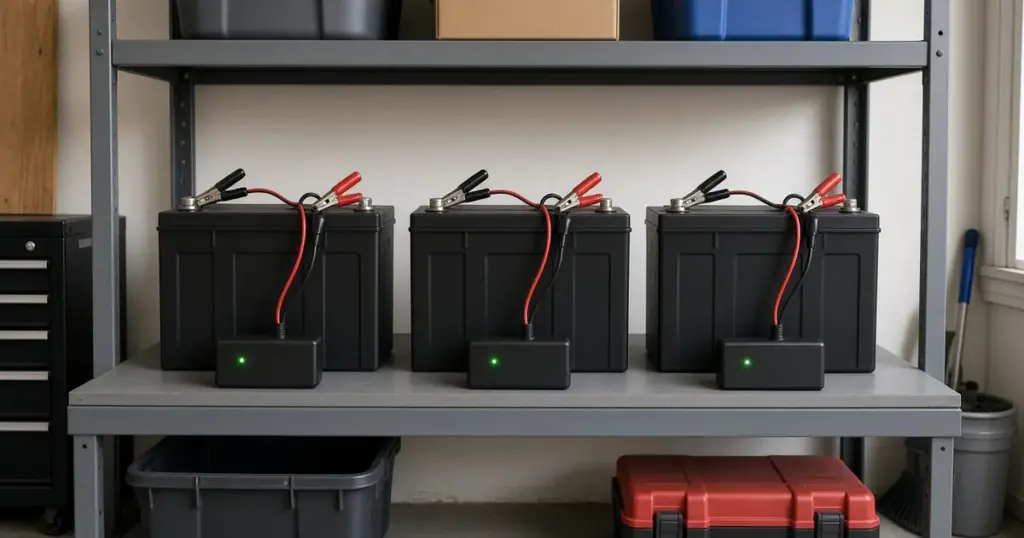
Trolling motor batteries take more abuse than any other battery on a fishing boat. They’re discharged deeply, often several times a week, and then too often left that way when the season ends. Proper storage protects your investment and gets your bank through the off-season ready to fish. This guide explains how to store trolling motor batteries.
Why trolling batteries need special care
- Deep discharges leave lead-acid batteries vulnerable to sulfation if they sit.
- Series banks can become unbalanced if one battery self-discharges faster.
- Freezing is a risk for discharged lead-acid batteries.
- Cost: a set of three trolling batteries is expensive to replace.
Step 1: Charge fully after the last trip
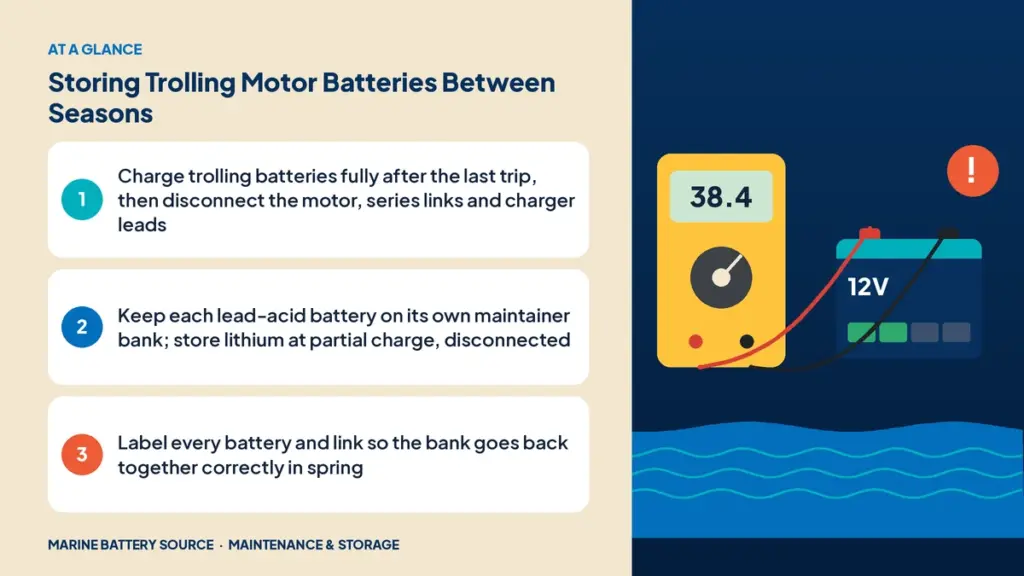
Don’t leave trolling batteries discharged, even for a few days. Charge fully with the onboard charger or a smart charger set for the battery chemistry.
Step 2: Disconnect
- Unplug the trolling motor.
- Label each battery (1, 2, 3) and each series link.
- Disconnect the motor leads, negative first.
- Disconnect the series links.
- Disconnect the charger leads if removing batteries.
Disconnecting the series links lets each battery be maintained individually and prevents a weak battery from dragging down the others.
Step 3: Decide where to store them
In the boat
Fine if:
- The boat is in a garage or covered space with power
- An onboard multi-bank charger stays connected in maintenance mode
- Temperatures won’t drop to dangerous levels with discharged batteries
Indoors
Remove batteries and store them in a cool, dry, ventilated place above freezing. See removing a boat battery for winter.
Lead-acid trolling batteries
- Keep each battery fully charged.
- Use a smart maintainer on each battery, or a multi-bank charger like the EPOCH 4-bank charger.
- Check water levels in flooded batteries after charging.
- If you can’t maintain them, recharge every four to six weeks.
See storing lead-acid batteries off-season.
Lithium trolling batteries
- Charge to the maker’s storage level, often 50% to 80%.
- Disconnect from the motor and charger.
- Store above freezing if possible.
- Check every two to three months.
See how to winterize a lithium battery.
Single 36V lithium batteries, like the EPOCH 36V 50Ah, are easy to store because there’s only one battery and no series links to manage.
Freezing risk
A discharged lead-acid battery can freeze at temperatures as mild as 10°F to 20°F. Charged batteries resist freezing to far lower temperatures. See can a marine battery freeze?.
Trailered boats
If the boat is stored on a trailer, consider removing the batteries in cold climates or using an onboard charger with power. See trailer boat battery storage.
Storage location tips
- Cool and dry, ideally 40°F to 60°F
- Ventilated, especially for flooded batteries on chargers
- On a shelf or workbench
- Away from sparks and flammables
- Out of reach of children and pets
Spring reconnection
- Charge each battery fully.
- Test each battery’s voltage after resting. They should be within about 0.1V to 0.2V of each other.
- Load test lead-acid batteries if possible.
- Reinstall in the boat, following your labels.
- Reconnect the series links, then the motor leads.
- Measure total bank voltage before plugging in the motor.
- Reconnect the charger leads.
- Test the trolling motor at all speeds.
See spring boat battery commissioning.
Signs a battery didn’t survive storage
- Won’t charge fully
- Voltage drops quickly after charging
- Much lower voltage than the other batteries in the bank
- Bulging case
Replace the whole bank if batteries are mismatched in age, since a new battery in an old bank wears unevenly.
Upgrading to lithium
If you’re tired of maintaining a trolling bank through the winter, lithium is the easiest upgrade. It doesn’t sulfate, self-discharges slowly and doesn’t need a maintainer. Browse our trolling motor batteries.
Balancing a series bank after storage
If one battery in a lead-acid series bank comes out of storage noticeably lower than the others, charge it separately until it reaches full, then let all batteries rest and compare again. Batteries that stay unbalanced after a few charge cycles usually mean one is failing. Running a mismatched bank forces the weak battery to reverse-charge near the end of a discharge, which damages it further.
Common mistakes
- Leaving batteries discharged after the last trip
- Leaving series links connected so batteries can’t be maintained individually
- No labels, leading to wiring mistakes
- Charging lithium in freezing conditions
- Replacing one battery in an old bank
Storing the trolling motor itself
While you’re at it, give the motor some attention:
- Rinse it with fresh water, especially after saltwater use.
- Check the prop for fishing line wrapped around the shaft, which can damage seals.
- Inspect the power cable and plug for cuts or corrosion.
- Store the motor stowed and secured, or remove it and store it indoors.
- Keep the plug covered so moisture and debris stay out.
A trolling motor that’s ready to go in spring pairs well with a battery bank that’s been properly stored.
Example storage plans
Three flooded batteries, 36V: charge fully, disconnect series links, top up water, connect each battery to its own bank on a 3- or 4-bank charger in the garage, and check water monthly.
Two AGM batteries, 24V: charge fully, disconnect series link, store in the basement on a two-bank maintainer, and check voltage monthly.
One 36V lithium battery: charge fully, then run the motor to about 60%, disconnect, store on a basement shelf, and check the app every two to three months.
For the full off-season guide, see winter storage for marine batteries, our marine battery maintenance guide and the seasonal boat battery calendar.
Frequently asked questions
Should I disconnect my trolling motor batteries for winter?
Yes. Disconnect the motor, series links and, if removing them, the charger leads.
Can I leave trolling batteries on the onboard charger all winter?
Yes, if it’s a smart charger with maintenance mode and the boat has power.
How should I store lithium trolling batteries?
Charge to about 50% to 80%, disconnect, store above freezing and check every few months.
Should I replace all my trolling batteries at once?
Yes, if they’re part of a series bank. Mismatched batteries wear unevenly.
What voltage should trolling batteries read after storage?
Each 12V lead-acid battery should read about 12.6V or higher after charging and resting, and within about 0.1V to 0.2V of the others.