


Marine Battery Maintenance: The Complete Guide
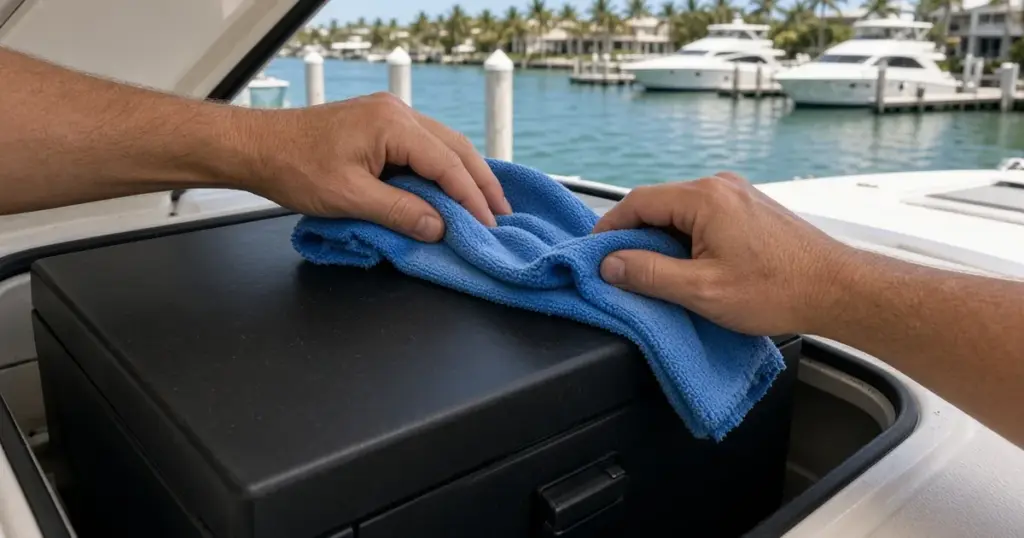
Marine batteries live a hard life: vibration, heat, humidity, salt and long periods of sitting unused. Good maintenance can double a lead-acid battery’s lifespan and keep a lithium battery performing for a decade. The good news is that most of it takes only a few minutes. This marine battery maintenance guide covers routine care for flooded, AGM and lithium batteries, with links to detailed guides on each task.
The most important habit: keep batteries charged
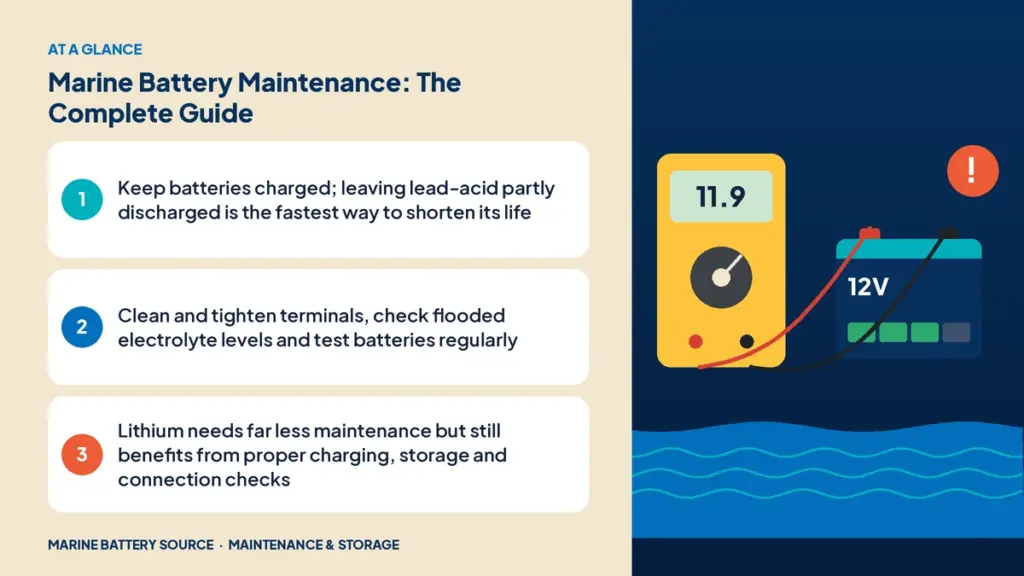
For lead-acid batteries, nothing matters more than charging. A lead-acid battery left partly discharged forms hard sulfate crystals on its plates, which permanently reduces capacity. Recharge as soon as possible after each use, and never store a lead-acid battery discharged. Our battery sulfation guide explains why.
Lithium batteries don’t sulfate, so they tolerate partial charge much better. Still, recharge after use and store them at the maker’s recommended level.
Maintenance by battery type
Flooded lead-acid
The most maintenance-intensive:
- Check electrolyte levels monthly in season and add distilled water as needed. See how to water flooded batteries.
- Equalize periodically if the maker recommends it. See equalizing flooded batteries.
- Test with a hydrometer to check each cell. See battery hydrometer test.
- Keep vents clear and the compartment ventilated.
AGM
Sealed and maintenance-free in terms of water, but still needs:
- Correct charging voltage (AGM is sensitive to overcharging)
- Clean, tight terminals
- Regular charging and proper storage
See AGM vs flooded battery maintenance for a side-by-side comparison.
Lithium (LiFePO4)
The least maintenance:
- No watering, no equalization
- Use a lithium-compatible charger
- Check terminals and connections
- Store at partial charge in moderate temperatures
- Watch for BMS warnings
See lithium battery maintenance for details.
Clean terminals and connections
Corrosion on terminals adds resistance, causing hard starts and slow charging. Clean terminals with a baking soda solution and a wire brush, rinse, dry and apply terminal protectant. See how to clean boat battery terminals.
Check tightness
Vibration loosens terminals over time. Check them monthly in season with a wrench or torque wrench. A loose terminal can heat up, melt and fail.
Inspect cables and hold-downs
Look for cracked insulation, corroded lugs and loose hold-down straps. Replace damaged cables and tighten hold-downs.
Test regularly
- Voltage: a quick check of state of charge for lead-acid at rest.
- Load test: checks a lead-acid battery’s ability to deliver current.
- Hydrometer: checks each cell of a flooded battery.
- Battery monitor or app: tracks lithium state of charge and health.
A monthly routine is ideal. See our monthly boat battery checklist.
Charging best practices
- Use a smart charger with the correct profile for each battery.
- Avoid deep discharges on lead-acid; recharge before 50%.
- Don’t leave lead-acid batteries on a non-smart charger indefinitely.
- Use a maintainer during storage for lead-acid.
- For lithium, avoid charging below freezing unless the battery has heating.
An onboard multi-bank charger, like the EPOCH 4-bank charger, makes regular charging automatic. Browse our marine battery chargers.
Storage
Off-season storage is where many batteries die. For lead-acid, charge fully, disconnect and use a maintainer. For lithium, charge to the recommended storage level and disconnect. See winter storage for marine batteries.
Signs of trouble
- Slow cranking or clicking
- Short runtime
- Swollen or cracked case
- Excessive heat while charging
- Rotten egg smell (flooded lead-acid overcharging)
- Low voltage after a full charge
- Frequent BMS shutdowns (lithium)
How long should a marine battery last?
With good care, flooded batteries often last three to five years, AGM four to six, and lithium ten years or more. See how long marine batteries last.
Maintenance schedule
After each trip
- Recharge
- Quick visual check
Monthly in season
- Check terminals and connections
- Check electrolyte (flooded)
- Test voltage
Every few months
- Clean terminals
- Hydrometer test (flooded)
- Load test (lead-acid)
Annually
- Full inspection of cables, hold-downs and fuses
- Equalize flooded batteries if recommended
- Check charger settings
Off-season
- Prepare batteries for storage
Maintenance in saltwater and hot climates
Saltwater boats and boats in hot climates need extra attention:
- Rinse and dry battery compartments after spray gets in. Salt residue attracts moisture and speeds corrosion.
- Check terminals more often, every two weeks in heavy use.
- Keep batteries shaded and ventilated. Heat speeds up chemical reactions inside lead-acid batteries, raising self-discharge and shortening life. Every 15°F above about 77°F can roughly halve a lead-acid battery’s life.
- Use sealed or lithium batteries where spray and heat are constant concerns.
- Use corrosion-resistant hardware such as tinned lugs and stainless fasteners.
Upgrading to reduce maintenance
If maintenance is a hassle, consider lithium. A battery like the EPOCH 12V 105Ah LiFePO4 needs no watering or equalization and lasts many times longer than lead-acid. Compare options in our lithium marine batteries.
Keeping records
A simple battery log helps you spot problems before they leave you stranded. Note the install date, model and chemistry of each battery, then record voltage readings, hydrometer results, water added and any problems. When one battery in a bank starts reading lower than the others month after month, you’ll see it on paper before it fails on the water. Records also help with warranty claims, since many manufacturers want to know how the battery was charged and maintained.
Common maintenance mistakes
- Using tap water in flooded batteries. Minerals shorten battery life; use distilled water only.
- Overfilling cells, which causes electrolyte to spill during charging.
- Charging AGM on a flooded profile, which can overcharge and dry it out.
- Leaving batteries connected to loads during storage, letting small drains pull them flat.
- Ignoring loose hold-downs until a battery breaks free.
- Mixing old and new batteries in a bank, which shortens the life of the new ones.
Frequently asked questions
How often should I maintain my marine battery?
Recharge after every trip, check terminals and electrolyte monthly in season, and do a full inspection annually.
Do AGM batteries need maintenance?
They don’t need water, but they still need proper charging, clean terminals and correct storage.
Do lithium marine batteries need maintenance?
Very little. Use a lithium charger, check connections, and store them correctly.
What shortens marine battery life?
Leaving lead-acid batteries discharged, overcharging, heat, loose connections and poor storage.
Should I use a battery maintainer?
Yes, for lead-acid batteries in storage or between infrequent trips.