


How to Test Flooded Batteries with a Hydrometer
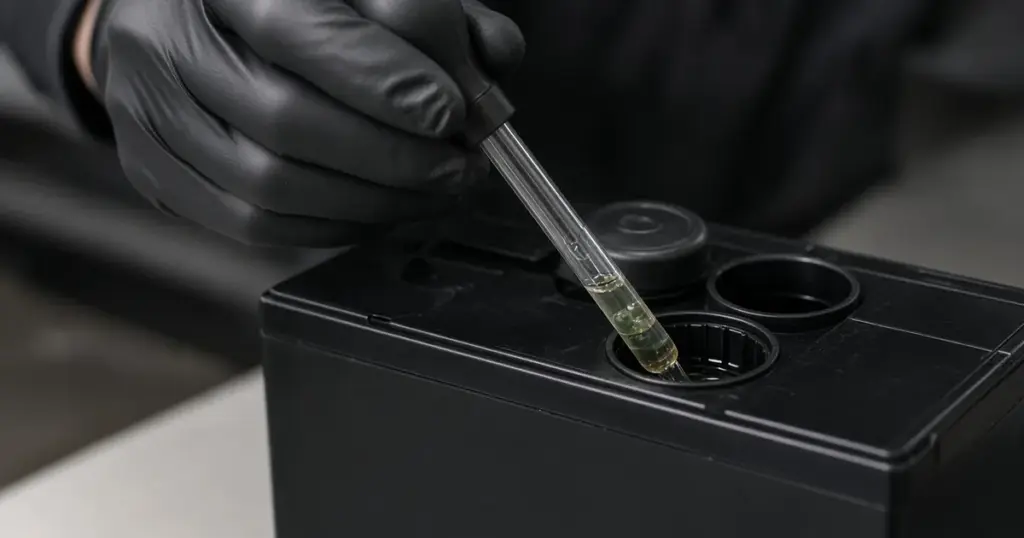
A voltmeter tells you about the whole battery. A hydrometer tells you about each cell. For flooded lead-acid batteries, a hydrometer test is the most accurate way to check state of charge and find a weak or failing cell before it leaves you stranded. This guide explains how to do a battery hydrometer test and interpret the results.
What a hydrometer measures
A hydrometer measures the specific gravity of the electrolyte, which is the ratio of its density to water. As a lead-acid battery discharges, sulfuric acid moves from the electrolyte into the plates, so the electrolyte becomes less dense. As it charges, the acid returns to the electrolyte, and specific gravity rises.
Because each cell has its own electrolyte, a hydrometer can show you if one cell is weaker than the rest, something a voltmeter can’t do.
Which batteries can be tested
Only flooded (wet cell) lead-acid batteries with removable caps. AGM, gel and lithium batteries are sealed and can’t be tested with a hydrometer. For those, use voltage, a load test or the battery’s app.
Types of hydrometers
- Float hydrometer: a glass tube with a calibrated float. Draw electrolyte in, read the float level. Accurate and inexpensive.
- Ball hydrometer: counts how many floating balls rise. Less precise, but easy to use.
- Refractometer: uses a few drops of electrolyte and a prism. Accurate, fast and needs only a small sample.
A temperature-compensated float hydrometer or a refractometer is the best choice.
Safety
- Wear safety glasses and gloves. Electrolyte is sulfuric acid.
- Work in a ventilated area.
- Keep baking soda and water nearby for spills.
- Rinse the hydrometer with clean water after use.
When to test
- After a full charge and rest of at least a few hours (ideally overnight) to get an accurate state-of-charge reading
- Monthly for batteries in regular use
- Before and after equalization
- When a battery seems weak
If the battery was just charged, surface charge can raise readings temporarily. Let it rest or apply a small load for a few minutes first.
Step-by-step hydrometer test
- Charge the battery fully and let it rest.
- Remove the vent caps.
- Squeeze the hydrometer bulb, insert the tip into the first cell, and slowly release to draw electrolyte.
- Hold the hydrometer vertically at eye level and read the float where the liquid surface crosses it.
- Record the reading and the electrolyte temperature if your hydrometer has a thermometer.
- Return the electrolyte to the same cell.
- Repeat for each cell.
- Rinse the hydrometer with clean water.
- Replace the vent caps.
Draw and release the electrolyte a few times in each cell before reading to get an accurate sample.
Reading the results
Approximate specific gravity and state of charge at 80°F (27°C):
- 1.265 to 1.280: 100%
- 1.225 to 1.240: 75%
- 1.190 to 1.200: 50%
- 1.155 to 1.160: 25%
- 1.120 or below: discharged
Values vary slightly by battery maker; check your battery’s documentation.
Temperature correction
Specific gravity changes with temperature. A common rule: add 0.004 for every 10°F above 80°F, and subtract 0.004 for every 10°F below 80°F. Many hydrometers include a correction chart or automatic compensation.
Comparing cells
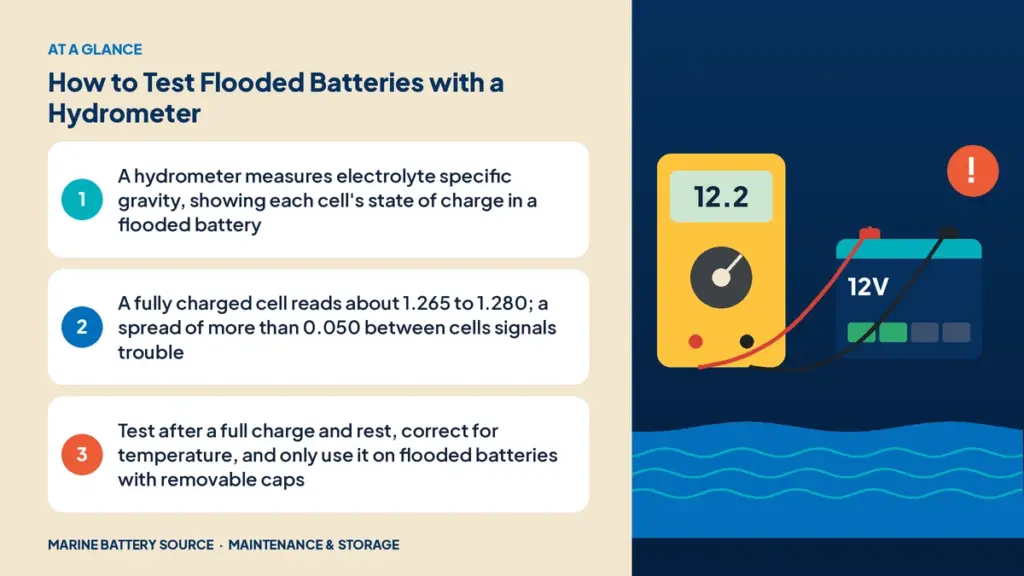
After a full charge, all cells should read within about 0.025 to 0.050 of each other.
- Small spread (under 0.025): healthy battery
- Moderate spread (0.025 to 0.050): consider equalizing. See equalizing flooded batteries.
- Large spread (over 0.050) after equalizing: a weak or failing cell
- One cell much lower: likely a bad cell; the battery may need replacement
What low readings across all cells mean
If all cells read low after a full charge, the battery may be:
- Not fully charging (check charger settings and time)
- Sulfated. See battery sulfation explained.
- At the end of its life. See how long marine batteries last.
Combining with other tests
- Voltage test: quick check of overall state of charge.
- Load test: checks the battery’s ability to deliver current.
- Hydrometer test: checks each cell’s state of charge.
Using all three gives the clearest picture.
Hydrometer tips
- Don’t test right after adding water. Wait until after charging so the water mixes.
- Keep the hydrometer clean to avoid contaminating cells.
- Use a separate hydrometer for each battery type if you have several.
- Record results in a log to track trends.
When to replace the battery
If a cell stays low after equalization, or the battery’s readings keep dropping over time, replacement is usually the best option. Flooded options include the Interstate SRM-27 deep cycle. If you’d rather skip hydrometer tests entirely, consider lithium, such as the EPOCH 12V 105Ah LiFePO4. See lithium battery maintenance for what changes.
Before winter storage
Test each battery before storage, charge fully, and use a maintainer. See winter storage for marine batteries. For the full maintenance routine, see our marine battery maintenance guide.
Keeping a test log
A simple table makes hydrometer results far more useful:
- Date
- Battery (start, house 1, troll 1, and so on)
- Each cell’s reading
- Temperature
- Notes (charged overnight, equalized, water added)
Over a season, you’ll see whether readings are stable, slowly dropping or suddenly diverging. A cell that drops a little more each month is a warning that the battery is nearing the end of its life, giving you time to replace it before a failure.
Hydrometer readings and freezing
Specific gravity also tells you how well a battery will resist freezing. A fully charged battery with a specific gravity around 1.265 won’t freeze until about -70°F, while a discharged battery around 1.120 can freeze near 10°F. That’s why keeping lead-acid batteries charged in winter matters. Browse our AGM and lead-acid batteries for replacements.
Frequently asked questions
What should a fully charged battery read on a hydrometer?
About 1.265 to 1.280, corrected to 80°F, depending on the battery maker.
How much variation between cells is normal?
Within about 0.025 to 0.050 after a full charge. More than that suggests equalizing or a weak cell.
Can I use a hydrometer on an AGM battery?
No. AGM batteries are sealed. Use a voltage test or load test instead.
Do I need to correct hydrometer readings for temperature?
Yes. Add about 0.004 for every 10°F above 80°F and subtract 0.004 for every 10°F below.
When should I do a hydrometer test?
After a full charge and rest, monthly in season, and before and after equalization.