


Battery Sulfation: What Kills Lead-Acid Batteries
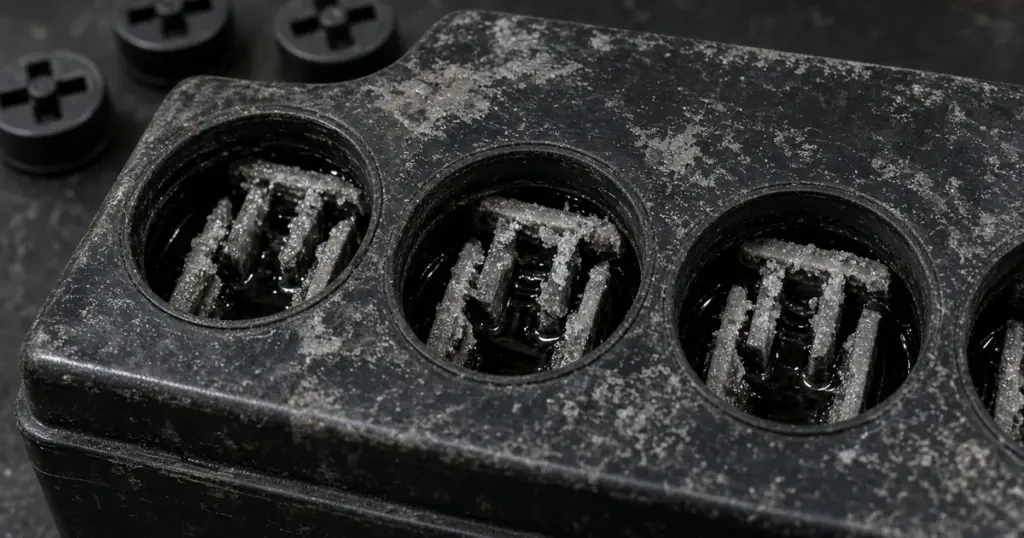
Sulfation is the number one cause of early lead-acid battery failure. It’s why a battery that sat in the garage all winter won’t crank in spring, and why trolling batteries that are never fully charged lose runtime season after season. Understanding sulfation makes it easy to prevent. This guide explains battery sulfation, its causes and symptoms, and how to avoid it.
What is sulfation?
Every time a lead-acid battery discharges, lead sulfate forms on the plates. That’s a normal part of how the battery works. When you recharge, the sulfate converts back into lead and sulfuric acid.
The problem starts when a battery sits partly or fully discharged. The soft, fine sulfate crystals begin to grow and harden into larger crystals that don’t convert back easily. Those hard crystals:
- Reduce the active plate area
- Increase internal resistance
- Lower capacity
- Make the battery harder to charge
Soft vs hard sulfation
Soft (reversible) sulfation
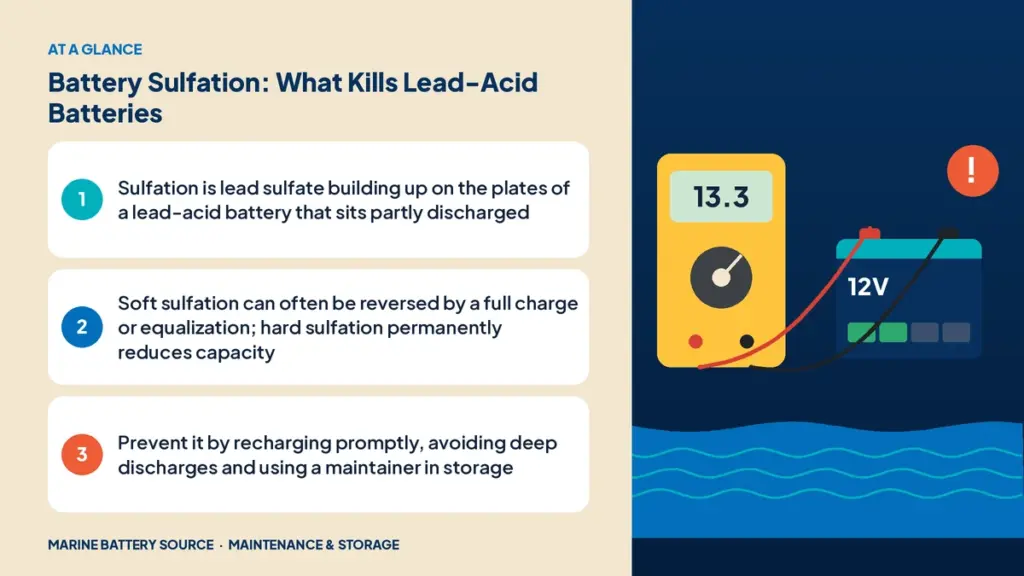
Forms when a battery is left partly discharged for a short time or isn’t fully charged regularly. A full charge, a longer absorption phase or an equalization charge can often break it down.
Hard (permanent) sulfation
Forms when a battery sits discharged for weeks or months. The crystals harden and can’t be fully converted back. Capacity is permanently lost.
Which batteries sulfate
- Flooded lead-acid: yes
- AGM: yes
- Gel: yes
- Lithium (LiFePO4): no. Lithium chemistry doesn’t form lead sulfate.
Common causes
- Storing a battery discharged, especially over winter
- Chronic undercharging, such as short charging sessions that never reach full
- Deep discharges without prompt recharging
- Low electrolyte in flooded batteries, exposing plates
- High temperatures, which speed up self-discharge and sulfation
- Stratification, where acid settles at the bottom of cells
- Wrong charger settings that don’t reach full absorption voltage
Symptoms
- Slow cranking
- Reduced runtime
- Battery charges quickly but drains quickly (low capacity)
- Low resting voltage after a full charge
- Hydrometer readings low across all cells. See battery hydrometer test.
- Battery gets hot during charging
- Visible white crystals on plates (in flooded batteries, through the fill openings)
How to prevent sulfation
- Recharge promptly after every use.
- Charge fully. Make sure your charger reaches absorption voltage and completes the cycle.
- Avoid deep discharges. Keep lead-acid above 50% state of charge when possible.
- Use a maintainer during storage.
- Keep flooded batteries watered.
- Equalize flooded batteries periodically if the maker recommends it.
- Keep batteries cool.
- Check monthly. See our monthly boat battery checklist.
Can sulfation be reversed?
Soft sulfation often can. Options include:
- A long, full charge at the correct absorption voltage
- Equalization for flooded batteries
- Desulfation modes on some smart chargers, which use pulses or controlled voltage to break down crystals
Hard sulfation usually can’t be fully reversed. Desulfation may recover some capacity, but a heavily sulfated battery rarely returns to full performance.
Is it worth trying to desulfate?
If the battery is relatively new and sat discharged for a short time, it’s worth trying. If it’s old, sat discharged for months or fails a load test after desulfation, replacement is usually the better choice.
Sulfation and battery life
Sulfation is a major reason lead-acid batteries don’t reach their expected life. See how long marine batteries last. AGM batteries are somewhat more resistant to sulfation than flooded, but still need regular charging. See AGM vs flooded battery maintenance.
Storage tips to avoid sulfation
- Charge fully before storage.
- Use a smart maintainer, or charge every month.
- Store in a cool place.
- Disconnect loads to prevent drain.
See winter storage for marine batteries.
Choosing a charger
A smart charger that completes a full charge cycle and maintains the battery is the best defense. Look for chargers with a proper absorption phase and float or maintenance mode. Browse our marine battery chargers.
Switching to lithium
If you’ve lost batteries to sulfation, lithium eliminates the problem. LiFePO4 batteries like the EPOCH 12V 105Ah or the EPOCH 36V 50Ah can sit partly charged without damage.
How fast sulfation happens
Sulfation begins as soon as a lead-acid battery drops below full charge, but it becomes a real problem over days and weeks. A battery left at 50% overnight loses very little. A battery left at 50% for a month in a warm garage can lose a noticeable share of its capacity for good. A battery left fully discharged over a winter may never recover. Self-discharge makes it worse: a flooded battery can lose several percent of its charge per month on its own, more in heat, so even a battery stored full slides into the danger zone without a maintainer.
Testing for sulfation
A battery that charges to full voltage quickly but then drops sharply under load is a classic sign. To confirm:
- Fully charge the battery and let it rest overnight.
- Check resting voltage. A healthy 12V battery reads about 12.6V to 12.8V.
- Do a load test, or run a known load and time it.
- For flooded batteries, check specific gravity in each cell.
Low results across the board after a full charge point to sulfation or general aging.
Sulfation in trolling batteries
Trolling batteries are especially prone to sulfation because they’re discharged deeply and often left overnight or longer before charging. A few habits help:
- Plug in the onboard charger as soon as you get home, every time.
- Make sure each battery in the bank is on its own charger bank so they all reach full charge.
- Don’t let a charger’s “full” light fool you if it’s an older unit; check voltage after a rest.
- If the boat sits for weeks between trips, leave the charger connected in maintenance mode.
Sulfation in starting batteries
Starting batteries rarely see deep discharges, but they sulfate when a boat sits for weeks with small parasitic drains slowly pulling the battery down. A bilge pump float switch, a stereo memory or a chartplotter’s standby draw can drain a battery over a month. Turning off the battery switch and using a maintainer prevents this.
For a complete care routine, see our marine battery maintenance guide.
Frequently asked questions
What is battery sulfation?
It’s the buildup of lead sulfate crystals on a lead-acid battery’s plates, which reduces capacity when the battery sits discharged.
Can a sulfated battery be fixed?
Soft sulfation can often be reversed with a full charge or equalization. Hard sulfation usually can’t be fully reversed.
Do lithium batteries sulfate?
No. Lithium chemistry doesn’t form lead sulfate.
How do I prevent sulfation?
Recharge promptly, charge fully, avoid deep discharges and use a maintainer in storage.
Do desulfator chargers work?
They can help with soft sulfation, but they rarely restore a heavily sulfated battery to full capacity.