


Lights Dim When the Motor Starts? Diagnosing Voltage Drop
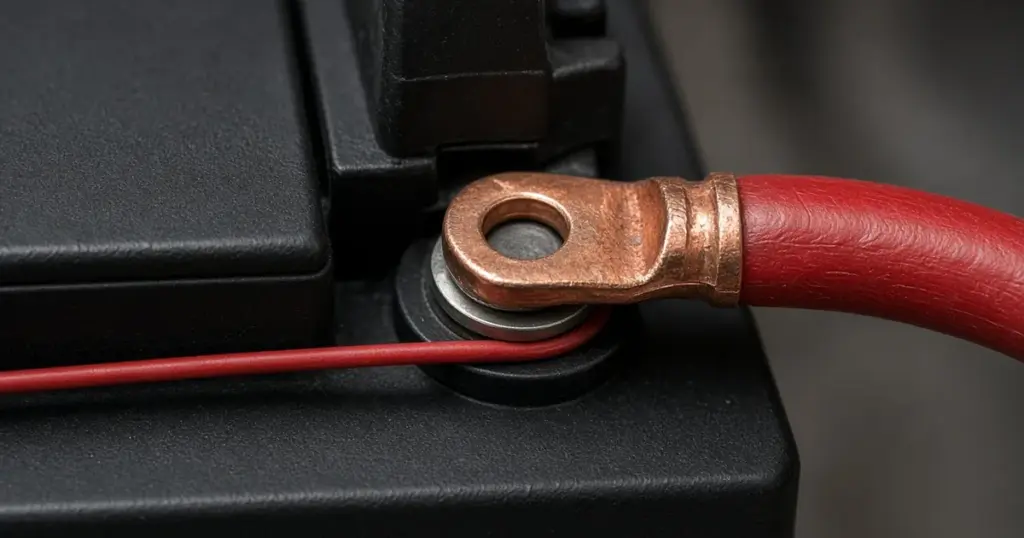
A battery can read a perfect 12.7 volts at rest and still leave your trolling motor sluggish, your bilge pump slow and your electronics resetting. The culprit is often voltage drop: power lost in wires, connections, switches and fuses between the battery and the load. Voltage drop only shows up when current flows, which is why a resting voltage check misses it. This guide explains what causes voltage drop, how to measure it and how to fix it.
What voltage drop is
Every wire and connection has some resistance. When current flows, that resistance turns some of the voltage into heat. The higher the current and the higher the resistance, the more voltage is lost. Ohm’s law sums it up: voltage drop equals current times resistance.
- A trolling motor drawing 50A through a connection with just 0.01 ohm of resistance loses 0.5V at that connection.
- A starter drawing hundreds of amps loses even more through a corroded lug.
Why it matters
- Motors run slower and weaker.
- Electronics reset or show low-voltage warnings.
- Pumps move less water.
- Chargers may not fully charge batteries.
- Connections heat up, which speeds corrosion and can melt insulation.
Common causes
- Undersized wire for the current and length
- Corroded terminals and lugs
- Loose connections
- Poor crimps
- Worn battery switches
- Corroded fuse holders and breakers
- Long wire runs
- Bad grounds
Acceptable limits
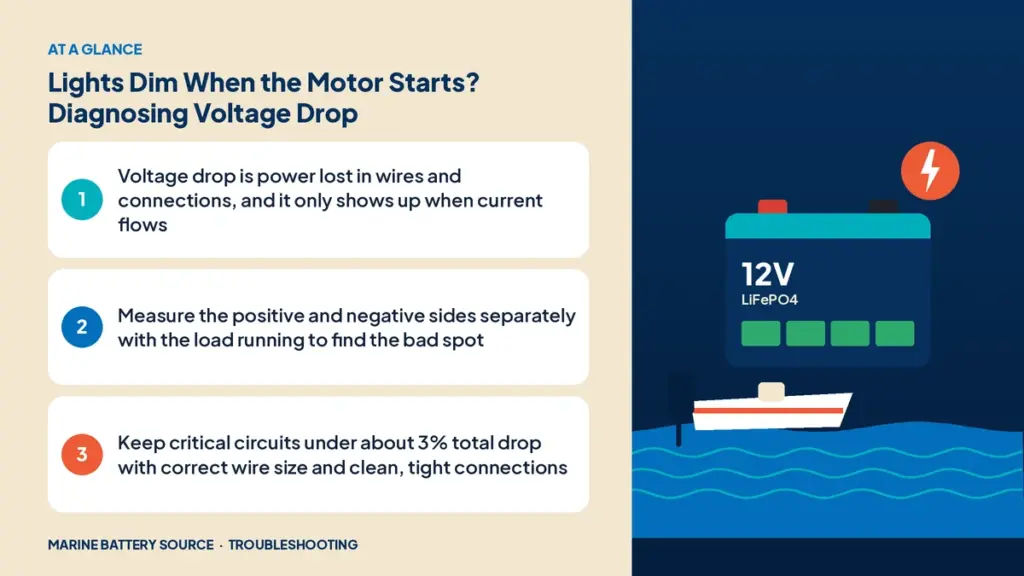
A common marine guideline is to size wiring for no more than 3% voltage drop on critical circuits (navigation, electronics, bilge pumps) and 10% on less critical ones (some lighting). On a 12V system, 3% is about 0.36V. Trolling motor makers often specify wire sizes for their motors; follow those.
How to measure voltage drop
You’ll need a digital multimeter and the load running.
Positive side
- Turn on the load.
- Put the red probe on the battery positive post.
- Put the black probe on the load’s positive terminal.
- The reading is the voltage lost on the positive side.
Negative side
- With the load still running, put the red probe on the load’s negative terminal.
- Put the black probe on the battery negative post.
- The reading is the voltage lost on the negative side.
Add the two for the total drop.
Finding the bad spot
Move one probe step by step along the circuit: across each connection, switch, fuse and busbar. Where the reading jumps, you’ve found the resistance.
Testing specific circuits
Trolling motor
Run the motor on high. Measure from the battery bank’s positive to the motor plug’s positive, and from the plug’s negative to the bank’s negative. Include the series jumpers on multi-battery banks.
Starting circuit
Crank the engine. Measure from battery positive to the starter positive terminal, and from the engine block to the battery negative.
Electronics
Turn on the electronics. Measure at the device’s power connector.
Fixing voltage drop
- Clean and tighten every connection in the circuit.
- Replace corroded lugs and cut back to bright copper.
- Use the right wire size for current and round-trip length.
- Replace worn switches and corroded fuse holders.
- Shorten runs where possible.
- Improve grounds: a dedicated negative return to the battery or busbar.
- Consolidate connections: a busbar like the EPOCH heavy-duty power distribution block reduces stacked lugs.
If cables are corroded inside, replace them. See replacing battery cables on a boat.
Wire sizing basics
Wire size depends on current and round-trip length (positive plus negative). Longer runs and higher currents need thicker wire. Use a marine wire sizing chart for the target drop, and use tinned copper marine cable.
Voltage drop and lithium
Lithium batteries hold voltage well, so drop in the wiring becomes the main source of low voltage at the load. Lithium can also deliver very high currents, which makes resistance heat up faster. Good wiring is essential. If a lithium battery seems to charge slowly, voltage drop between the charger and battery may be part of the cause; see lithium battery won’t charge.
Voltage drop in series banks
In 24V and 36V banks, jumpers between batteries add connections. A corroded jumper causes drop and imbalance. See unbalanced battery bank.
Electronics and noise
High resistance in electronics power and ground wiring can increase noise and resets. See fish finder interference from the trolling motor.
Example
A 24V trolling motor feels weak. At the batteries, voltage under load is 25.0V; at the plug, 23.4V. That’s 1.6V lost, about 6.5%. Testing connection by connection finds 0.9V across a corroded breaker terminal. Replacing the breaker and cleaning the lugs brings the drop to 0.5V, and the motor runs noticeably stronger.
Heat as a clue
Resistance turns lost voltage into heat, so a hot connection is a voltage drop you can feel. After running a heavy load for a few minutes, turn it off and carefully touch each connection with the back of your hand. A lug, breaker, plug or switch that’s noticeably warmer than the cable around it is the likely problem. An inexpensive infrared thermometer makes this safer and more precise.
Prevention
- Use correctly sized tinned wire.
- Seal crimps with adhesive heat-shrink.
- Protect connections from moisture.
- Inspect and test circuits seasonally.
Battery and fuse hardware
A Battle Born MRBF fuse block protects circuits close to the battery with low-resistance terminal fuses. When upgrading batteries, a single-case 36V lithium battery like the EPOCH 36V 100Ah removes series jumpers entirely. Find more in marine battery accessories.
Related guides
For trolling motor system design, see the trolling motor power system guide. For general troubleshooting, read boat electrical problems troubleshooting and the marine battery troubleshooting guide.
Frequently asked questions
What is voltage drop under load?
The voltage lost in wires and connections when current flows. It reduces the voltage reaching the device.
How much voltage drop is acceptable on a boat?
About 3% for critical circuits like electronics and bilge pumps, up to 10% for less critical loads.
How do I test voltage drop?
With the load running, measure from the battery post to the load terminal on each side of the circuit.
Can a corroded connection cause voltage drop?
Yes. Corrosion adds resistance, which causes drop and heat under load.
Does wire size affect voltage drop?
Yes. Thinner wire and longer runs cause more drop. Size wire for current and round-trip length.