


How Many Batteries Does My Boat Need?
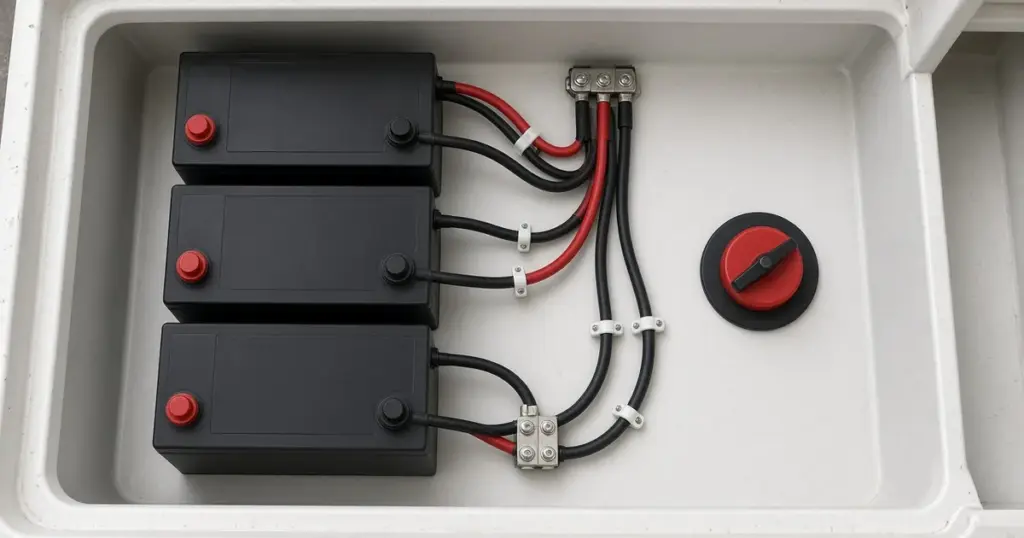
The number of batteries on a boat depends on the jobs they do: starting engines, running a trolling motor, and powering electronics and accessories. A small jon boat may need one battery. A tournament bass boat might carry four. A cruiser could have six or more. This guide explains how to work out what your boat needs, with common setups.
Step 1: Count the jobs
Starting: one start battery per engine is typical. Twin outboards usually have one each, sometimes with a shared house bank.
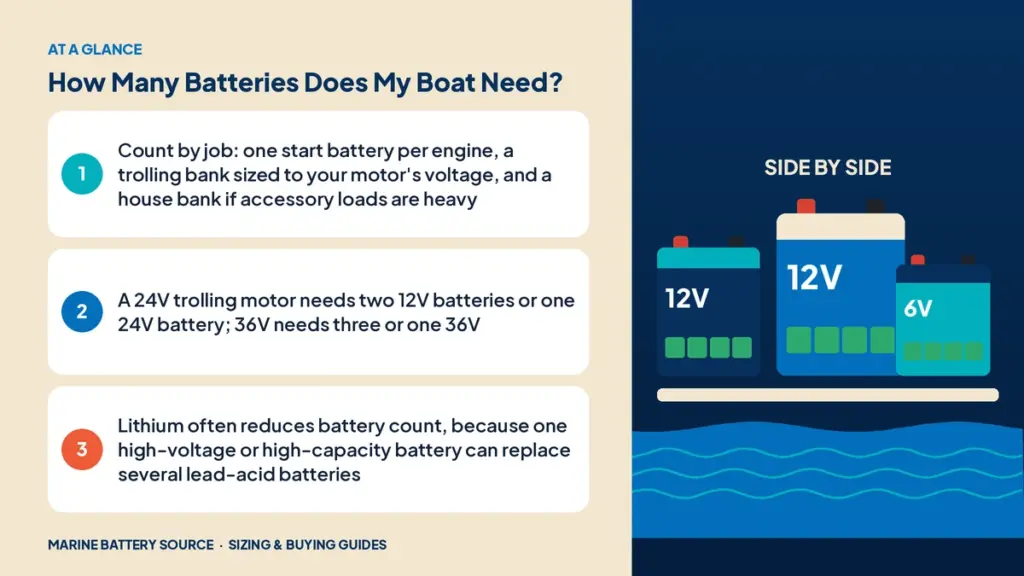
Trolling: a trolling motor needs its own battery or bank, matched to the motor’s voltage:
| Motor voltage | Lead-acid or 12V lithium | Single-case lithium |
|---|---|---|
| 12V | 1 x 12V | 1 x 12V |
| 24V | 2 x 12V in series | 1 x 24V |
| 36V | 3 x 12V in series | 1 x 36V |
House: electronics, lights, pumps, a stereo, refrigeration, an inverter. If these loads are light, the start battery can handle them in a dual-purpose role. If they’re heavy, a separate house battery or bank protects your ability to start the engine.
Step 2: Decide whether to combine jobs
Small boats with light loads can combine starting and house use in one dual-purpose battery. That’s simple and light, but it puts all your eggs in one basket. If the battery runs flat from the stereo, you can’t start the engine.
Two batteries, one for starting and one for house, are safer and more flexible. A battery switch or an automatic charging relay lets the engine charge both while keeping the start battery protected.
Common setups
Kayak or small electric-only boat: one 12V lithium battery for the trolling motor and electronics. A Battle Born 30Ah or a Dakota 10Ah mini can run a fish finder alone; a group 24 lithium suits a kayak trolling motor.
Jon boat with small outboard: one dual-purpose battery. A Dakota DL+ 60Ah lists 1,000 CCA at 16.5 pounds.
Jon boat or skiff with outboard and 12V trolling motor: two batteries: a start or dual-purpose battery, and a 12V deep-cycle trolling battery.
Bass boat with 24V trolling motor: three batteries: one start battery, plus two 12V deep-cycle batteries in series, or one 24V lithium battery.
Bass boat with 36V trolling motor: four batteries: one start battery plus three 12V deep-cycle batteries, or two batteries if you use a single 36V lithium battery for trolling.
Pontoon with stereo: one start battery plus a house battery for the stereo and lights, especially if you anchor and play music for hours.
Center console, single outboard: one start battery plus a house battery for electronics, especially with large displays and radar.
Center console, twin outboards: one start battery per engine, plus a house bank for electronics.
Cruiser with refrigeration and inverter: one start battery per engine plus a large house bank, often two or more batteries or a single large lithium battery.
Step 3: Size each bank
Battery count is only half the question; capacity is the other half. For each deep-cycle bank:
- Estimate daily amp-hours: amps times hours for each load.
- Add 20–30% margin.
- Double it for lead-acid, or divide by about 0.9 for lithium.
See amp-hours explained and lithium vs lead-acid amp-hours for details.
How lithium changes the count
Lithium can reduce battery count in two ways:
- Higher-voltage single cases: a 36V lithium battery replaces three 12V batteries, removing jumpers and saving weight.
- More usable capacity per case: a group 31 12V 300Ah lithium battery can replace a bank of several lead-acid batteries for house use.
Fewer batteries means fewer connections to corrode, simpler charging and more storage space.
Charging multiple batteries
Each battery or bank needs a way to charge:
- Onboard charger: multi-bank chargers charge each battery separately. A 3-bank charger suits a start battery plus a 24V bank; a 4-bank charger suits a start battery plus a 36V bank of three 12V batteries.
- Single-case lithium: use a charger matched to its voltage, like a 36V lithium charger, or a two-bank 12V/36V charger that handles the start battery too.
- Engine charging: an automatic charging relay or DC-DC charger lets the engine charge house or trolling batteries without draining the start battery.
Battery switches
A battery switch lets you isolate batteries, select which ones power the engine, and combine them in an emergency. On boats with a start and house battery, a dual-circuit switch keeps the two separate in normal use. Use spec sheets to confirm each battery’s role and limits.
Weight and space
Every battery adds weight. Three lead-acid group 31 batteries for a 36V trolling motor can weigh about 200 pounds. Lithium can cut that by more than half. Place batteries low and near the centerline, and secure each one.
When to add a battery
- You regularly run the start battery low with accessories.
- Your trolling battery dies before the end of the day.
- You’ve added a stereo, a refrigerator or new electronics.
- Sonar interference from the trolling motor suggests a separate electronics battery.
More reading
For sizing and costs, read battery price per kWh and how to read a battery spec sheet. Ordering? See buying a marine battery online. The marine battery buying guide walks through the full process, the lithium buyer’s guide covers lithium, and BCI group sizes covers fit.
Products mentioned
- Dakota DL+ 12V 60Ah dual purpose
- EPOCH 36V 50Ah
- EPOCH 12V/36V onboard charger
- EPOCH 4-bank 12V charger
- Browse house bank batteries.
Frequently asked questions
How many batteries does a bass boat need?
Typically one start battery plus two (24V) or three (36V) trolling batteries, or one single-case lithium trolling battery.
Can one battery start the engine and run electronics?
Yes, a dual-purpose battery can, on boats with light loads. Two batteries are safer.
How many batteries for a 36V trolling motor?
Three 12V batteries in series, or one 36V battery.
Do I need a house battery on a pontoon?
If you run a stereo or lights at anchor for long periods, a separate house battery protects your start battery.
Does lithium reduce the number of batteries I need?
Often. A single 24V or 36V lithium battery replaces two or three 12V batteries.