


Marine Battery Buying Guide: Amp-Hours, Watt-Hours and Value
Buying a marine battery can feel complicated: group sizes, CCA, MCA, amp-hours, reserve capacity, flooded, AGM, lithium. But the decision comes down to a few questions, asked in the right order. This guide walks through them and links to deeper articles on each topic. If you’d rather talk it through, contact us with your boat and current setup.
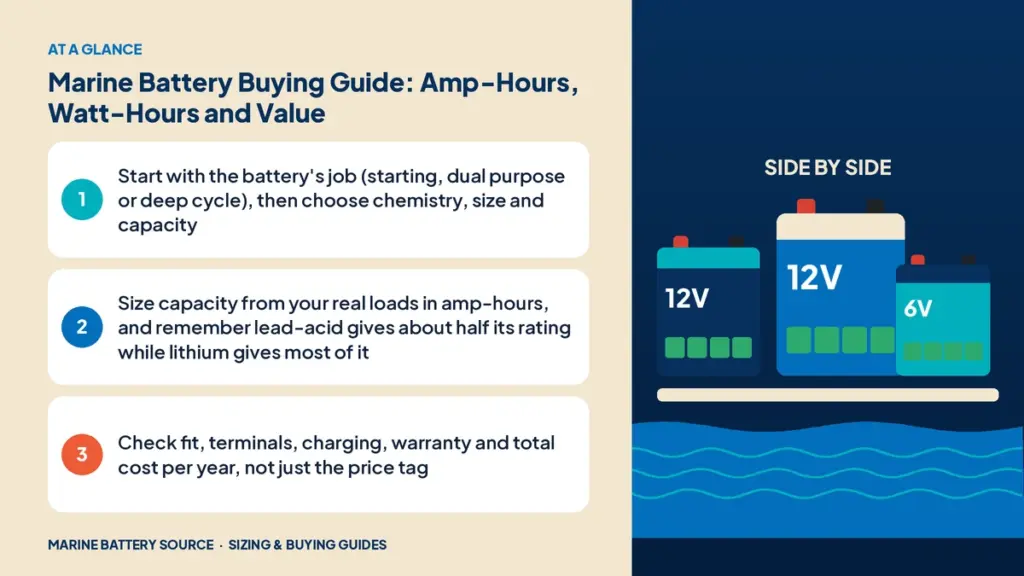
Step 1: Define the battery’s job
Every battery on a boat has a primary job:
- Starting (cranking): short, high-current bursts to start the engine, then recharged by the engine.
- Deep cycle: steady current for hours, discharged deeply and recharged, for trolling motors and house loads.
- Dual purpose: starting plus moderate accessory loads, common on boats with one battery.
Many boats use two or more batteries with different jobs: a start battery plus a trolling bank, or a start battery plus a house bank. Keeping jobs separate means heavy accessory use can’t leave you unable to start the engine. See how many batteries does my boat need for common setups.
Step 2: Choose a chemistry
| Flooded lead-acid | AGM | Lithium (LiFePO4) | |
|---|---|---|---|
| Upfront cost | Lowest | Moderate | Highest |
| Usable capacity | About 50% of rating | About 50% | Most of rating |
| Weight | Heavy | Heavy | About half or less |
| Maintenance | Watering, venting | Sealed | Sealed, no watering |
| Cycle life | Hundreds of cycles | Hundreds of cycles | Thousands of cycles |
| Charging | Standard | AGM profile | LiFePO4 profile; heating or above-freezing temps |
Flooded batteries are economical for starting and light use. AGM adds sealed, spill-proof convenience and vibration resistance. Lithium wins for deep cycling: trolling motors and house banks you use often.
Step 3: Work out capacity
For deep-cycle batteries, capacity is measured in amp-hours (Ah). Add up what you’ll use per day:
- List each load and its current in amps.
- Multiply by hours of use.
- Total the amp-hours.
- Add a margin of 20–30%.
Then account for chemistry. A lead-acid battery should generally be used to about 50% for good life, so double your total. A lithium battery can use most of its rating. Read amp-hours explained and depth of discharge for details, and lithium vs lead-acid amp-hours for why a 100Ah lithium battery outlasts a 100Ah lead-acid battery.
For higher-voltage systems, comparing in watt-hours is easier. See amp-hours to watt-hours and kWh.
Step 4: Check cranking needs
For starting and dual-purpose batteries, check your engine maker’s minimum cranking rating, in CCA or MCA, and choose a battery that meets or exceeds it. CCA is measured at 0°F and MCA at 32°F, so MCA numbers are higher. Northern boaters should give extra margin, because cranking power drops in the cold.
Step 5: Find a size that fits
Measure your battery box or tray and check the exact dimensions on product listings. Common marine sizes are group 24, 27 and 31, with 4D and 8D on bigger boats and GC2 golf-cart batteries in some house banks. See BCI battery group sizes explained for the full chart.
Step 6: Confirm terminals and mounting
Check terminal type (posts, studs or M8 bolts), terminal layout, cable reach and hold-down fit. A battery that fits the box but not the cables isn’t a good fit.
Step 7: Plan charging
Every charger and charging source must match the chemistry:
- Onboard chargers: set to flooded, AGM or LiFePO4.
- Engine alternators: fine for lead-acid and AGM. For lithium, check engine compatibility and consider a DC-DC charger.
- Cold weather: lithium needs internal heating or above-freezing temperatures to charge.
Step 8: Read the spec sheet carefully
Look at continuous discharge current, maximum charge current, cycle life, operating and charging temperatures, IP rating and warranty. See how to read a battery spec sheet and battery C-rate explained.
Step 9: Compare total cost, not just price
A cheaper battery that lasts three seasons can cost more per year than a pricier one that lasts ten. Compare:
- Price per usable kWh.
- Expected cycle life and warranty.
- Charger upgrades, trays and fuses needed.
- Any core charge on lead-acid batteries.
See battery price per kWh for a worked method.
Example setups
Jon boat with a small outboard and fish finder: one dual-purpose battery, such as a group 24 AGM or a Dakota DL+ 60Ah lithium.
Bass boat with a 36V trolling motor: a group 31 AGM start battery, plus three 12V deep-cycle batteries or one 36V lithium battery for the trolling motor, with a multi-bank onboard charger.
Pontoon with a stereo: a dual-purpose start battery plus a separate house battery for the stereo, joined by a battery switch or charging relay.
Center console with big electronics: a start battery per engine, plus a lithium house bank charged by DC-DC chargers.
Buying checklist
- ☐ Battery job: starting, dual purpose or deep cycle
- ☐ Chemistry chosen
- ☐ Daily amp-hours calculated, with margin
- ☐ Cranking requirement met
- ☐ Dimensions and terminals confirmed
- ☐ Hold-down and tray planned
- ☐ Chargers matched to chemistry
- ☐ Fuse planned close to the battery
- ☐ Warranty and cost per year compared
Buying online
Ordering online gives you more choice and makes it easy to compare specs. Just confirm fit, shipping rules for lithium, and how core charges and returns work. See buying a marine battery online. We offer flat-price installation (from $99 per battery) anywhere from Venice to Gainesville, FL; see our local installation page.
Products to start with
- Interstate 27M-AGM dual purpose
- EPOCH 12V 105Ah lithium
- Trojan 27TMX deep cycle
- Browse trolling motor batteries and chargers.
Frequently asked questions
What’s the most important factor when buying a marine battery?
The battery’s job. Starting, dual-purpose and deep-cycle batteries are built differently.
How do I know what size battery my boat needs?
Measure the battery box or tray and compare it with listing dimensions. Group size is a starting point.
Is lithium worth it for a boat?
For deep cycling, such as trolling and house use, usually yes. For starting only, AGM or flooded is economical.
How many amp-hours do I need?
Add up your loads in amps times hours, add 20–30%, and double it for lead-acid.
Do I need a new charger for lithium?
You need a charger with a LiFePO4 profile. Many modern chargers have one.