


Why 100Ah of Lithium Isn’t the Same as 100Ah of Lead-Acid
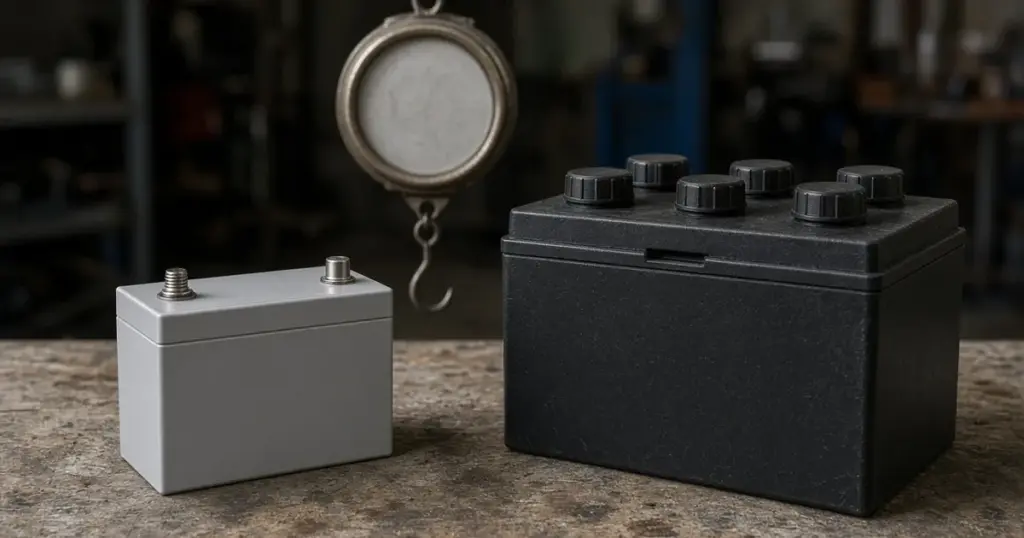
Two batteries with the same amp-hour label can deliver very different runtime on your boat. A 100Ah lithium battery and a 100Ah lead-acid battery aren’t equivalent, and understanding why helps you size a bank correctly and compare prices fairly. This guide explains the differences with simple examples.
Difference 1: Usable capacity
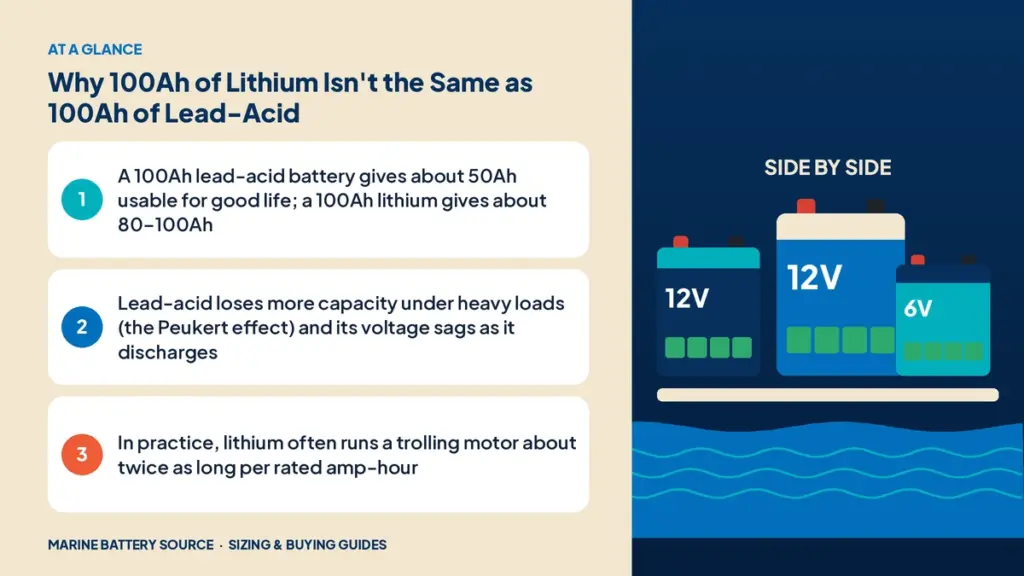
Lead-acid batteries, flooded and AGM, last much longer when discharged only to about 50%. Regularly going deeper shortens their life. Lithium iron phosphate (LiFePO4) batteries are routinely used to 80–90%, and some makers list 100% usable depth of discharge.
| 100Ah lead-acid | 100Ah lithium | |
|---|---|---|
| Recommended routine use | ~50Ah | ~80–100Ah |
That alone nearly doubles lithium’s useful capacity. Battle Born, for example, lists its 100Ah batteries as equivalent to 200Ah of lead-acid, and its 75Ah as equivalent to 150Ah.
Difference 2: The Peukert effect
Lead-acid capacity is usually rated at the 20-hour rate, which for a 100Ah battery is about 5A. At higher currents, lead-acid batteries deliver less total capacity. A trolling motor drawing 25–40A pulls much harder than the rating condition, so a lead-acid battery delivers noticeably less than its label. Lithium batteries are far less affected and deliver close to their rated capacity across typical marine loads.
Difference 3: Voltage under load
As a lead-acid battery discharges, its voltage drops steadily. A trolling motor slows down as the day goes on, and electronics may complain or shut off as voltage falls. A lithium battery holds a nearly flat voltage until it’s close to empty. For a 12V LiFePO4 battery, resting voltage moves only from about 13.3–13.4V full to about 12.9–13.0V at 20%. Your motor keeps running at full speed for most of the discharge.
Difference 4: Charging efficiency
Lithium batteries charge efficiently right up to full. Lead-acid batteries slow down sharply in the final absorption stage, and they need a full charge regularly to avoid sulfation. On a weekend trip with limited charging time, lithium recovers more of its capacity from the same charger or alternator.
Putting it together: runtime
Say your trolling motor averages 15A over a day.
| Battery | Usable Ah | Estimated runtime |
|---|---|---|
| 100Ah lead-acid at 50% | ~50Ah, less under heavy load | ~3–3.5 hours |
| 100Ah lithium at 90% | ~90Ah | ~6 hours |
In practice, many anglers find a lithium battery runs their trolling motor about twice as long as a lead-acid battery with the same rating, and the motor stays stronger throughout.
Sizing a replacement
When switching from lead-acid to lithium, you don’t need the same amp-hour rating to get the same runtime:
- Replacing a 100Ah lead-acid trolling battery: a 60–75Ah lithium battery gives similar usable capacity; a 100Ah lithium gives roughly double.
- Replacing a pair of 6V golf-cart batteries (12V 225Ah, ~112Ah usable): a 12V 100Ah or 135Ah lithium battery gives similar or more usable energy.
- Replacing three group 27 batteries in a 36V bank (~100Ah each, ~50Ah usable): a 36V 50–65Ah lithium battery gives similar usable energy; a 36V 100–120Ah gives roughly double.
Weight per usable amp-hour
| Typical lead-acid group 27 | Lithium 12V 100Ah | |
|---|---|---|
| Weight | 55–66 lb | ~21–31 lb |
| Usable Ah | ~50 | ~90 |
| Pounds per usable Ah | ~1.1–1.3 | ~0.25–0.35 |
Lithium carries roughly four times the usable energy per pound.
Where lead-acid still makes sense
- Starting batteries, where only a little capacity is used each start.
- Infrequent use, where lithium’s cycle-life advantage won’t be realized.
- Cold-weather charging without a heated lithium battery.
- Tight budgets, where upfront cost matters most.
Comparing in watt-hours
When comparing batteries of different voltages, use watt-hours. A 12V 100Ah lithium battery stores about 1.28 kWh. A 12V 105Ah lead-acid battery stores about 1.26 kWh rated, but only about 0.63 kWh usable. See amp-hours explained for the basics.
Cold weather
Both chemistries lose some capacity in the cold. Lead-acid also loses cranking power. Lithium can discharge in the cold but shouldn’t be charged below freezing unless it has internal heating. Heated models, like EPOCH Essential batteries and the Dakota DL+ 135Ah, handle this automatically.
A note on battery age
All batteries lose capacity as they age. Lead-acid capacity falls faster, especially if the battery is undercharged or deeply discharged. Lithium batteries typically retain most of their capacity for thousands of cycles. Dakota, for example, lists up to 5,000 cycles to 80% capacity under recommended conditions.
Why reserve capacity can mislead
Reserve capacity (minutes at 25A to 10.5V) is a useful lead-acid rating, but it measures discharge all the way to 10.5V, which is far deeper than you’d want to go routinely. A battery with 180 minutes RC delivers about 75Ah in that test, but only about half of its rated capacity should be used on a regular basis. Interstate’s Li27M lithium lists 240 minutes RC, and a lithium battery can deliver that kind of reserve regularly without the same wear.
Real-world tips
- Track actual use. A battery monitor shows how many amp-hours you really use. Many owners discover they need less lithium capacity than they expected.
- Don’t overbuy lead-acid. If you’re staying with lead-acid, size for 50% use, but remember a bigger bank also takes longer to recharge.
- Match the charger. Lithium’s fast-charging benefit only shows up if your charger delivers enough current.
More reading
See how many batteries does my boat need for bank sizing and how to read a battery spec sheet to compare listings. Ordering online? Read buying a marine battery online. The marine battery buying guide covers the full process, and BCI group sizes covers fit.
Products mentioned
- Battle Born 100Ah (200Ah lead-acid equivalent)
- Battle Born 75Ah (150Ah equivalent)
- EPOCH 12V 105Ah Essential
- Trojan 27TMX (105Ah lead-acid)
Frequently asked questions
Is a 100Ah lithium battery better than a 100Ah lead-acid?
For deep cycling, yes. It gives roughly twice the usable capacity at about half the weight.
What size lithium replaces a 100Ah lead-acid?
A 60–75Ah lithium gives similar usable capacity; a 100Ah lithium gives about double.
Why does my lead-acid trolling battery die early?
Heavy loads reduce lead-acid capacity, and you should stop at about 50% for good life.
Does lithium voltage drop as it discharges?
Very little until near empty, so trolling motors keep their speed.
Is lead-acid ever better?
For starting, infrequent use, cold charging without heating, or tight budgets.