


How Long Will a Trolling Motor Battery Last? Run-Time Math

“How long will my trolling motor battery last?” is the question behind most trolling battery purchases. The answer comes from simple math, a few honest estimates and some margin for the conditions you fish in. This guide shows how to calculate trolling motor battery run time for 12V, 24V and 36V systems, how chemistry changes the answer, and how to check your numbers on the water.
The basic formula
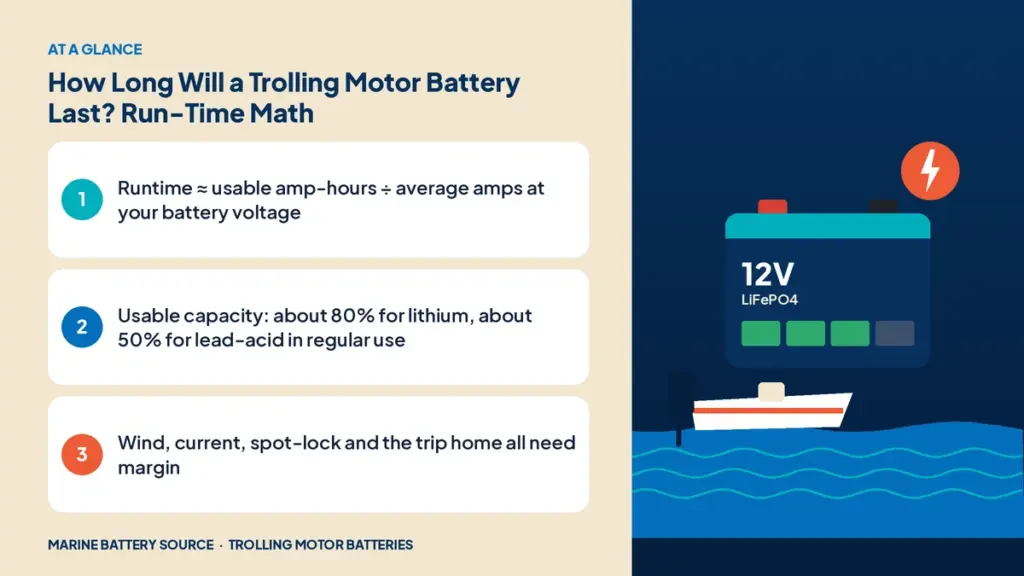
Runtime (hours) ≈ usable amp-hours ÷ average current (amps)
Two inputs matter:
- Usable amp-hours: the capacity you can actually use, not just the label rating.
- Average current: what your motor draws on average across the day, not its maximum.
Usable capacity by chemistry
- Lithium (LiFePO4): commonly used to about 80% or more of rated capacity. Lithium also delivers close to its rating even at high current.
- Lead-acid (AGM or flooded): for long life, plan on about 50% of rated capacity in regular use. At high current, lead-acid delivers fewer amp-hours than its 20-hour rating suggests.
So a 100Ah lithium battery gives you roughly 80Ah to plan with, while a 100Ah AGM gives roughly 50Ah, and less if you run hard.
Watch the voltage in series banks
In a 24V or 36V series bank, amp-hours don’t add. Three 12V 100Ah batteries in series are 36V at 100Ah. Your motor’s current draw is measured at that bank voltage. So for a 36V motor drawing 20A, use the bank’s 100Ah figure, not 300Ah.
Watt-hours make cross-voltage comparisons easier:
Watt-hours = volts × amp-hours
A 36V 100Ah bank stores about 3,600 to 3,840Wh; a 12V 100Ah battery about 1,200 to 1,280Wh.
Worked examples
12V jon boat
- Battery: 12V 100Ah lithium, about 80Ah usable.
- Average draw: 12A at moderate speeds.
- Runtime: 80 ÷ 12 ≈ 6.7 hours.
Same boat with a 12V 100Ah AGM: about 50Ah usable, so 50 ÷ 12 ≈ 4.2 hours, and less if the motor runs hard, because lead-acid capacity falls at higher current.
24V bay boat
- Battery: 24V 100Ah lithium, such as the EPOCH 24V 100Ah, about 80Ah usable.
- Average draw: 18A, with periods into the wind.
- Runtime: 80 ÷ 18 ≈ 4.4 hours.
If that’s not enough, either increase capacity or change how you use the motor. A 24V system can also be built from two 12V batteries; see the 24V battery guide.
36V bass boat, tournament day
- Battery: 36V 100Ah lithium, such as the EPOCH 36V 100Ah, about 80Ah usable.
- Average draw: 12A, mostly slow trolling and spot-lock in light wind.
- Runtime: 80 ÷ 12 ≈ 6.7 hours.
On a windy day with heavy spot-lock use, average draw might double, cutting runtime in half. That’s why tournament anglers often choose more capacity than calm-day math suggests. The 36V guide compares options.
How to estimate your average current
Your motor’s manual gives maximum current. The average depends on how you fish. To estimate:
- Measure it. A battery app or a shunt-based monitor shows real current. Note readings at your common settings.
- Log a day. Check state of charge at the start and end of a trip and divide amp-hours used by hours fished.
- If you can’t measure, start from the maximum and assume a conservative fraction, then refine after a few trips.
Our amp draw guide goes deeper into what affects current.
What eats into runtime
- Wind and current: holding position against wind takes far more power than cruising in calm water.
- Spot-lock and anchor modes: they make constant corrections and can run near full power in rough conditions.
- Boat weight: more people, gear and fuel need more thrust.
- Hull and motor setup: a clean hull and correctly sized prop help.
- Battery temperature: cold reduces available capacity.
- Aging batteries: older lead-acid batteries deliver less than their rating.
- Extra loads: electronics on the same 12V battery reduce trolling time.
Runtime with two banks or a spare
Some anglers carry a second battery or a parallel bank to stretch the day. Two identical 12V lithium batteries in parallel double the amp-hours at 12V, which doubles runtime at the same draw. Parallel lead-acid batteries do the same, though both must be the same type, capacity and age, and they should be charged together. A spare battery that you swap in at lunch also works, but it means handling a heavy battery on the water with lead-acid. If you’re regularly carrying a spare, it’s usually better to install a larger single bank sized for the full day.
Build in margin
Plan for 20% or more spare capacity for the unexpected: a wind shift, a long run back, a stubborn spot-lock session. If your calculated runtime barely covers your typical day, you don’t have enough battery.
Lithium vs lead-acid runtime in practice
Lithium has three runtime advantages: more usable capacity, little capacity loss at high current, and steady voltage that keeps motor speed constant. With lead-acid, anglers often turn the motor up as voltage sags, which draws more current and shortens the day further. That’s a big reason lithium trolling motor batteries have become so popular.
Checking your results on the water
- Start each trip fully charged.
- Note state of charge at lunch and at the end of the day.
- Compare with your estimate and adjust.
- If you regularly finish below 20%, add capacity or change habits.
Planning checklist
- Confirm motor voltage.
- Estimate average current at that voltage.
- Multiply by your longest typical day.
- Divide by 0.8 for lithium or 0.5 for lead-acid to get rated capacity.
- Add 20% margin.
- Check that the battery’s continuous current rating exceeds the motor’s maximum draw.
The full process is in how to choose a trolling motor battery, and system design is covered in our trolling motor power system guide. Browse trolling motor batteries and lithium batteries to compare capacities.
Frequently asked questions
How long will a 100Ah battery run a trolling motor?
Divide usable amp-hours by average current. A 100Ah lithium battery, about 80Ah usable, averaging 10A runs about 8 hours. A 100Ah lead-acid battery, about 50Ah usable, runs about 5 hours at the same draw.
Do two batteries in series last longer?
In series, voltage increases but amp-hours stay the same. A 24V or 36V motor draws less current than a 12V motor for the same power, so the bank’s energy is used efficiently, but capacity in amp-hours doesn’t add.
Why does my lead-acid trolling battery die faster than expected?
Lead-acid delivers less capacity at high current, loses capacity with age and causes voltage sag, which leads many anglers to turn the motor up and draw more current.
How much margin should I plan for?
At least 20% beyond your typical day, more if you fish big water or depend on spot-lock in wind.