


How to Pick a Lithium Trolling Motor Battery

Lithium has become the default upgrade for trolling motors, and for good reason: it’s a fraction of the weight of lead-acid, it delivers more of its rated capacity, and it keeps your motor at a steady speed all day. But lithium trolling batteries vary a lot in capacity, current rating, features and fit. This guide shows how to pick a lithium trolling motor battery step by step, with examples from the store for 12V, 24V and 36V motors.
Why lithium suits trolling motors
- Deep usable capacity: LiFePO4 is commonly used to 80% or more of its rating, versus about 50% for lead-acid in regular cycling.
- Steady voltage: the motor keeps its speed instead of slowing as the battery drains.
- Weight: a 36V lithium battery can weigh less than one of the three lead-acid batteries it replaces.
- Cycle life: thousands of rated cycles suit anglers who fish hard and often.
- Fast charging: with a correctly sized charger, lithium recharges faster.
Step 1: Match the voltage
Your motor’s voltage decides your options:
- 12V: one 12V lithium battery.
- 24V: two 12V lithium batteries in series, or one native 24V battery.
- 36V: three 12V lithium batteries in series, or one native 36V battery.
- 48V: four 12V batteries, or a native 48V battery.
Native batteries simplify wiring and charging. Series sets let you spread weight across compartments. One 24V battery vs two 12V compares those trade-offs.
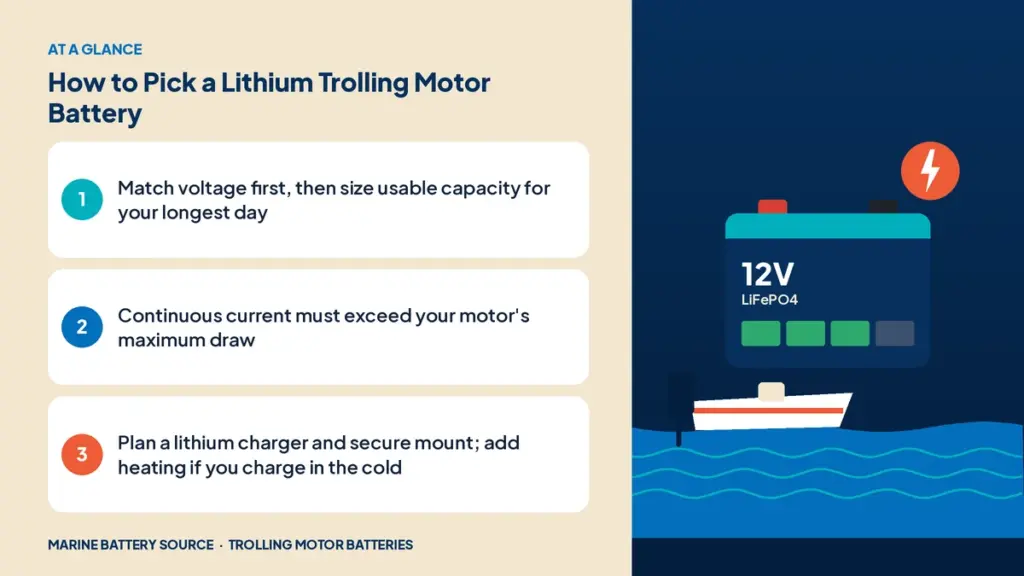
Step 2: Size capacity
Estimate average current and your longest typical day:
Rated Ah ≈ (average amps × hours) ÷ 0.8, plus 20% margin
Measure your real draw if you can. Our amp draw guide explains how, and the run-time guide walks through examples.
Step 3: Check continuous and peak current
Compare your motor’s maximum draw with the battery’s continuous discharge rating. If the motor can exceed it, the BMS may shut off at full throttle. Listed examples:
- Dakota Lithium 12V 100Ah heated: 100A continuous, 200A for 10 seconds.
- Dakota Lithium 36V 60Ah: 60A continuous, 180A for 30 seconds.
- Dakota Lithium 36V 110Ah: 200A continuous.
- Lithium Rhino marine kits: 150A continuous.
Give yourself headroom; running a battery at its limit all day generates heat.
Step 4: Decide on heating
If you’ll charge below freezing, such as early spring fishing up north or ice-out walleye trips, choose a heated battery. Many of the store’s options are heated, including Dakota Lithium’s 12V 100Ah and its 36V 60Ah, and EPOCH’s 24V and 36V batteries.
Step 5: Decide on monitoring
Lithium’s flat voltage makes simple voltage gauges unreliable. Bluetooth batteries like the EPOCH 36V 100Ah and Lithium Rhino’s kits show state of charge on your phone. Otherwise, add a shunt monitor.
Step 6: Check fit and terminals
Measure your compartment and check the battery’s footprint and height. Some native 36V batteries are large single cases; others, like the Dakota Lithium 36V 60Ah in a Group 31 footprint or the EPOCH 36V 50Ah Essential in Group 31 size, fit where one lead-acid battery used to sit. Confirm terminal type and position so cables reach.
Step 7: Plan charging
You’ll need lithium charging:
- Native battery: a charger for that voltage with a lithium profile, such as the EPOCH 36V 15A lithium charger.
- Series set of 12V batteries: a multi-bank charger with a lithium profile on every bank.
- Charging while running: a DC-DC charger from the engine’s 12V system, such as EPOCH’s 12V to 36V DC-DC charger.
Store options by voltage
12V
EPOCH 12V 100Ah Eco, 21 lb, 6-year warranty; EPOCH 12V 105Ah Essential, Bluetooth and heating; Dakota Lithium 12V 100Ah heated; Interstate Li27M 12V 100Ah; Battle Born 100Ah.
24V
Dakota Lithium 24V 60Ah, 24.9 lb; EPOCH 24V 60Ah Pro and 24V 100Ah, both with Bluetooth and heating; Battle Born 24V 50Ah; Interstate Li31M 24V 60Ah; Lithium Rhino 24V 100Ah kit.
36V
Dakota Lithium 36V 60Ah and 110Ah; EPOCH 36V 50Ah Essential and 36V 100Ah; Lithium Rhino 36V 65Ah and 120Ah kits; Interstate Li31M 36V 50Ah.
Stock varies, so check the product pages for current availability.
Installation tips
- Secure the battery with a tray or bracket; lithium is light enough to move if it’s not clamped.
- Fuse or breaker the positive lead per the motor maker’s spec, close to the battery.
- Use correctly sized, tinned marine cable.
- Don’t tap 12V from a series bank for electronics; use a separate battery or DC-DC converter.
- Charge fully before the first trip.
Rebalancing the boat after the swap
Pulling 100 lb or more of lead-acid out of the bow or stern changes how a boat sits. Bass boats with batteries in the rear deck may ride higher at the stern and trim differently at idle. Some anglers move the starting battery, a livewell load or tackle storage to restore balance. Others enjoy the faster hole shot as it is. Take the boat out after the upgrade and note how it planes, how it handles at speed and how it sits at rest before deciding whether anything needs to move. If you do relocate a battery, keep cable runs as short as practical and resize cables for any extra length.
Is AGM ever the better choice?
For budget-limited anglers, occasional users or boats where weight doesn’t matter much, AGM can still make sense. Our AGM trolling motor battery guide explains when.
Next steps
For the core selection framework, start with how to choose a trolling motor battery, and for wiring and charging details, see the trolling motor power system guide. Browse the store’s trolling motor batteries to compare.
Frequently asked questions
What size lithium battery do I need for my trolling motor?
Match your motor’s voltage, then size capacity from average current times hours, divided by about 0.8 for usable lithium capacity, plus margin.
Can I use a lithium battery with any trolling motor?
Most trolling motors run on LiFePO4 at the correct voltage. Check the motor maker’s guidance and make sure the battery’s continuous current rating exceeds the motor’s maximum draw.
Do I need a special charger for a lithium trolling battery?
Yes, a charger with a lithium profile for the battery’s voltage, or a multi-bank charger set to lithium on every bank for a series set.
Is a single 36V lithium battery better than three 12V batteries?
It’s lighter and simpler to wire and charge. Three 12V batteries spread weight and let you reuse batteries elsewhere. Both work well.