


12V vs 24V House Banks for Boats
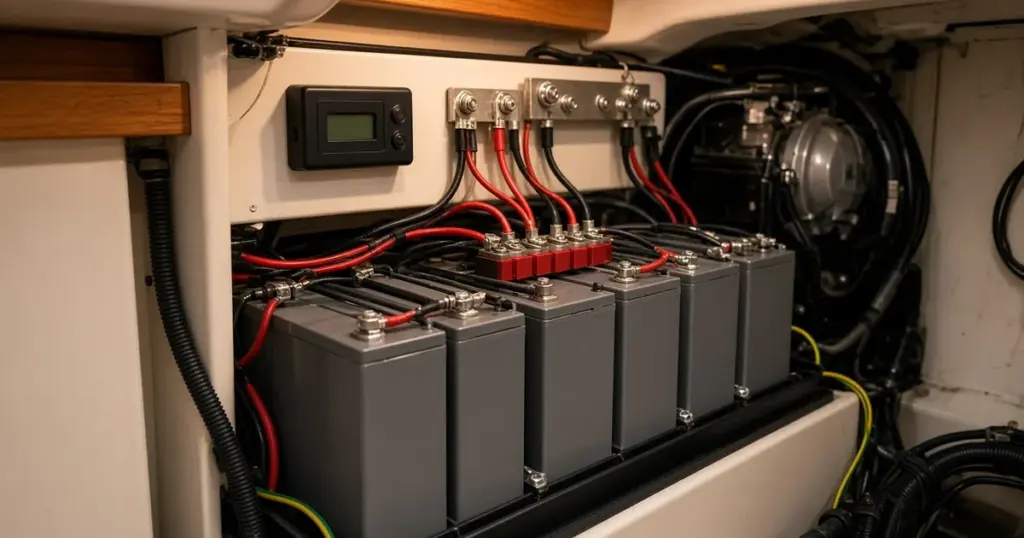
Most small and mid-size boats run 12V house systems. Larger yachts, many commercial vessels and some cruising boats use 24V. As house loads grow with lithium banks, big inverters and electric cooking, more owners are asking whether to go 24V. This guide compares 12V vs 24V house banks for boats and explains when the switch makes sense.
The physics: voltage, current and loss
Power equals voltage times current. For the same power, doubling the voltage halves the current.
| Load | Current at 12V | Current at 24V |
|---|---|---|
| 240W | 20A | 10A |
| 1,200W | 100A | 50A |
| 2,400W | 200A | 100A |
Lower current brings real advantages:
- Smaller cables for the same voltage drop percentage. Voltage drop depends on current, so halving the current halves the drop in volts, and the drop is also a smaller percentage of a higher system voltage.
- Less heat in cables, switches and connections.
- Smaller fuses and switches for the same power.
When 12V makes sense
- Most small and mid-size boats. Nearly all marine electronics, lights, pumps and accessories are designed for 12V.
- Modest loads. If your biggest loads are a fridge, electronics and a small inverter, 12V is simple and well supported.
- Outboard boats. Engines and their charging systems are 12V.
- Easy replacement parts. 12V components are available everywhere.
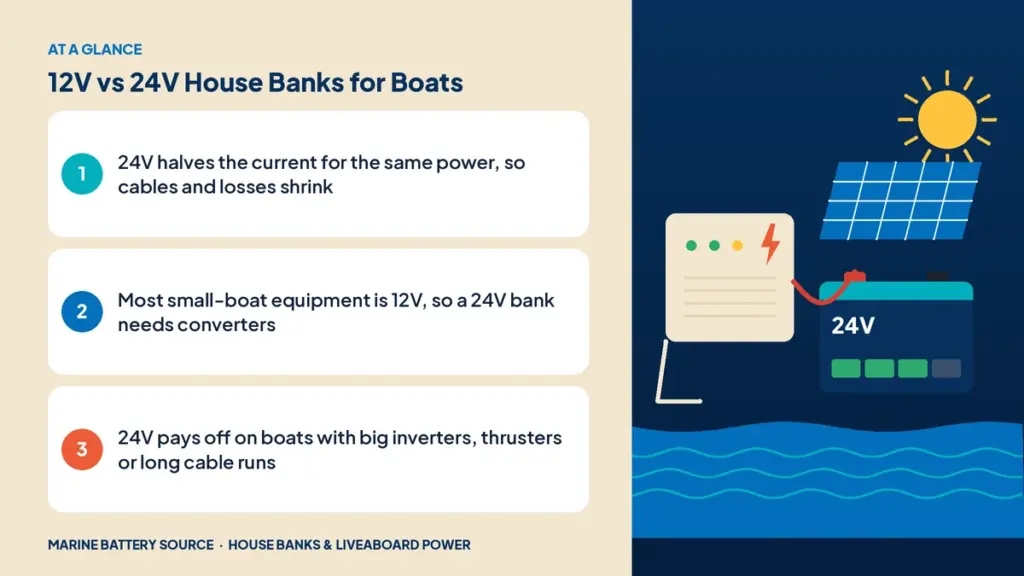
When 24V makes sense
- Large inverter loads. Running a 3,000W inverter at 12V draws nearly 300A; at 24V it’s around 140A. See inverter sizing.
- Air conditioning on batteries. See running A/C on batteries.
- Thrusters and windlasses on larger boats, which may be available in 24V versions.
- Long cable runs on larger boats.
- Boats with 24V engines, common on larger diesel installations.
The equipment question
Most marine electronics accept 12V. Many also accept a wide range, such as 10V to 32V, which allows them to run directly on 24V. Check every device’s input range. For 12V-only devices on a 24V boat, you need a 24V-to-12V DC-DC converter sized for the 12V loads, or a separate 12V battery.
Some boats run a hybrid: 24V for the big loads (inverter, thruster, windlass) and a converter-fed 12V bus for electronics and lighting.
Battery options
Lead-acid
- 12V: one or more 12V batteries in parallel, or 6V pairs in series. See 6V batteries for house banks.
- 24V: pairs of 12V batteries in series, or four 6V batteries in series.
Lithium
Single-case 24V lithium batteries simplify 24V banks:
- EPOCH 24V 230Ah Essential: 5.89 kWh, 8D size, 84 lb.
- EPOCH 24V 100Ah: 2.56 kWh, 48.5 lb.
- The Interstate Li31M 24V 60Ah, in a Group 31M case.
At 12V, large-format options include the EPOCH 12V 460Ah Essential, which holds the same 5.89 kWh as the 24V 230Ah model.
Charging a 24V bank
- Alternator: a 24V engine alternator charges a 24V bank directly. With a 12V engine, use a 12V-to-24V DC-DC charger.
- Shore and generator: a 24V battery charger or inverter/charger.
- Solar: a solar charge controller set for 24V.
Mixed-voltage boats need careful planning so every bank gets the right charge profile. If your bank is lithium, the charger must have a lithium profile at 24V; see charging lithium batteries on a boat.
Monitoring
A shunt-based battery monitor works at either voltage, though you must configure it for the system voltage and capacity. See battery monitors and shunts.
Cost of converting an existing boat
Converting a 12V boat to 24V is a significant project: new batteries or rewiring, chargers, converters, and possibly new equipment. It’s usually easiest when you’re already doing a major refit or building a new system. For many existing boats, a well-designed 12V lithium bank with heavy, short inverter cables works fine.
A worked comparison
Imagine a 40-foot cruising boat with a 3,000W inverter, a windlass and a refrigerator, with the batteries 10 feet from the inverter and 30 feet from the windlass.
At 12V, the inverter can draw close to 300A at full load. Keeping voltage drop low over that distance needs very heavy cable, often 4/0 AWG or paralleled cables, along with a large fuse and heavy switches. The windlass run to the bow is long and also needs heavy cable.
At 24V, the inverter’s maximum current is roughly halved, so the cable can be several sizes smaller for the same percentage drop. The windlass run benefits the same way, if a 24V windlass is used. The 12V electronics run from a converter sized for perhaps 20A to 40A.
The 24V design saves copper, weight and heat. The 12V design keeps every device simple and uses parts available in any chandlery. Both can work well; the right answer depends on the boat and the owner’s priorities.
Common mistakes in mixed-voltage boats
- Powering 12V devices from one battery of a 24V series pair, which unbalances the bank.
- Undersizing the 24V-to-12V converter for the electronics load.
- Using 12V-rated switches, breakers or relays on a 24V circuit.
- Forgetting that a 12V engine alternator can’t charge a 24V bank without a DC-DC charger.
- Mislabeling panels, so circuits get connected to the wrong voltage.
Decision guide
| Situation | Suggested voltage |
|---|---|
| Outboard boat, modest loads | 12V |
| Weekend cruiser with small inverter | 12V |
| Large inverter (3,000W+), A/C or electric cooking | 24V or 48V |
| Boat with 24V engines | 24V |
| New build or major refit with big loads | Consider 24V |
Safety
Regardless of voltage, use proper fusing close to the battery, cables sized for current and length, and components rated for the system voltage. Many 12V components aren’t rated for 24V. Follow ABYC standards and the equipment makers’ instructions.
For overnight power planning, read power planning for anchoring out and house bank sizing for overnight boating. Our pillar on sailboat and liveaboard battery systems covers complete systems. Browse house bank batteries.
Frequently asked questions
Is 24V better than 12V on a boat?
24V carries the same power with half the current, which helps with large loads and long runs. 12V is simpler for small boats because most marine equipment is 12V.
Can I run 12V electronics on a 24V boat?
Some devices accept a wide input range that includes 24V. For 12V-only devices, use a 24V-to-12V DC-DC converter or a separate 12V battery.
How do I make a 24V battery bank?
Use a single 24V lithium battery, or connect matched 12V batteries in series pairs, or four 6V batteries in series.
Do I need a special charger for a 24V bank?
Yes. Use a charger designed for 24V systems with the correct profile for your battery chemistry.