


Power Planning for Anchoring Out: A Weekend Off the Grid
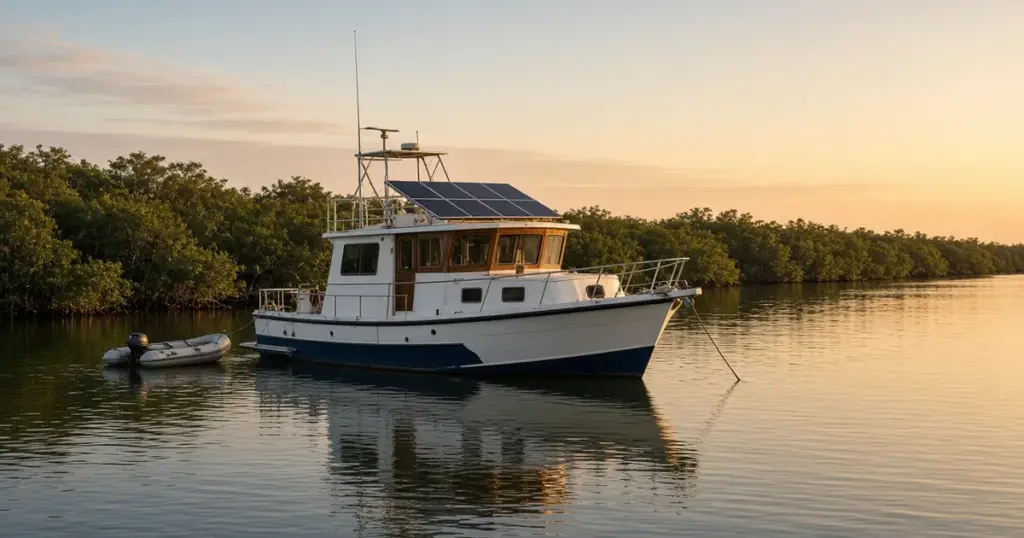
A weekend at anchor in a quiet cove is one of the best parts of boating, as long as the fridge stays cold, the anchor light stays on and the engine starts on Sunday afternoon. Planning boat power at anchor is straightforward once you know your loads and your charging options. This guide walks through a weekend energy plan step by step.
Step 1: Estimate the weekend’s loads
Start with a simple energy audit; our boat energy audit guide explains the method. For a typical weekend aboard a small cruiser or large center console, the main loads are:
| Load | Average draw | Hours per day | Ah per day |
|---|---|---|---|
| 12V fridge (average) | 2A | 24 | 48 |
| Anchor light (LED) | 0.3A | 10 | 3 |
| Cabin lights (LED) | 1A | 4 | 4 |
| Fans | 1A | 8 | 8 |
| Stereo | 2A | 4 | 8 |
| Phone and tablet charging | 1A | 3 | 3 |
| Water pump | 5A | 0.4 | 2 |
| VHF and plotter on standby | 1A | 6 | 6 |
| Total | 82Ah |
These are example figures. Use your own boat’s numbers, measured with a battery monitor if possible.
Over two nights and two days, that’s about 165Ah.
Step 2: Decide how you’ll recharge
- No charging: the bank must cover the whole weekend plus reserve.
- Engine charging: running the engine or moving between anchorages puts energy back. Short runs may replace only part of the daily use.
- Solar: a panel array tops up the bank during the day.
- Generator: if the boat has one, a few hours a day with a charger.
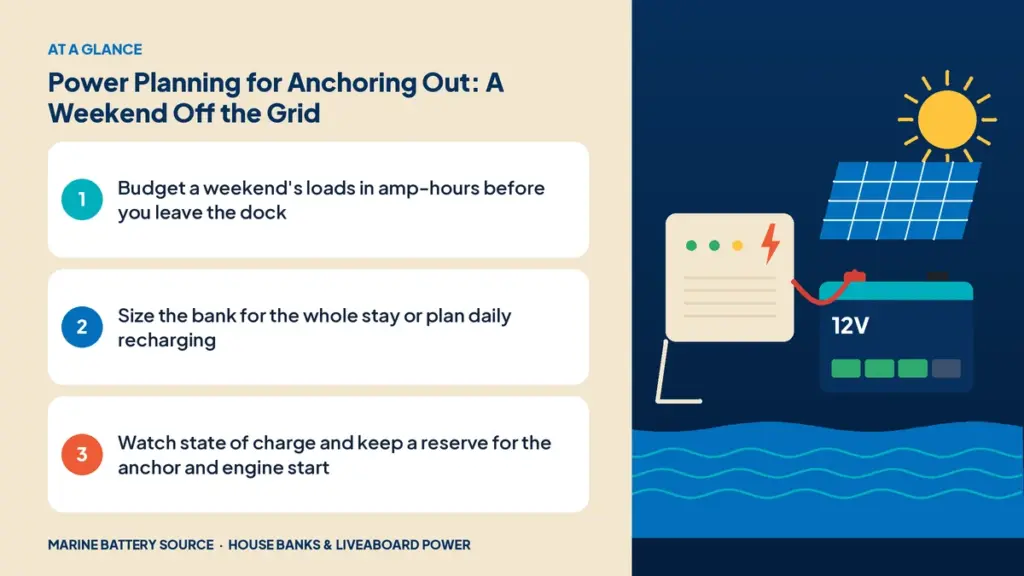
Step 3: Size the bank
If you don’t plan to recharge, a 165Ah weekend load means:
- Lithium (about 80% usable): around 200Ah rated, plus reserve, so roughly 250Ah.
- Lead-acid (about 50% usable): around 330Ah rated, plus reserve, so roughly 400Ah.
That’s a big lead-acid bank for a small boat, which is why lithium is so popular for weekend cruising. Options from the store include:
- EPOCH 12V 300Ah Essential: 3.84 kWh in a Group 31 size, 58 lb.
- EPOCH 12V 314Ah Eco: 4.02 kWh in a Group 31 size, 57 lb.
- Battle Born 270Ah 12V GC3: 80.8 lb.
If you’ll run the engine or have solar, you can size smaller. For more detail, see house bank sizing for overnight boating.
Step 4: Keep the starting battery separate
At anchor, the most important rule is to protect your ability to start the engine. Keep house loads on the house bank and the starting battery isolated. If your boat has only one battery, be very conservative; a jump pack is essential.
Step 5: Plan for the windlass
Retrieving the anchor with an electric windlass draws heavy current for a few minutes. Many owners run the engine while using the windlass so the alternator supports the load. See powering an anchor windlass for battery placement and wiring.
Step 6: Monitor as you go
A battery monitor or Bluetooth battery app lets you check state of charge morning and evening. If you’re using more than planned, cut non-essential loads or plan a charging run. Read battery monitors and shunts to set one up.
Solar at anchor
Solar is ideal for weekends at anchor. Panels produce most at midday, when fans and the fridge work hardest. Actual daily output depends on panel rating, orientation, shading from canvas and rigging, latitude, season and weather. A modest array can significantly reduce how much battery you need, especially for multi-day stays.
Engine charging at anchor
Idling the engine at anchor to charge batteries is generally inefficient and noisy, and some engines don’t like long idle periods. If you rely on the engine, plan to charge while moving between spots, or run at a fast idle only as the engine maker allows. For lithium house banks, a DC-DC charger protects the alternator and applies the correct profile.
Energy-saving tips at anchor
- Pre-cool the fridge and its contents on shore power before leaving.
- Use LED lighting everywhere, including the anchor light.
- Turn the inverter off when you’re not using it.
- Charge devices from 12V USB outlets instead of the inverter.
- Use fans rather than air conditioning where possible.
- Turn off the stereo amplifier when not in use; amplifiers can draw meaningful current even at low volume.
12V or 24V for bigger setups?
For weekend boats, 12V is almost always the practical choice. Larger cruisers with big inverter loads may benefit from 24V; see 12V vs 24V house banks.
A sample weekend plan
- Friday: leave the dock fully charged. Fridge pre-chilled.
- Friday evening: anchor. Bank at about 95%.
- Saturday morning: check the monitor. About 60% left after the first night if no solar.
- Saturday midday: move to a new anchorage, charging en route; solar adds more.
- Sunday morning: check again. Plan the windlass retrieval with the engine running.
- Sunday afternoon: return to the dock and recharge on shore power.
Pre-departure checklist
- House bank fully charged on shore power.
- Fridge and drinks pre-chilled.
- Starting battery tested and isolated from house loads.
- Battery switch positions confirmed and labeled.
- Jump pack charged and stowed where you can reach it.
- Anchor light and navigation lights tested.
- Spare fuses for the main circuits aboard.
When things go wrong
- Bank lower than expected: look for a forgotten load, such as an inverter left on.
- Fridge shuts off: check voltage at the fridge; undersized wiring can cause low-voltage cutoffs.
- Starting battery low: check whether the battery switch was left on Both.
For longer stays and liveaboard systems, see our pillar on sailboat and liveaboard battery systems. Browse house bank batteries in the store.
Frequently asked questions
How much battery do I need for a weekend at anchor?
Estimate your daily amp-hours, multiply by the days without charging, then divide by about 0.8 for lithium or about 0.5 for lead-acid, and add reserve.
Can I run my boat fridge all weekend on batteries?
Yes, with a bank sized for the fridge plus other loads, or with solar or engine charging to replace energy each day.
Should I idle my engine to charge batteries at anchor?
It’s generally inefficient. Charging while underway, solar, or a generator are better options. Follow your engine maker’s guidance on idling.
How do I make sure I can start the engine after a weekend at anchor?
Keep a separate starting battery isolated from house loads, check the battery switch, and carry a jump pack.