


6V Golf-Cart Batteries for a Boat House Bank: Pros and Cons
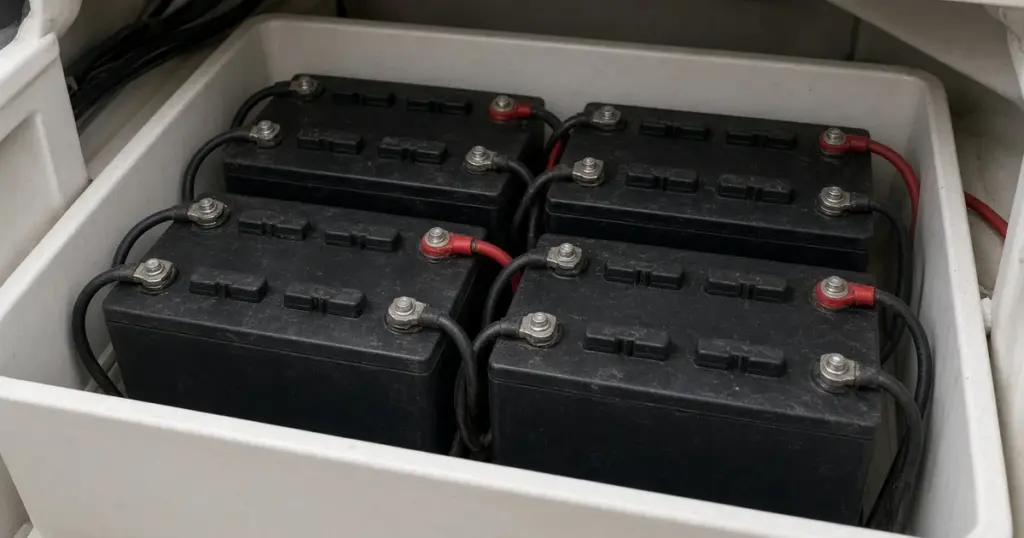
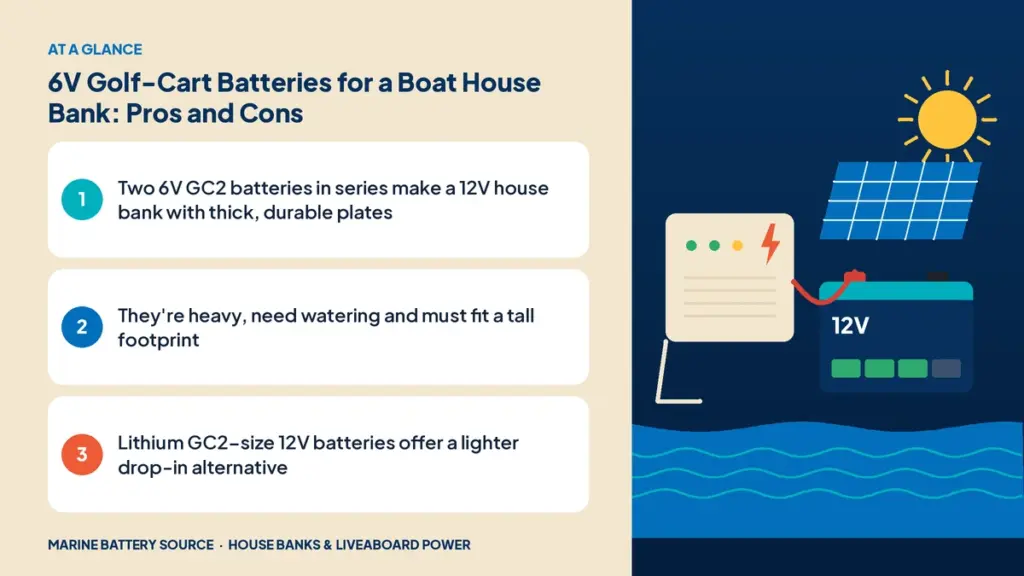
Ask experienced cruisers about house banks and many will mention golf-cart batteries. Pairs of 6V GC2 batteries wired in series have powered sailboats, trawlers and RVs for decades. They’re rugged, widely available and cost-effective. But they’re also heavy, tall and need maintenance. This guide explains the pros and cons of 6V batteries for a boat house bank and how they compare with modern lithium options.
What are GC2 batteries?
GC2 is a BCI group size originally associated with golf carts. GC2 batteries are typically 6V flooded deep-cycle batteries with a footprint of roughly 10.3 × 7.1 inches and a height around 11 inches. A taller variant, GC2H, adds capacity in the same footprint. They use thick plates designed for repeated deep cycling, which is exactly what a house bank needs.
How to make 12V from 6V batteries
Connect two 6V batteries in series: the positive of one to the negative of the other. The remaining free terminals give 12V. Capacity in amp-hours stays the same as one battery, but energy doubles.
To build a larger bank, add more series pairs in parallel: two pairs make a four-battery 12V bank, three pairs make six batteries, and so on. Keep every battery the same model and age.
For 24V, connect four 6V batteries in series. See 12V vs 24V house banks for when that makes sense.
Real examples from the store
| Battery | Type | Group | RC (min) | Energy (20-hr) | Weight |
|---|---|---|---|---|---|
| Trojan T-105 | Flooded 6V | GC2 | 447 | 1.50 kWh | 62 lb |
| Trojan T-125 | Flooded 6V | GC2 | 488 | 1.60 kWh | 66 lb |
| Trojan T-145 | Flooded 6V | GC2H | 530 | 1.72 kWh | 72 lb |
| Trojan T-605 | Flooded 6V | GC2 | 383 | 1.39 kWh | 58 lb |
| Trojan T105 AES | AGM 6V | GC2 | 529 | 1.48 kWh | 89 lb |
A pair of T-105s gives about 3.0 kWh at 12V at the 20-hour rate. Planning to use about half, that’s roughly 1.5 kWh of usable energy, or around 115Ah at 12.8V. Trojan’s model differences are covered in our brand comparison of the T-105, T-125 and T-145.
Why cruisers like 6V batteries
- Thick plates. Designed for deep cycling, which generally gives good cycle life for lead-acid.
- Cost-effective energy. Flooded GC2 batteries often offer a low cost per kWh up front.
- Availability. GC2 batteries are sold widely, which matters when cruising.
- Fewer, larger cells. A 6V battery has three cells; a pair has six, the same as one 12V battery but with more capacity per cell.
The downsides
- Weight. Each battery weighs roughly 60 to 70 lb or more. A four-battery bank can exceed 250 lb.
- Height. At around 11 to 12 inches tall, they may not fit under bunks or in shallow compartments.
- Watering. Flooded batteries need regular electrolyte checks and distilled water top-ups. Hard-to-reach batteries tend to get neglected.
- Ventilation. Flooded batteries vent hydrogen while charging and need ventilated compartments.
- Charging time. Lead-acid absorbs slowly near full charge, which matters when you’re charging with an engine or generator.
- Usable capacity. You get roughly half the rated energy if you want good cycle life.
- Single point of failure per pair. If one 6V battery fails, its pair stops working.
Charging 6V house banks
Charge the bank as a 12V (or 24V) bank using a charger with a flooded profile. Equalize periodically if the maker recommends it. Equalization can help balance cells in flooded batteries, but don’t equalize AGM batteries unless the maker allows it. Lithium charging is different entirely; see charging lithium batteries on a boat.
Monitoring a 6V bank
Because you need to stay above about half charge, accurate monitoring matters. A shunt-based monitor tracks amp-hours in and out; see battery monitors and shunts. With flooded batteries, a hydrometer reading of each cell’s specific gravity is also a reliable check.
The lithium alternative in a GC2 case
Several lithium makers build 12V batteries in a GC2-size case. The Battle Born 100Ah 12V GC2 is listed at 31 lb in a 10.31 × 7.28 × 11.02-inch case. Because it’s already 12V, each battery replaces a series pair of 6V batteries electrically, but it fits one GC2 footprint. In practice, owners often install two lithium batteries in the space of two 6V batteries, giving a 12V bank with 200Ah of lithium capacity.
Comparing a pair of T-105s with two 12V 100Ah GC2 lithium batteries:
| Two Trojan T-105 (series) | Two Battle Born 12V GC2 (parallel) | |
|---|---|---|
| System voltage | 12V | 12V |
| Rated energy | About 3.0 kWh (20-hr) | About 2.56 kWh |
| Planned usable | About 1.5 kWh (50%) | About 2.0 kWh (80%) |
| Weight | 124 lb | 62 lb |
| Watering | Yes | No |
Watering and maintenance routine
Flooded 6V batteries reward a simple routine:
- Check electrolyte levels monthly in season, more often in hot weather or with heavy cycling.
- Top up with distilled water only, after charging, to the level the battery maker specifies.
- Keep tops clean and dry, and terminals tight and protected.
- Equalize as the maker recommends.
- Check specific gravity with a hydrometer a few times a season to spot a weak cell early.
Single-point watering systems make the job easier on banks of four or more batteries, especially in tight compartments.
Who should choose 6V flooded?
- Budget-conscious owners who can reach the batteries easily for watering.
- Boats with tall compartments and weight capacity to spare.
- Cruisers who value easy replacement in remote places.
Who should consider lithium instead?
- Boats where weight matters.
- Owners who want more usable energy and faster charging.
- Batteries in hard-to-reach places.
High-current loads on a 6V bank
Inverters, windlasses and thrusters draw heavy current. Lead-acid voltage sags under heavy loads, which can trigger inverter low-voltage alarms. Parallel pairs spread the load. Read inverter sizing and running A/C on batteries for high-load considerations.
For more on house banks, read house bank sizing for overnight boating and our pillar on sailboat and liveaboard battery systems. Browse Trojan batteries in the store.
Frequently asked questions
Are 6V golf-cart batteries good for a boat?
Yes, for house banks. Their thick plates handle deep cycling well. They are heavy, tall and need watering and ventilation.
How do I wire 6V batteries for 12V?
Connect two 6V batteries in series, positive of one to negative of the other. The free terminals give 12V.
Can I mix 6V batteries of different ages?
It’s not recommended. Batteries in a bank should be the same model and age so they charge and discharge evenly.
Is lithium better than 6V golf-cart batteries?
Lithium offers more usable energy, much less weight and no watering, at a higher up-front cost. Flooded 6V batteries remain a cost-effective choice where weight and maintenance aren’t concerns.