


Sealed vs Vented Batteries in Saltwater Use
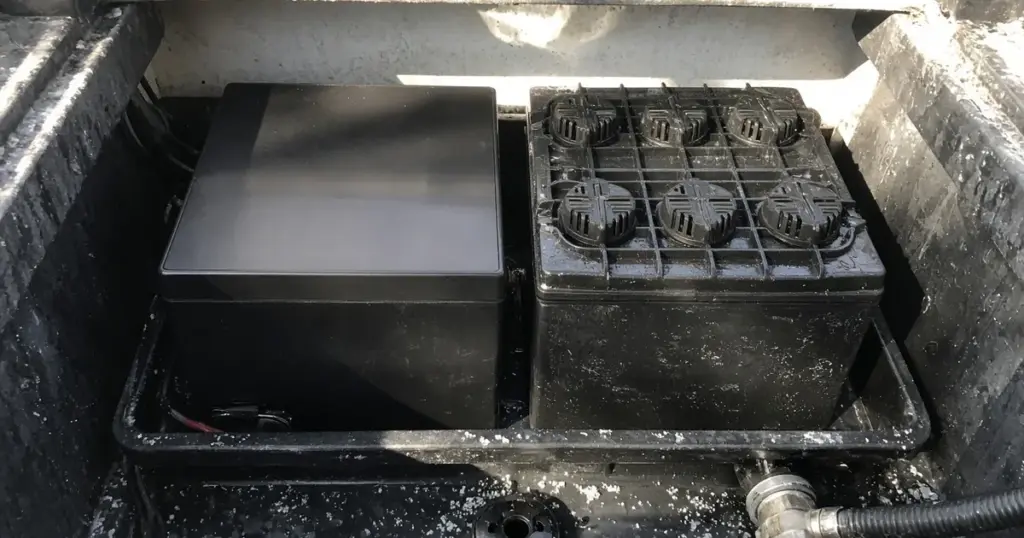
On a saltwater boat, the battery you choose affects more than run time. It affects how quickly your terminals corrode, whether acid can spill into the bilge, how much ventilation the compartment needs and how often you have to open the hatch for maintenance. The main divide is between vented batteries, which means traditional flooded lead-acid, and sealed batteries, which means AGM, gel and lithium. Here’s how they compare in salt air.
What “vented” and “sealed” mean
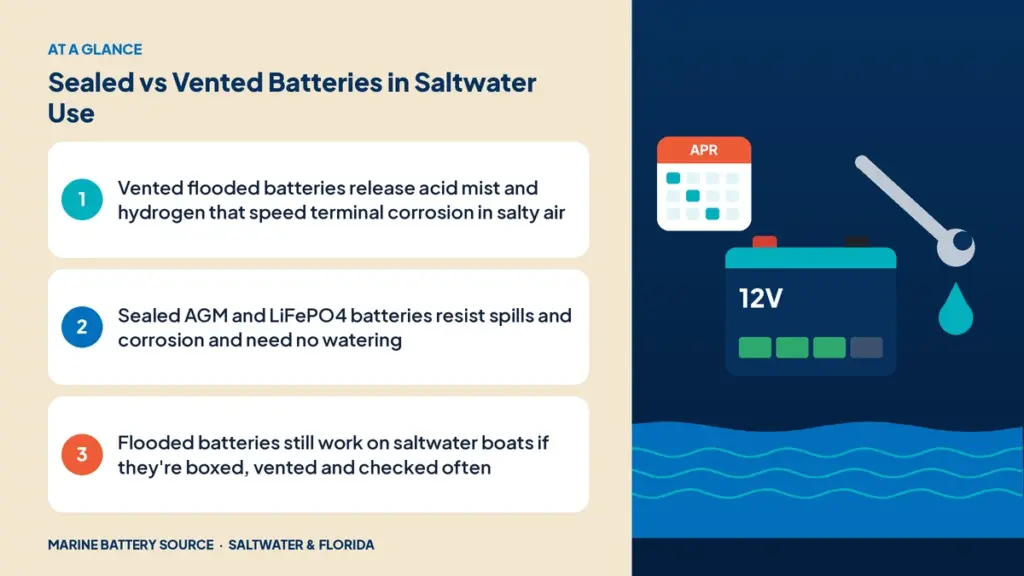
- Vented (flooded) batteries have removable caps or vent ports. As they charge, they release hydrogen and oxygen, along with a fine acid mist. Water is lost over time and must be replaced.
- Sealed lead-acid (AGM and gel) batteries are valve-regulated. Under normal charging, gases recombine inside. A pressure valve releases gas only if the battery is overcharged or overheated.
- Lithium (LiFePO4) batteries are fully sealed and don’t produce gas in normal operation.
Why it matters in salt water
Salt air already carries moisture and chloride to every metal surface. Add acid mist from a vented battery, and terminals, lugs, hold-down hardware and nearby wiring corrode faster. The white and green crust you see on flooded battery terminals is a combination of acid reaction products and salt. Sealed batteries remove most of that acid source, so the corrosion that remains is mostly from the environment.
For the full corrosion picture, see saltwater corrosion prevention for marine batteries.
Flooded batteries on saltwater boats
Pros
- Lowest upfront cost
- Tolerant of a wide range of chargers
- Easy to check state of charge with a hydrometer
Cons
- Acid mist speeds corrosion
- Electrolyte can spill in rough water or if the boat heels
- Need regular watering, which means opening the compartment in spray conditions
- Hydrogen gas requires real ventilation
- More sensitive to vibration
If you use flooded batteries: put them in a covered acid-resistant box with a strap, vent the compartment, check water levels monthly in hot weather, and clean terminals often. Never let salt water enter a cell when topping up; use distilled water only.
AGM batteries on saltwater boats
Pros
- Spill-proof and mountable in more orientations (check the manufacturer)
- Very vibration resistant
- Low gassing, so less corrosion and less ventilation demand
- No watering
- Strong cranking for engine starting
Cons
- More expensive than flooded
- Sensitive to overcharging; needs a charger with an AGM profile
- Still heavy
- Usable capacity is limited if you want long life
AGM batteries are a common choice for start and dual-purpose duty on center consoles and bay boats. The Interstate 31M AGM and Trojan 31-AES AGM deep cycle are examples for saltwater rigs.
Lithium batteries on saltwater boats
Pros
- No gassing in normal use
- Light weight
- Most of rated capacity usable
- Long cycle life
- No maintenance
Cons
- Highest upfront cost
- Requires a lithium-compatible charging setup
- BMS limits charging in high or low temperatures
Lithium has become the default for trolling motor and house banks on many saltwater boats. See lithium batteries on saltwater boats for details.
Side-by-side
| Factor | Flooded | AGM | LiFePO4 |
|---|---|---|---|
| Gas and acid mist | Yes | Minimal | None in normal use |
| Spill risk | Yes | No | No |
| Watering | Monthly checks | None | None |
| Ventilation need | High | Low | Low (for heat) |
| Terminal corrosion | Fastest | Slower | Slowest |
| Vibration tolerance | Lower | High | High |
| Weight | Heavy | Heavy | Light |
| Upfront cost | Low | Medium | High |
Ventilation still matters for sealed batteries
Sealed batteries can vent if they’re overcharged or overheat, and every battery compartment benefits from airflow that keeps temperatures down and moisture out. In hot climates, a sealed battery in an unventilated console can still cook. Read Florida heat and marine battery life for heat strategies.
Hardware matters no matter what you choose
Even a sealed battery will have corroded terminals if the hardware is wrong. Use tinned lugs, stainless or coated hold-downs, and protect connections after tightening. Our guides on corrosion-resistant battery hardware and dielectric grease on battery terminals cover the details.
Charging differences
- Flooded: standard flooded profile, sometimes with periodic equalization.
- AGM: AGM profile with lower absorption voltage; avoid equalizing unless the manufacturer allows it.
- Lithium: LiFePO4 profile, no equalization, no high float.
A charger set to the wrong profile is a common cause of short battery life. On mixed boats, a multi-bank charger with independent profile settings per bank solves this. The EPOCH 4-bank marine charger is one multi-bank option to compare.
Which should you choose?
- Tight budget, easy-access compartment, frequent checks: flooded can work.
- Engine starting and dual-purpose on a saltwater boat: AGM is a reliable, proven choice.
- Trolling motor and house banks, weight-sensitive boats, low maintenance: LiFePO4.
- Offshore boats: sealed batteries throughout. See offshore boat battery reliability.
Switching from flooded to sealed
- Confirm the new battery’s dimensions and terminal type fit the tray and cables.
- Change the charger profile (or the charger) to match.
- Clean the compartment and neutralize any acid residue with baking soda solution.
- Replace corroded lugs and cables while you have access.
- Secure the new battery with a proper hold-down.
Example
A bay boat owner in a salty marina replaces two group 27 flooded batteries every two to three years and cleans terminals monthly. Switching the start battery to AGM and the trolling bank to lithium, with a matched charger, eliminates watering, cuts corrosion and lowers the weight in the stern. The terminals still get a monthly look, but cleaning becomes rare.
Shop AGM and lead-acid marine batteries or lithium marine batteries.
Frequently asked questions
Are sealed batteries better for saltwater boats?
Generally yes. They don’t spill, need no watering and produce little or no acid mist, so terminals corrode more slowly.
Can I use a flooded battery on a saltwater boat?
Yes, with a covered box, good ventilation, regular watering with distilled water and frequent terminal cleaning.
Do sealed batteries need ventilation?
Less than flooded batteries, but compartments still need airflow to control heat and moisture, and sealed lead-acid can vent if overcharged.
Is AGM or lithium better in salt water?
Both are sealed and resist corrosion. AGM costs less and cranks well; lithium is lighter and offers more usable capacity and cycle life.
Why do my flooded battery terminals corrode so fast?
Acid mist released during charging combines with salt air to attack the terminals. Sealed batteries and good hardware slow this down.