


Choosing Corrosion-Resistant Battery Hardware
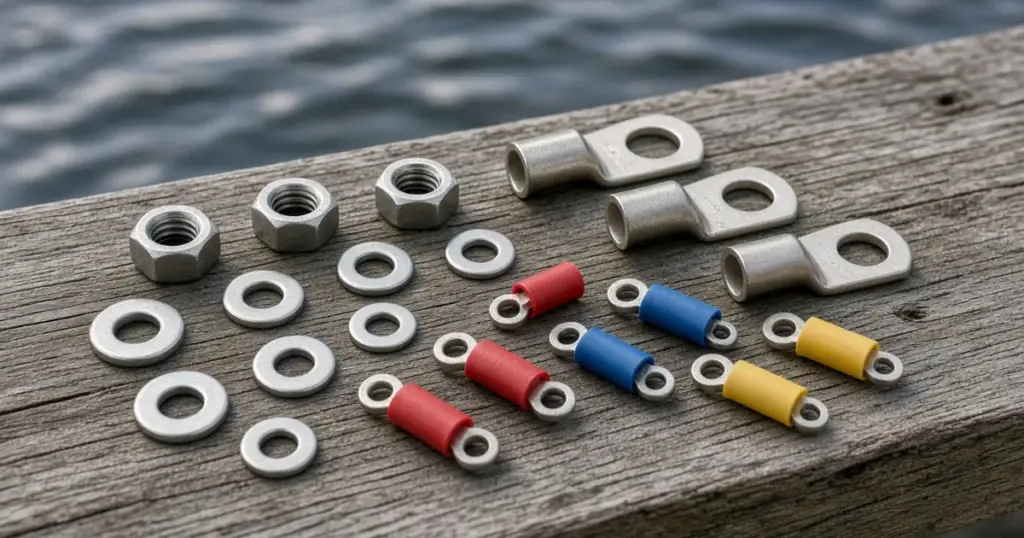
The battery itself is rarely the first thing to fail on a saltwater boat. More often it’s the hardware around it: corroded lugs, rusted hold-down bolts, crumbling cable ends and wing nuts welded on by salt. Those failures add resistance, cause slow cranking and voltage drop, and can even start fires when a corroded connection heats up. Choosing corrosion-resistant hardware from the start, and protecting it properly, keeps the whole system healthy.
Cable: tinned copper is the standard
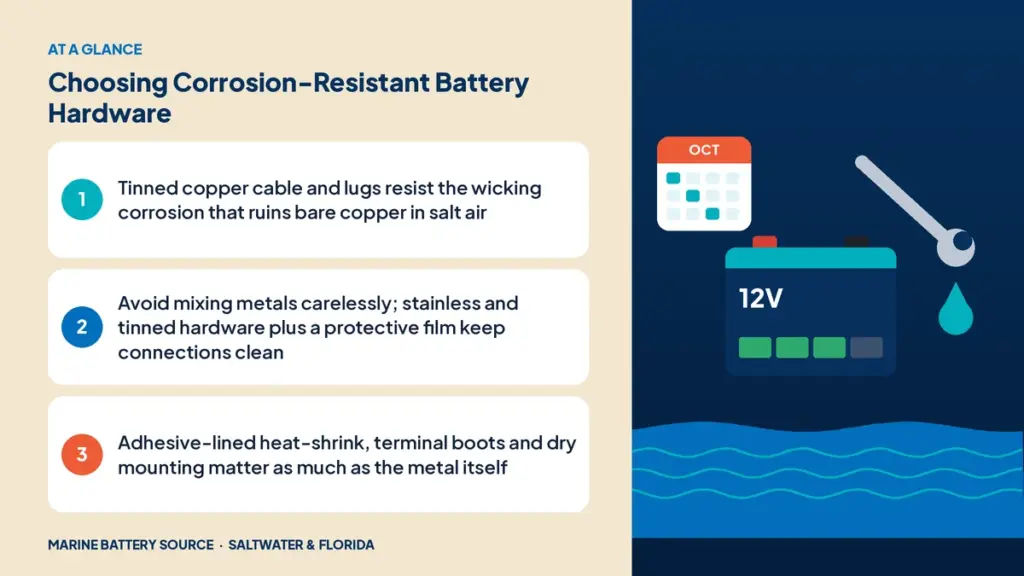
Marine battery cable should be tinned copper: each fine strand is coated with tin before the cable is made. Bare copper corrodes and turns black inside the insulation, and the corrosion spreads along the strands far from the visible end. Tinned strands resist this wicking, so the cable stays conductive for years.
- Use fine-stranded marine cable, which flexes and resists vibration fatigue.
- Size it for the current and run length. Undersized cable heats up and drops voltage.
- Use insulation rated for marine and engine-room environments.
Lugs and terminals
- Tinned copper lugs match tinned cable and resist corrosion.
- Heavy-wall lugs crimp more securely than thin stamped terminals.
- Crimp with the right tool, a hammer crimper or hydraulic crimper sized for the cable. A poor crimp lets moisture in and creates resistance.
- Seal with adhesive-lined heat-shrink over the crimp and onto the insulation.
Avoid relying on solder alone in a battery cable. Solder wicks into strands and creates a stiff point that can fatigue under vibration. A good crimp, sealed with adhesive heat-shrink, is the marine standard.
Battery posts and connection hardware
- Lead posts on lead-acid batteries corrode readily. Clean and protect them.
- Threaded stud terminals with stainless or tinned nuts and washers make reliable connections.
- Wing nuts are convenient but easy to under-tighten. Use hex nuts with a lock washer, torqued to the battery manufacturer’s spec.
- Lithium batteries often use threaded insert terminals. Use the bolts supplied or ones matching the specified length so you don’t bottom out or damage the insert.
Fasteners and hold-downs
- 316 stainless steel fasteners resist salt better than 304 stainless, and much better than plated steel.
- Plated steel hardware rusts quickly in salt air and stains everything around it.
- Plastic or coated hold-down brackets avoid rust entirely.
- Straps should be made of corrosion-resistant materials with stainless buckles.
Galvanic corrosion at connections
When different metals touch in the presence of moisture, the less noble metal corrodes. In a battery connection, you may have lead posts, tinned copper lugs, stainless or brass hardware and copper busbars.
- Keep the connection dry and protected, which removes the electrolyte.
- Use matched materials where possible, such as tinned lugs on tinned busbars.
- Don’t place stainless washers between the lug and the post; the current path should be lug-to-post, with the washer under the nut.
Galvanic and stray current corrosion also affect underwater metals. See stray current and galvanic corrosion for that side of the problem.
Protective coatings
After a connection is assembled and tight:
- Apply a thin film of dielectric grease or a marine terminal protector spray over the outside of the connection.
- Don’t put a thick layer of grease between the lug and the post; the metal-to-metal contact should be clean. See dielectric grease on battery terminals.
- Cover with terminal boots to keep spray and dropped tools off the positive post.
Fuse blocks and busbars
Every connection is a corrosion point, so fewer, better connections are best.
- Use a busbar or distribution block instead of stacking many lugs on one post.
- Mount fuse blocks and busbars in a dry, ventilated location, not in the bilge.
- Choose blocks with tinned or plated contacts and protective covers.
The Battle Born MRBF fuse block protects multiple cables right at the battery, and the EPOCH heavy-duty power distribution block consolidates positive or negative connections.
Fuses
A corroded fuse holder adds resistance and can overheat. Use marine-rated fuses and holders designed for the environment. For high-current battery protection, a marine-rated 300A battery fuse is a good example of hardware built for this use.
Connectors for trolling motors and accessories
Trolling motor plugs and receptacles live in the bow, in spray and rain.
- Use marine-rated plugs with caps.
- Inspect the pins for green corrosion.
- Protect the pins with a thin film of dielectric grease.
- A purpose-made kit, like the Dakota Lithium 12V trolling motor connection kit, saves piecing together the connection from loose parts.
Batteries that reduce corrosion
Vented flooded batteries release acid mist that speeds terminal corrosion. Sealed AGM and lithium batteries remove that source. See sealed vs vented batteries for saltwater and lithium batteries on saltwater boats.
Hot, humid environments
Heat accelerates every chemical reaction, including corrosion. In Florida and the Gulf, hardware choices matter even more. See Florida heat and marine battery life.
Upgrade checklist
- ☐ Replace bare copper cables with tinned copper
- ☐ Replace thin stamped terminals with heavy-wall tinned lugs
- ☐ Seal every crimp with adhesive-lined heat-shrink
- ☐ Swap plated steel fasteners for 316 stainless
- ☐ Replace rusted hold-downs with coated or plastic brackets
- ☐ Consolidate stacked lugs onto a busbar or fuse block
- ☐ Protect finished connections and add terminal boots
Inspecting hardware
Check monthly on saltwater boats: look for crust, discoloration, swollen insulation and loose connections. Clean and re-protect as needed. The saltwater corrosion prevention guide and the marine battery maintenance guide cover the full routine.
Find fuses, blocks and trays in our marine battery accessories.
Frequently asked questions
What is the best battery cable for saltwater?
Fine-stranded tinned copper marine cable sized for the current and run length.
Should I use stainless steel nuts on battery terminals?
Stainless nuts and washers are fine as long as the lug sits directly on the post and the connection is kept dry and protected.
Is solder better than crimping for battery cables?
A proper crimp sealed with adhesive heat-shrink is the marine standard. Solder alone can create a stiff point that fatigues.
How do I stop battery hold-downs from rusting?
Use 316 stainless, coated or plastic hold-downs instead of plated steel.
Does dielectric grease go between the lug and the post?
No. Make a clean, tight metal-to-metal connection first, then coat the outside of the connection.