


Are Lithium Batteries Good for Saltwater Boats?
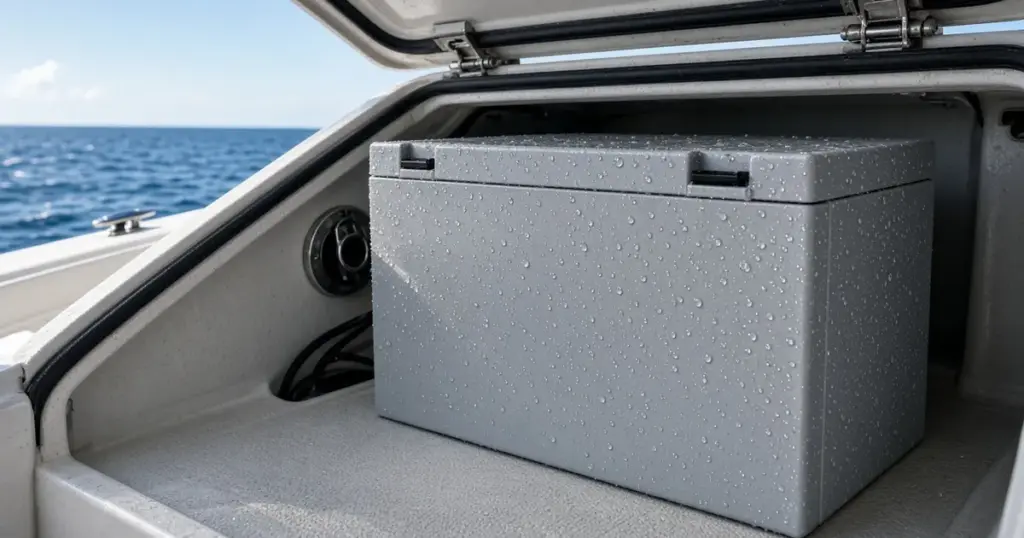
Lithium iron phosphate (LiFePO4) batteries have become a common choice on saltwater boats, from flats skiffs to offshore center consoles. They’re lighter than lead-acid, deliver steady voltage, and handle deep discharges that would ruin an AGM. But salt water is hard on everything, and some boaters wonder whether a battery with electronics inside can survive it. This guide explains what LiFePO4 does well in a saltwater environment, where it still needs protection and how to install it to last.
Why lithium suits saltwater boats
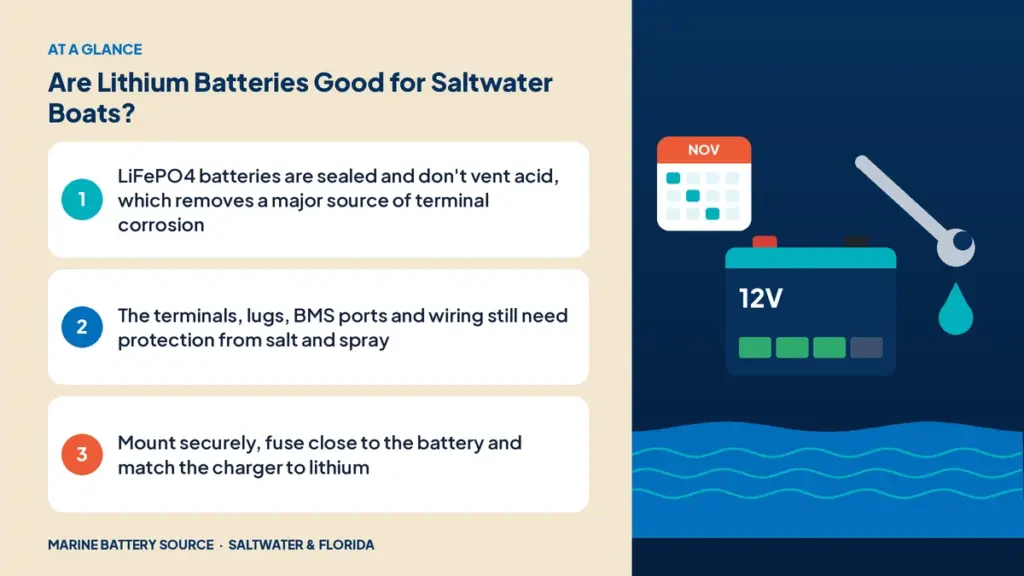
- Sealed construction. LiFePO4 batteries don’t vent acid or hydrogen in normal operation. On a flooded lead-acid battery, acid vapor is a big driver of terminal corrosion. Removing it makes a real difference.
- No maintenance. No water to add and no equalizing.
- Weight savings. A lithium battery typically weighs about half as much as a lead-acid battery of similar usable capacity, which matters on small boats and on bow-mounted trolling motor setups.
- Usable capacity. You can use most of the rated capacity without the life penalty lead-acid pays for deep discharge.
- Steady voltage. Trolling motors and electronics see consistent voltage until the battery is nearly empty.
- Partial-state-of-charge tolerance. Lithium doesn’t sulfate when it sits partly charged, which helps boats that get used hard and then sit.
Where lithium still needs protection
Sealed doesn’t mean salt-proof. Watch these areas:
- Terminals and lugs. Salt spray and humidity still corrode exposed metal. Brass, copper and steel hardware all need protection.
- Cable ends. Corrosion wicks up into the strands under the insulation. Tinned cable and sealed lugs help.
- Communication or Bluetooth ports. Some batteries have connectors for monitoring. Keep caps on and keep them dry.
- The case seams. Most cases are well sealed, but they’re not designed to be submerged. Keep batteries above bilge water.
For a step-by-step protection routine, see saltwater corrosion prevention for marine batteries, and choose hardware from corrosion-resistant battery hardware.
How the BMS handles saltwater conditions
Every LiFePO4 battery has a battery management system (BMS) that monitors cell voltages, current and temperature. It disconnects the battery to protect it from over-discharge, overcharge, short circuits and, on many models, charging when it’s too cold or too hot. In saltwater boating, the temperature limits matter most. Battery compartments in a console under the summer sun can get hot, and a BMS may stop charging until the battery cools. That’s normal protection, not a failure. Read Florida heat and marine battery life for heat management ideas.
Mounting lithium on a saltwater boat
- Secure it. Lithium batteries are light, which means a weak hold-down lets them bounce more. Use a tray and strap, or a bracket. The EPOCH battery tray for 12V 105Ah models fits that battery’s footprint.
- Keep it high and dry. Mount above the normal bilge water line, away from washdown spray. See boat washdown battery safety.
- Ventilation. Lithium doesn’t gas like flooded batteries, but airflow still keeps temperatures down and helps compartments dry.
- Orientation. Check the manufacturer’s guidance. Many LiFePO4 batteries can mount in several orientations, but confirm before you install one on its side.
Wiring for saltwater
- Tinned copper cable sized for the current, with crimped and heat-shrink sealed lugs.
- Fuse close to the battery. Lithium can deliver very high short-circuit current, so a properly rated fuse near the positive terminal is essential. Class T or marine-rated terminal fuses are common choices.
- Torque terminals to the manufacturer’s spec. Loose connections heat up quickly under high current.
- Protect connections with terminal boots and a thin film of dielectric grease or corrosion inhibitor after tightening.
Charging lithium on a saltwater boat
Lithium needs a charger with a lithium profile. Using a lead-acid charger with an equalization or high float stage isn’t appropriate for LiFePO4.
- Onboard charger: pick one with a LiFePO4 setting. The EPOCH 12V/36V onboard marine lithium charger is built for trolling motor and house setups.
- Alternator charging: a DC-DC charger limits current and applies a lithium profile, protecting both the alternator and the battery.
- Mixed systems: many saltwater boats keep a lead-acid or AGM start battery and add a lithium house or trolling bank. That works well with a DC-DC charger between them.
Lithium vs AGM for saltwater
| Factor | LiFePO4 | AGM |
|---|---|---|
| Acid venting | None in normal use | Minimal, sealed |
| Weight | Light | Heavy |
| Usable capacity | Most of rated | About half for long life |
| Cycle life | Long | Moderate |
| Upfront cost | Higher | Lower |
| Cold cranking | Depends on model | Strong |
| Charger needs | Lithium profile | Standard AGM profile |
AGM is still a solid choice, especially for engine starting. For more, see sealed vs vented batteries for saltwater.
Offshore considerations
Offshore boats see more pounding, longer engine-off periods and bigger loads. Lithium house banks handle the loads well, but the installation must be solid and the start battery should stay isolated. Read offshore boat battery reliability for system design.
Good saltwater lithium options
- EPOCH 12V 105Ah Essential LiFePO4 for house or 12V trolling setups
- Dakota Lithium 12V 135Ah heated dual-purpose if the boat also travels north in winter
- EPOCH 36V 50Ah for bow-mount trolling motors on flats and bay boats
Browse all lithium marine batteries.
Maintenance routine
- Monthly: check terminal torque, look for corrosion, clean if needed.
- After washdowns: confirm the compartment stayed dry.
- Seasonally: check the BMS app or monitor if your battery has one, and confirm the charger profile.
- Storage: store at partial charge per the manufacturer’s guidance, disconnected or with loads off.
The marine battery maintenance guide covers the full routine for every battery type.
Frequently asked questions
Can lithium batteries get wet?
Splashes on the case aren’t a problem, but they aren’t meant to be submerged, and wet terminals will corrode. Keep them high, dry and covered.
Do lithium batteries corrode less than lead-acid?
Yes, at the terminals, because they don’t vent acid. The rest of the hardware and wiring still faces salt and humidity.
Is lithium safe on a saltwater boat?
LiFePO4 is among the most stable lithium chemistries. Install with proper fusing, secure mounting and a compatible charger.
Will heat damage my lithium battery?
High heat shortens any battery’s life. The BMS will stop charging if it gets too hot, which is protection rather than damage.
Can I mix lithium and AGM on the same boat?
Yes, on separate banks. A common setup is an AGM start battery and a lithium house or trolling bank charged through a DC-DC charger.