


Battery Reliability for Offshore Fishing Trips
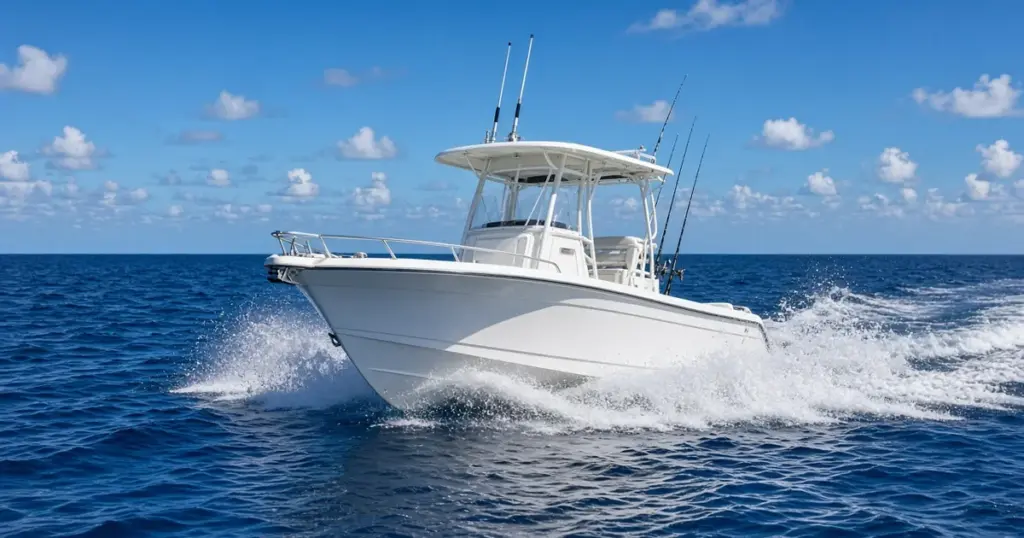
Thirty miles out, a dead battery isn’t an inconvenience. It can mean no engines, no VHF, no bilge pumps and no navigation. Offshore boats face everything that makes batteries fail: heavy pounding, salt spray, heat, long days of electronics and livewell use, and engines that may not charge as much as you assume at trolling speeds. The good news is that reliable offshore power isn’t complicated. It comes down to a sound system design, good installation and a few habits before every run.
What makes offshore different
- Vibration and impact. Running in a chop slams batteries into their trays thousands of times per trip. Loose hold-downs, cracked cases and broken internal connections follow.
- Salt. Spray reaches places it never gets on inland lakes, and salt crust on terminals adds resistance. See saltwater corrosion prevention for marine batteries.
- Heavy loads. Multiple displays, radar, livewells, pumps, lights, stereos and sometimes refrigeration all draw from the house side.
- Long engine-off periods. Drifting or anchored over a wreck, the engines are off but the electronics and livewells keep running.
- No backup nearby. There’s no one to give you a jump.
Design principle 1: protect the start battery
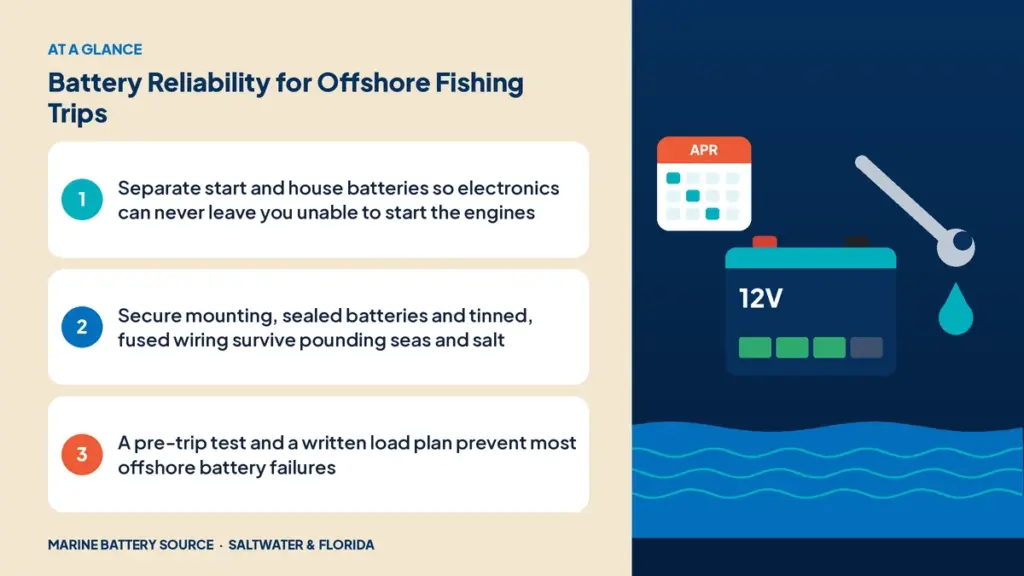
The single most important rule offshore is that nothing should be able to drain the battery you need to start the engines.
- Dedicate a start battery to each engine on twins, or at least one start battery that the house loads can’t touch.
- Use a separate house bank for electronics, livewells, pumps and lights.
- Charge both sides automatically with a charging relay, isolator or DC-DC charger, so the house bank can’t pull the start battery down.
- Keep an emergency parallel switch so you can combine banks to start if a start battery fails.
A strong cranking battery like the Interstate 27M-XHD starting battery handles big outboards, while the house side can be AGM or lithium depending on your loads and budget.
Design principle 2: build in redundancy
- Two ways to start. Twin engines with independent start batteries and a parallel switch, or a single engine with a start battery and the ability to combine with the house bank.
- Bilge pumps wired to stay on. The automatic float switch circuit for the bilge pump should be wired so it works even when the main switch is off, with its own fuse.
- A handheld VHF and GPS with charged batteries, so a total electrical failure doesn’t leave you without communication.
- Spare fuses of every size on the boat, in a dry bag.
Choosing batteries for offshore use
Sealed batteries are the standard for offshore boats. They don’t spill when the boat heels or pounds, they don’t need water added, and they don’t vent acid onto nearby wiring.
- AGM batteries are rugged, vibration resistant and widely available. A dual-purpose unit like the Interstate 31M AGM dual-purpose is common on center consoles.
- Lithium (LiFePO4) is popular for house banks because it’s lighter, holds voltage under load and tolerates deep discharge. Learn more in lithium batteries on saltwater boats.
- Flooded batteries are the cheapest but the least suited to offshore pounding and heeling. See sealed vs vented batteries for saltwater for the full comparison.
Installation that survives the ride
- Hold-downs that actually hold. Straps or brackets should keep the battery from moving at all. If you can rock it by hand, it will move in a head sea.
- Trays and boxes contain any spill and protect against chafe.
- Tinned copper cable with properly crimped, sealed lugs. See boat wiring corrosion inspection for what failing wiring looks like.
- Fuses close to the battery on every positive cable except the starter circuit where the standards allow. A marine-rated 300A battery fuse protects large house cables.
- Support cables so they don’t hang from the terminals and work loose.
- Dry, ventilated compartments high enough to stay above bilge water.
Charging offshore
Outboard alternators on many boats put out modest current, and less at low RPM. If you troll or idle for hours, the alternator may not keep up with the electronics. To get a picture:
- Add up the house loads in amps.
- Check your engine’s charging output at the RPM you actually run.
- Compare, and assume you’ll be running down the house bank during long drifts.
For lithium house banks, a DC-DC charger protects the alternator and charges properly from the engine. Back at the dock, an onboard charger brings everything back to full overnight.
Load planning
Write down what runs on the house bank and how long it runs. A typical offshore day might include:
| Load | Typical draw | Hours | Amp-hours |
|---|---|---|---|
| Two multifunction displays | 4A | 8 | 32 |
| Radar | 3A | 4 | 12 |
| Livewell pump | 4A | 6 | 24 |
| VHF and stereo | 2A | 8 | 16 |
| Lights and misc. | 2A | 3 | 6 |
| Total | 90Ah |
These are example figures; check your own equipment. A 90Ah day on a lead-acid house bank means you need roughly 180Ah of rated capacity to stay above 50% discharge. A 100Ah lithium battery would handle it with a little margin, and a larger one gives more cushion for drifting.
Pre-trip checklist
- ☐ Resting voltage on each battery after a full charge (see your battery’s chart)
- ☐ Terminals tight and clean
- ☐ Hold-downs tight, no movement
- ☐ Bilge pumps tested on automatic and manual
- ☐ Battery switch positions correct, parallel switch off
- ☐ Charger showed full charge before you unplugged
- ☐ Spare fuses and a basic tool kit aboard
- ☐ Handheld VHF charged
After every trip
- Rinse the boat with fresh water, keeping it out of battery compartments. Our boat washdown battery safety guide covers how.
- Plug in and charge fully.
- Note anything odd: slow cranking, dimming electronics, alarms.
Heat
Offshore boats in the South spend long days in full sun, and battery compartments in consoles can get very hot. Heat shortens lead-acid life and can trigger lithium charge limits. See Florida heat and marine battery life for ways to manage it.
Warning signs before a failure
- Slower cranking than normal
- Electronics resetting when the engine starts
- House voltage dropping faster than it used to
- Battery cases bulging or hot
- Corrosion reappearing quickly
Don’t head offshore with any of these unresolved. Test and replace weak batteries at the dock, not at the canyon. Shop our dual-purpose marine batteries for common center-console setups.
Frequently asked questions
What’s the best battery setup for an offshore boat?
A dedicated start battery for each engine, a separate house bank for electronics and pumps, automatic charging for both, and a parallel switch for emergencies.
Are lithium batteries good for offshore boats?
Yes, especially for house banks. They’re light, hold voltage under heavy loads and tolerate deep discharge. Use a charging system matched to lithium.
How do I keep batteries from moving offshore?
Use proper trays and straps or brackets that hold the battery completely still. If you can rock it by hand, it needs tightening.
Can my outboard keep my batteries charged while trolling?
Often not fully. Alternator output drops at low RPM, so plan for the house bank to run down during long drifts and trolling.
Should I carry a jump pack offshore?
It’s a reasonable backup, but a properly isolated start battery and a parallel switch are the primary safeguards.