


Lightning, Storms and Your Boat’s Electrical System

Florida has some of the highest lightning activity in the United States, and summer afternoon thunderstorms are a routine part of boating here. Most boats never take a direct strike, but strikes and near misses do happen, and both can damage batteries, chargers and electronics. This guide covers how lightning affects a boat’s electrical system, what to do as a storm approaches and how to inspect everything afterward. Your safety comes first: lightning on the water is dangerous, and the best move is always to get off the water before a storm arrives.
How lightning damages boat electrical systems
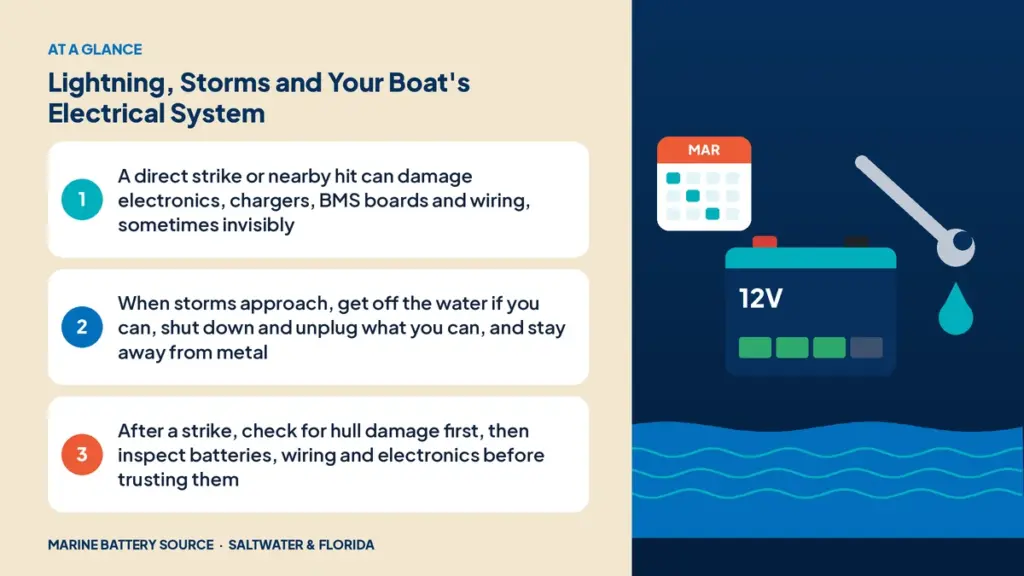
- Direct strikes send enormous current through the boat looking for a path to the water. That path may run through the mast, the T-top, antennas, wiring, engines or through-hull fittings. Damage can include burned wiring, destroyed electronics, holes in the hull and fire.
- Nearby strikes induce surges in wiring. Even without a direct hit, electronics, chargers, battery management systems and engine computers can be damaged.
- Shore power surges travel down the dock wiring into the boat’s AC system and charger when lightning hits the marina or nearby power lines.
Batteries themselves are usually sturdy, but lithium batteries have electronic BMS boards, and chargers, inverters and monitors are all vulnerable.
Before the storm: on the water
- Watch the sky and the radar. Florida’s summer storms often build in the afternoon. Plan trips to be back early.
- Head in early. If you hear thunder, lightning is close enough to strike.
- If you can’t reach shore, stay low in the boat, away from metal fittings, the T-top, rails and antennas. Stay in the cabin if you have one.
- Lower antennas and outriggers if you can do so safely.
- Turn off non-essential electronics. Keep the VHF on only if needed for safety.
- Avoid touching two metal parts at once, and stay out of the water.
Before the storm: at the dock
- Unplug shore power at the pedestal if a strong storm is expected and you can do so safely before it arrives. Never handle shore power during a storm.
- Turn off the main battery switch, leaving only bilge pump circuits live.
- Disconnect sensitive electronics where practical.
- Close hatches to keep heavy rain out of battery compartments.
Lightning protection systems
A lightning protection system gives current a direct path to the water through heavy conductors and a grounding plate, reducing the chance it jumps through people, wiring or the hull. These systems are designed and installed to industry guidance, such as ABYC recommendations, and are most common on sailboats and larger powerboats. They reduce risk but don’t guarantee that electronics survive. Talk to a qualified marine electrician if you want one.
After a strike or near miss: safety first
- Check people first. Anyone struck needs immediate medical help.
- Check for fire or smoke. Use an extinguisher if needed and call for help.
- Check the hull for leaks. Lightning can exit through through-hull fittings or blow small holes below the waterline. Check the bilge, and watch for bilge pumps running more than usual.
- Check steering and engines before relying on them.
Inspecting the electrical system
Once the boat is safe:
- Turn off the main switch and disconnect shore power.
- Smell and look. Burned insulation smells distinctive. Look for melted wiring, scorched terminals and blackened fuse holders.
- Inspect batteries for swelling, cracks, heat or leaks. Any of these means replacement. See battery compartment heat for what normal temperatures look like.
- Check terminals and cables for pitting or burn marks.
- Check fuses and breakers. Blown fuses point to circuits that took a surge.
- Test electronics one at a time. Bring up displays, VHF, GPS, autopilot and radar individually.
- Check the charger. Look for fault codes and confirm it charges normally.
- Check lithium battery BMS status if your battery has an app or display. A BMS that won’t reset needs manufacturer support.
- Check the compass. Lightning can change a compass’s deviation.
Hidden damage
Lightning damage isn’t always obvious. Electronics may work for days or weeks and then fail. Wiring insulation may be weakened inside a bundle. For any direct strike, have the boat inspected by a qualified marine electrician and, if needed, a surveyor. Document everything for insurance with photos and notes.
Batteries after a strike
- Lead-acid: usually survive, but test them with a load test. A battery that heated or swelled should be replaced.
- AGM: same as lead-acid; look for case bulging.
- Lithium: inspect carefully. If the BMS was damaged, the battery may not connect or may behave erratically. Contact the manufacturer before using a lithium battery that shows any abnormal behavior after a strike.
Reducing risk
- Get off the water before storms, which is the single biggest factor.
- Unplug shore power before storms when the boat is at the dock.
- Keep wiring tidy and well secured, with good grounding.
- Consider surge protection on shore power circuits; ask a marine electrician.
- Keep backups: a handheld VHF and handheld GPS stored in a metal box or bag can survive a strike that knocks out fixed electronics.
Florida boating patterns
On flats and bays, storms often build quickly over land and push out over the water in the afternoon. Morning trips and an early return are the simplest defense. See Florida flats fishing power for flats boat setups and year-round boating battery care for building storm checks into your routine.
Planning a long trip south? Read Florida Keys boat trip battery planning for weather planning and spares. For more on heat and salt, see Florida heat and marine battery life and saltwater corrosion prevention.
Replacing damaged components
If batteries or chargers need replacing after a strike, match the replacements to your system. An onboard charger with a lithium profile, like the EPOCH 12V/36V onboard lithium charger, suits mixed trolling and house setups. For starting, a sealed AGM like the Interstate 31M AGM is a durable choice. Browse marine battery chargers and AGM batteries.
Post-strike checklist
- ☐ People safe; medical help if needed
- ☐ No fire or smoke
- ☐ Hull and through-hulls checked for leaks
- ☐ Main switch off, shore power disconnected
- ☐ Batteries inspected for swelling, heat, leaks
- ☐ Wiring, terminals and fuses inspected
- ☐ Electronics tested one at a time
- ☐ Charger and BMS checked
- ☐ Compass checked
- ☐ Professional inspection and insurance documentation
Frequently asked questions
Can lightning damage a boat battery?
It can, especially through heat or surge damage to a lithium battery’s BMS. Lead-acid batteries usually survive but should be tested.
Should I unplug shore power during a thunderstorm?
Unplug before the storm arrives if you can do it safely. Never handle shore power cords during a storm.
What should I check first after a lightning strike?
People, fire, and the hull for leaks. Then move on to the electrical system.
Can a nearby strike damage electronics?
Yes. Induced surges from nearby strikes can damage electronics, chargers and BMS boards without a direct hit.
Do I need a lightning protection system?
It’s most common on sailboats and larger boats. It reduces risk but doesn’t guarantee electronics survive. Ask a marine electrician.