


Planning Battery Power for a Florida Keys Boat Trip
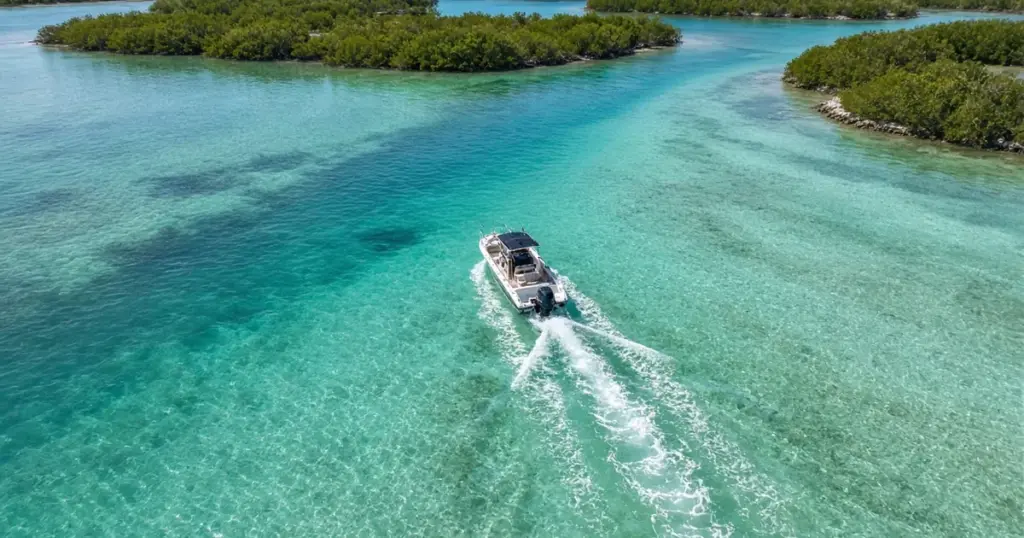
A run down to the Florida Keys is a bucket-list trip for many Gulf Coast and East Coast boaters. Whether you’re crossing Florida Bay from the Southwest coast, running down the Intracoastal from Miami or trailering to Islamorada or Marathon, the trip changes how your batteries are used. You’ll spend long days on the water, nights at anchor or on a mooring, hours drifting over patch reefs and plenty of time in full sun. Here’s how to plan battery power so the electrical system holds up from Key Largo to Key West.
How a Keys trip differs from a day trip
- Longer days. Electronics, livewells and pumps run for 8 to 12 hours.
- Nights away from the dock. Anchor lights, fans, refrigeration, phone charging and a stereo all run with the engine off.
- Heat. Compartment temperatures climb, which affects both lead-acid life and lithium charge limits. See Florida heat and marine battery life.
- Remote stretches. Parts of Florida Bay and the backcountry are a long way from help.
- Salt and spray. Open-water runs bring more spray than inshore boating. See saltwater corrosion prevention.
Step 1: Add up your daily loads
List what you’ll run and for how long. Use your equipment’s ratings where possible; these are example figures.
| Load | Amps | Hours/day | Ah/day |
|---|---|---|---|
| Chartplotter and sonar | 3 | 10 | 30 |
| VHF (mostly receive) | 0.5 | 12 | 6 |
| Livewell or baitwell pump | 4 | 5 | 20 |
| Anchor light (LED) | 0.2 | 11 | 2 |
| Cooler or 12V fridge | 3 | 12 (cycling) | 20 |
| Phone and device charging | 2 | 3 | 6 |
| Cabin or cockpit fans | 1 | 8 | 8 |
| Total | 92Ah |
Your list may be smaller or larger. A 12V fridge running around the clock in Keys heat is often the biggest single load.
Step 2: Size the house bank
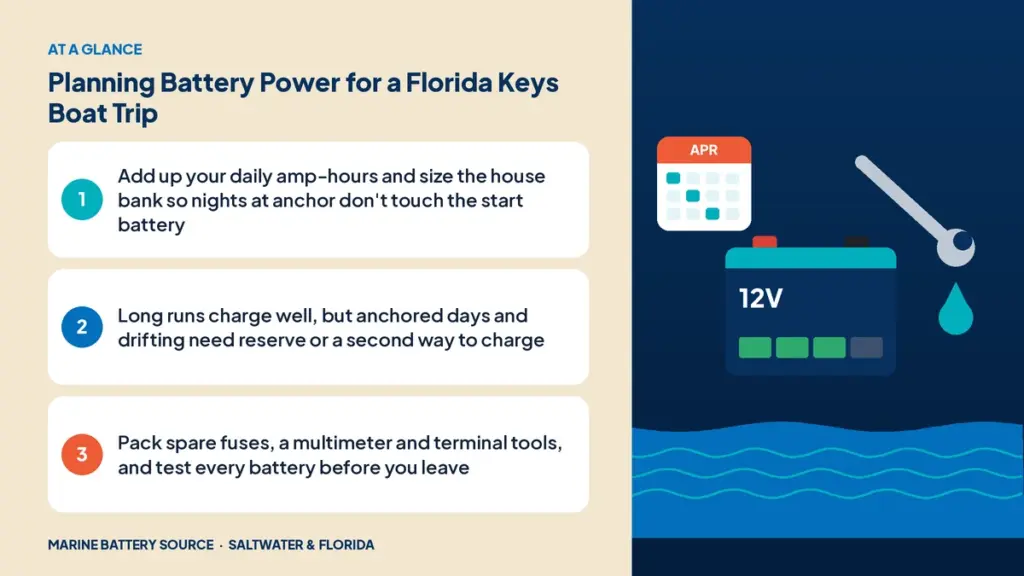
- Lead-acid (flooded or AGM): plan to use only about half the rated capacity for good life. A 92Ah day needs roughly 180–200Ah of rated capacity.
- Lithium (LiFePO4): most of the rated capacity is usable. A 100Ah battery covers 92Ah with little margin; a larger bank gives a cushion for an extra day at anchor.
For multi-day trips, an EPOCH 12V 300Ah LiFePO4 gives roughly three days of this example load without charging. For smaller boats, a EPOCH 12V 105Ah covers a single day.
Step 3: Protect the start battery
The house bank should never be able to drain the battery you need to start the engine. Use a dedicated start battery, a battery switch or automatic charging relay that isolates it, and a parallel option for emergencies. Make it a habit to check the switch position before you shut down for the night.
Step 4: Plan how you’ll recharge
- Underway: outboard and inboard alternators charge the batteries while you run. Long runs between keys help, but output varies with RPM.
- Lithium house banks: a DC-DC charger between the engine and the lithium bank applies the right charging profile and protects the alternator. If you also run a 36V trolling bank, the EPOCH 12V-to-36V DC-DC charger keeps a 36V trolling bank charged on the run.
- Marina nights: plug in and let the onboard charger bring everything back to full.
- Portable or solar charging: some boaters add a portable panel or generator from another supplier for long anchored stretches.
Plan your route so you get a marina night or a long run every day or two if your bank is small.
Step 5: Trolling motor batteries
If you’re fishing the flats around Islamorada or the backcountry, the trolling motor bank needs its own plan. A day of poling and trolling can use most of a lead-acid bank. Lithium trolling batteries handle heavy use with steady thrust, and charging on the run or at the marina restores them. See the Florida flats fishing power guide.
Before you leave
- ☐ Test every battery under load or with a capacity check
- ☐ Clean and tighten all terminals
- ☐ Check hold-downs for any movement
- ☐ Confirm the charger profile matches each bank
- ☐ Test bilge pumps on automatic and manual
- ☐ Check the anchor light and nav lights
- ☐ Pack spare fuses, a multimeter, terminal wrench, zip ties, electrical tape and a few spare lugs
- ☐ Charge the handheld VHF
Heat management on the trip
- Shade the console when anchored, using a T-top or a cover.
- Open battery hatches to air out when you’re tied up.
- Expect lithium batteries to limit charging if they get very hot; it’s normal BMS protection.
- Watch flooded batteries for water loss; carry distilled water if you use them.
Weather and lightning
Afternoon thunderstorms are common in the Keys in summer. Have a plan for lightning, including what to unplug and where to shelter. Read lightning and boat electrical systems.
Daily routine on the water
- Morning: check house bank voltage or state of charge, confirm the start battery is isolated.
- Midday: glance at voltage during long drifts; start the engine to charge if the bank is getting low.
- Evening: note state of charge before night loads begin.
- Night: switch off what you don’t need.
Coming from Tampa Bay or Sarasota
Running down from the Gulf Coast means a long open-water day or several hops down the coast. Plan fuel and power together. See our Tampa Bay and Sarasota guides for local setup tips, and the year-round boating battery care guide for keeping batteries healthy after the trip.
Shipping to the Keys
If you need batteries for a Keys boat, we ship throughout the Keys and the rest of Florida. See Florida shipping locations. Browse house bank batteries for multi-day trips.
Frequently asked questions
How big should my house battery be for a Keys trip?
Add up your daily amp-hours. For lead-acid, plan about twice that in rated capacity; for lithium, slightly more than the daily total, plus extra for days without charging.
Will my outboard keep my batteries charged on a Keys trip?
Long runs help a lot, but drifting and anchored time don’t charge anything. Plan for the house bank to cover engine-off periods.
Should I bring a spare battery?
A properly isolated start battery and a parallel switch are the main safeguards. A portable jump pack is a reasonable extra for small boats.
Are lithium batteries good for Keys trips?
Yes. Their usable capacity and steady voltage suit long days and nights at anchor. Use a lithium-compatible charging setup.
What spare parts should I bring for the electrical system?
Fuses of every size, a multimeter, terminal wrench, spare lugs, zip ties, electrical tape and a small crimper.