


Dielectric Grease and Terminal Protectants: What Works
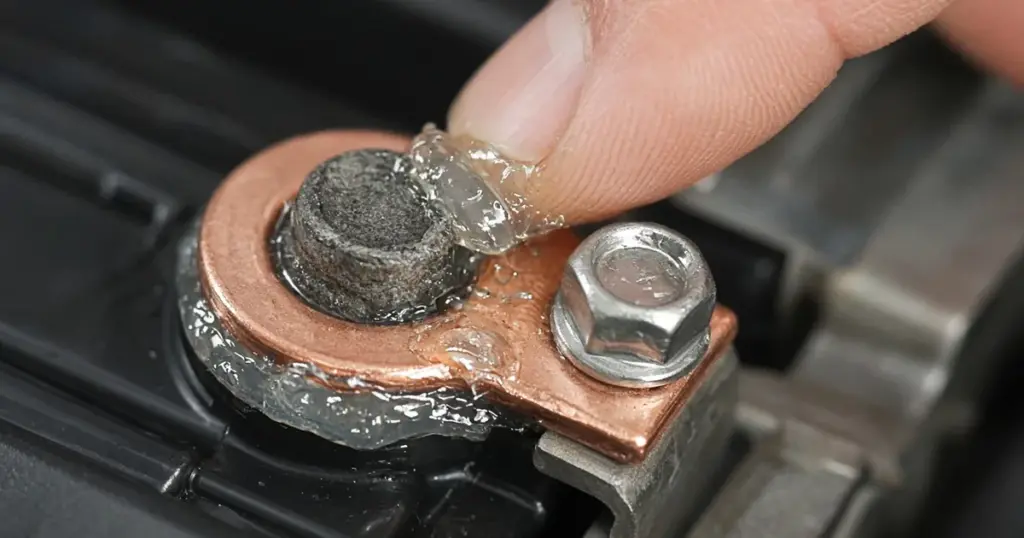
Dielectric grease is one of the cheapest ways to protect a boat’s battery connections from corrosion. Used correctly, it seals out moisture, salt and air. Used incorrectly, it can increase resistance and cause the very problems you’re trying to prevent. This guide explains how to use dielectric grease on battery terminals, and when other products work better.
What dielectric grease is
Dielectric grease is a silicone-based grease that doesn’t conduct electricity. It’s waterproof, resists high and low temperatures and doesn’t break down easily. It’s used on spark plug boots, connectors, bulb sockets and battery terminals to keep moisture out.
The key word is “dielectric,” which means it’s an insulator. That’s why where you put it matters.
How it protects terminals
Corrosion needs moisture and oxygen. By coating a connection, dielectric grease:
- Keeps water and salt spray out
- Blocks oxygen from reaching the metal
- Slows the chemical reactions that form corrosion
- Protects against acid vapor from flooded batteries
Where to apply it
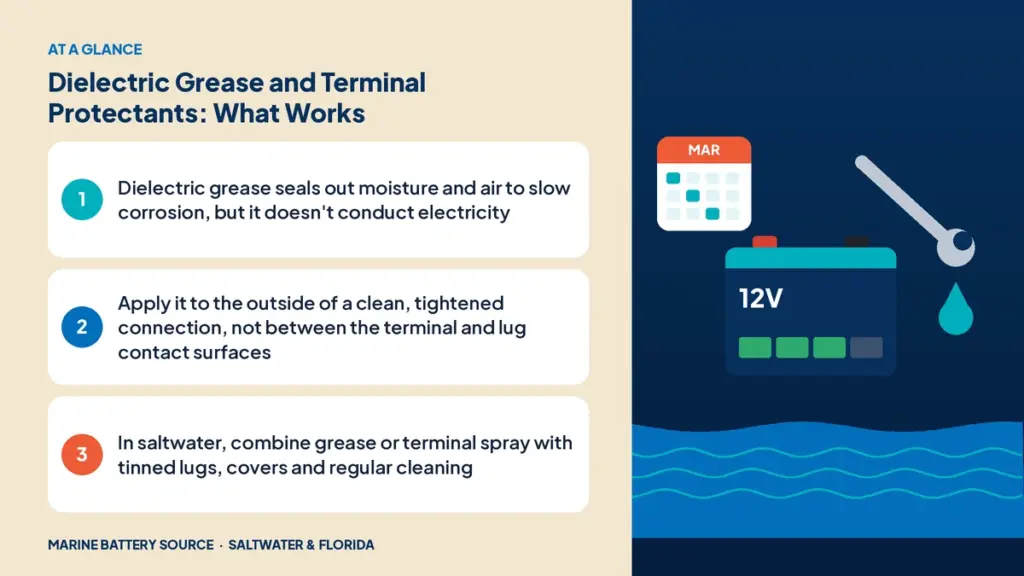
On the outside of a clean, tightened connection. The correct order is:
- Clean the terminal and lug to bright metal.
- Connect the lug to the terminal and torque to spec.
- Apply a thin coat of dielectric grease over the outside of the connection, covering the exposed metal.
Not between the terminal and lug. Because it’s an insulator, grease between the contact surfaces can increase resistance. In practice, a tight connection squeezes most grease out, but there’s no benefit to putting it there, and it can cause problems with loose connections.
Dielectric grease vs other products
Terminal protectant sprays
Sprays designed for battery terminals leave a coating, often colored so you can see coverage. They’re easy to apply after tightening and work well. Many are formulated specifically to resist battery acid.
Petroleum jelly
A traditional option. It works but can melt in heat and attract dirt. Dielectric grease or terminal sprays generally hold up better on boats.
Felt washers
Treated felt washers go on the post under the terminal on top-post batteries. They help neutralize acid vapor but don’t replace a protective coating.
Conductive grease
Some products contain metal particles designed to improve conductivity. They’re used in some electrical applications, but for battery terminals, a clean, tight connection with a protective coating on the outside is the standard approach.
Applying it on boats
- Clean first. Grease over corrosion traps it. See how to clean boat battery terminals.
- Use a thin coat. A heavy glob attracts dirt and makes inspection harder.
- Cover all exposed metal on the terminal, nut and lug.
- Fit a terminal cover over the positive.
- Reapply after any time you disconnect the battery.
Saltwater boats
Salt accelerates corrosion dramatically. For saltwater use:
- Use tinned copper lugs and cable. See corrosion-resistant battery hardware.
- Use stainless steel nuts and washers.
- Apply dielectric grease or terminal spray after every service.
- Check monthly and clean as needed.
- Keep the battery compartment dry and ventilated. See battery compartment ventilation.
For broader saltwater strategies, see saltwater corrosion prevention for marine batteries.
Other uses on a boat
Dielectric grease is useful on many marine connections:
- Trolling motor plugs and receptacles
- Navigation light sockets
- Bulb bases
- Deutsch and weatherpack connector seals
- Spark plug boots
Lithium battery terminals
Lithium batteries don’t vent acid, so they corrode less than lead-acid, but salt and humidity still affect their terminals and lugs. A thin coat of dielectric grease on the outside of tightened connections helps. Follow the maker’s torque spec first, then apply grease.
Stray current and corrosion
Not all corrosion comes from moisture at the terminal. Stray current from wiring faults can cause rapid corrosion of underwater metals and fittings. Grease won’t stop that. See stray current and galvanic corrosion.
Heat and grease
Dielectric grease handles high temperatures well, but extreme heat in a sun-baked compartment can soften some products. In very hot climates, check connections more often. See Florida heat and marine battery life.
Common mistakes
- Greasing dirty or corroded terminals
- Applying grease between contact surfaces
- Using too much
- Forgetting to reapply after service
- Relying on grease alone in saltwater without tinned hardware
How often to reapply
- After every disconnect or battery change
- At the start of each season
- When inspection shows the coating has worn off, usually every few months on saltwater boats
Step-by-step: protecting a battery connection
- Turn off the battery switch and disconnect the negative, then the positive.
- Clean the post and lug with baking soda solution and a wire brush until bright.
- Rinse and dry.
- Reconnect positive first, then negative.
- Torque each nut to spec.
- Wipe a thin coat of dielectric grease or spray protectant over the exposed metal.
- Fit the positive terminal cover.
- Check the connection by trying to twist the lug; it shouldn’t move.
Grease on trolling motor connections
Trolling motor plugs and battery connections see heavy current and frequent exposure to spray. After cleaning, a light film of dielectric grease on the plug contacts’ outer surfaces and seals keeps water out. Follow the plug maker’s guidance, since some designs specify a particular lubricant. Connection kits like the Dakota Lithium 24V trolling motor connection kit come with sealed connectors that benefit from the same care.
When grease isn’t enough
If corrosion keeps returning quickly even with grease, look for a cause: overcharging (which increases acid vapor on flooded batteries), a cracked case, a leaking vent cap or a compartment that stays wet. Sealed AGM or lithium batteries reduce acid-related corrosion significantly. Browse our marine battery accessories and lithium batteries.
For more on routine care, see our marine battery maintenance guide.
Frequently asked questions
Should I put dielectric grease on battery terminals?
Yes, on the outside of a clean, tightened connection to keep out moisture and slow corrosion.
Does dielectric grease conduct electricity?
No. It’s an insulator, which is why it goes on after the connection is tightened, not between contact surfaces.
Is terminal spray better than dielectric grease?
Both work. Sprays are easy to apply and often formulated for battery acid; grease is versatile for other connectors too.
Can I use petroleum jelly instead?
It works, but it can melt in heat and attract dirt. Dielectric grease or terminal spray usually holds up better on boats.
How often should I reapply dielectric grease?
After every disconnect, at the start of each season, and whenever the coating wears off.