


Allied Lithium Chargers: What Boaters Should Know
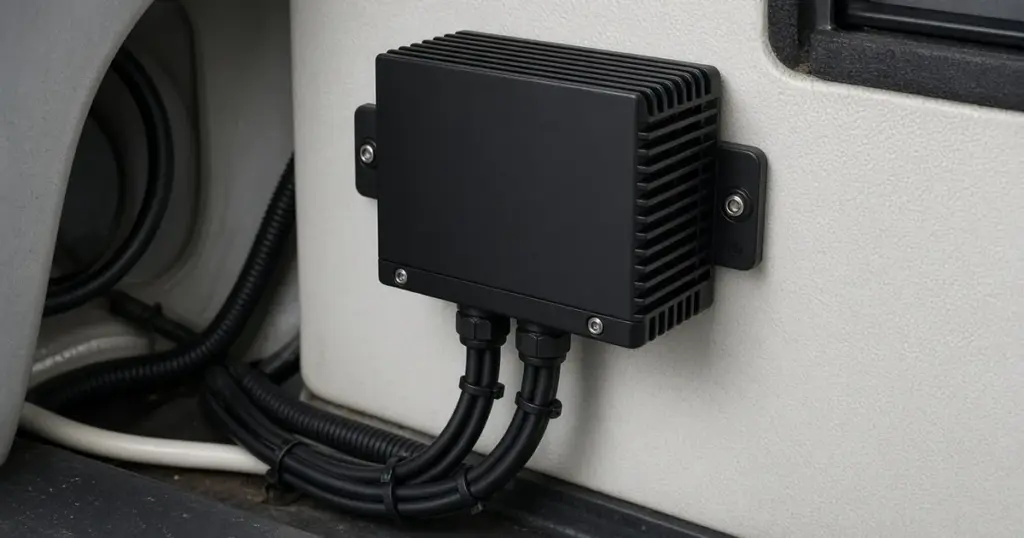
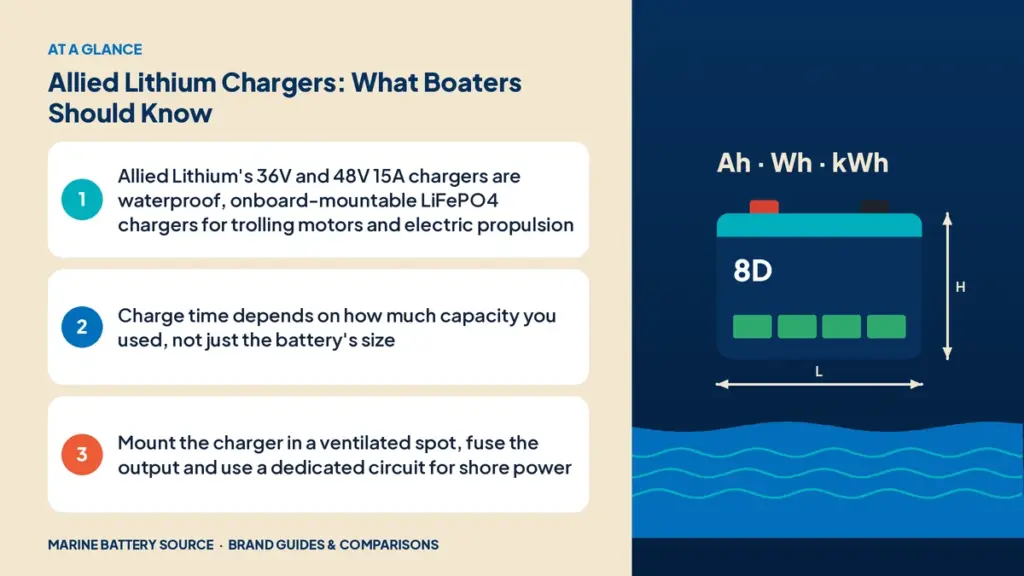
A lithium battery is only as good as the charger that fills it. For 36V trolling motors and 48V electric outboards, finding a waterproof, onboard charger with a proper LiFePO4 profile is the key to reliable charging. In our store, Allied Lithium is represented by two waterproof onboard chargers: a 36V 15A and a 48V 15A. This guide explains what they’re for, how to tell whether 15A is enough and how to install a charger on a boat. Specs come from our product listings.
The Allied Lithium chargers
| Charger | Voltage | Output | Enclosure |
|---|---|---|---|
| Allied Lithium 36V 15A | 36V | 15A | Waterproof, onboard-mountable |
| Allied Lithium 48V 15A | 48V | 15A | Waterproof, onboard-mountable |
They’re intended for lithium batteries at the matching voltage. Check the product page for profile details and compatible batteries.
Who needs a 36V or 48V lithium charger
- 36V trolling motor owners with a single 36V lithium battery, such as a Lithium Rhino or EPOCH 36V model.
- 48V systems: electric outboards, electric propulsion and some large trolling setups.
- Anyone upgrading from three 12V lead-acid batteries with a 3-bank charger to a single-case 36V lithium battery. A 12V multi-bank charger can’t charge a single 36V battery.
How long will charging take?
A simple estimate: amp-hours used divided by charger current, plus some time for the final absorption stage.
| Used capacity | 15A charger (approx.) |
|---|---|
| 30Ah | about 2 hours |
| 60Ah | about 4 hours |
| 100Ah | about 7 hours |
These are rough figures. Lithium charges efficiently, so most of the time goes to bulk charging. If you routinely use 100Ah or more and need a fast turnaround between tournament days, a higher-current charger or a second charging source like a DC-DC charger may help.
Matching the charger to the battery
- Voltage: must match the battery (36V charger for a 36V battery).
- Chemistry: LiFePO4 profile.
- Current: within the battery’s maximum charge current. Lithium Rhino kits list 50A maximum, so 15A is comfortably within range.
- Temperature: most LiFePO4 batteries won’t charge below freezing unless heated. The charger can’t override the battery’s BMS.
Installation tips
- Mount in a ventilated location where water drains away, even with a waterproof enclosure.
- Keep it away from fuel tanks and engines.
- Fuse the DC output near the battery, sized for the charger’s output.
- Use correctly sized cable for the run length.
- Use a marine AC inlet and a dedicated shore power circuit with proper protection.
- Secure the cables with drip loops so water runs off before reaching the charger.
Allied Lithium vs other chargers
EPOCH also offers 36V and 48V 15A lithium chargers, plus a two-bank 12V/36V onboard charger that charges a 12V start battery and a 36V trolling battery from one unit. If you need both, the two-bank design saves space. If you only need the trolling battery charged, a single-output charger like Allied’s is simpler. Dakota Lithium also lists a 48V 22A onboard charger for faster 48V charging. Compare charger options in marine battery comparisons.
Pairing with batteries
Allied’s 36V charger is a natural match for single-case 36V lithium batteries. See the Dakota Lithium guide, the Interstate guide for the Li31M 36V 50Ah, and the Trojan guide if you’re comparing with lead-acid banks that need different chargers. For a head-to-head on lithium brands, see Dakota Lithium vs Battle Born.
The marine battery brands compared pillar covers every brand we carry.
Example setup
A bass boat with a 36V 120Ah lithium trolling battery uses an Allied Lithium 36V 15A onboard charger for the trolling bank and a separate 12V charger for the start battery. After a day using about 80Ah, the trolling battery is full again in roughly 6 hours overnight.
Why a dedicated lithium charger matters
Lead-acid chargers use absorption and float voltages, and sometimes equalization, designed for lead-acid chemistry. LiFePO4 batteries need a different profile: a constant-current bulk stage, a short constant-voltage absorption at the battery maker’s recommended voltage, then either stopping or a low float. A lead-acid charger can leave a lithium battery partly charged, hold it at an unnecessarily high voltage or push it into BMS high-voltage protection. A charger designed for lithium avoids those problems and is one of the easiest ways to protect your battery investment.
Charging on the water
An onboard AC charger only works at the dock or with a generator. For long days or multi-day trips, a DC-DC charger can top up a 36V trolling battery from the outboard’s 12V charging system while you run between spots. That doesn’t replace an overnight AC charge, but it can add meaningful range during the day. Combined with an onboard AC charger, it’s a common setup for tournament anglers.
Signs your charger needs attention
- The battery doesn’t reach full after a normal overnight charge.
- The charger shows a fault indicator repeatedly.
- The case or cables get unusually hot.
- Water or corrosion appears at the cable entries.
48V systems
48V is common for electric outboards and some large electric propulsion setups. These systems use a lot of energy, so charging plans matter. A 48V 100Ah battery holds about 5 kWh; refilling half of that with a 15A charger takes several hours. Owners who use their boats daily often pair a charger like Allied’s 48V 15A with a second charging source or plan overnight charging into every trip.
Maintenance
- Inspect AC and DC connections twice a season.
- Keep the charger’s cooling surfaces clear.
- Check for corrosion at the output terminals.
- Watch for fault indicators and consult the manual.
Shop all Allied Lithium products and marine battery chargers.
Frequently asked questions
Can I charge a 36V lithium battery with three 12V chargers?
Not a single-case 36V battery. Use a 36V lithium charger. Three 12V banks are for three separate 12V batteries.
Is a 15A charger enough?
For most daily trolling use, yes, overnight. If you use over 100Ah and need fast turnaround, consider more current.
Are Allied Lithium chargers waterproof?
They’re listed as waterproof and onboard-mountable. Still mount them where water drains away.
Will the charger charge my lithium battery in the cold?
Only if the battery’s BMS allows it. Heated batteries can charge in the cold; unheated LiFePO4 usually can’t below freezing.
Can I use an Allied Lithium charger on lead-acid?
They’re designed for lithium. Use a charger with the right profile for lead-acid batteries.