


Trojan Deep-Cycle Batteries for Boats: Lineup Guide
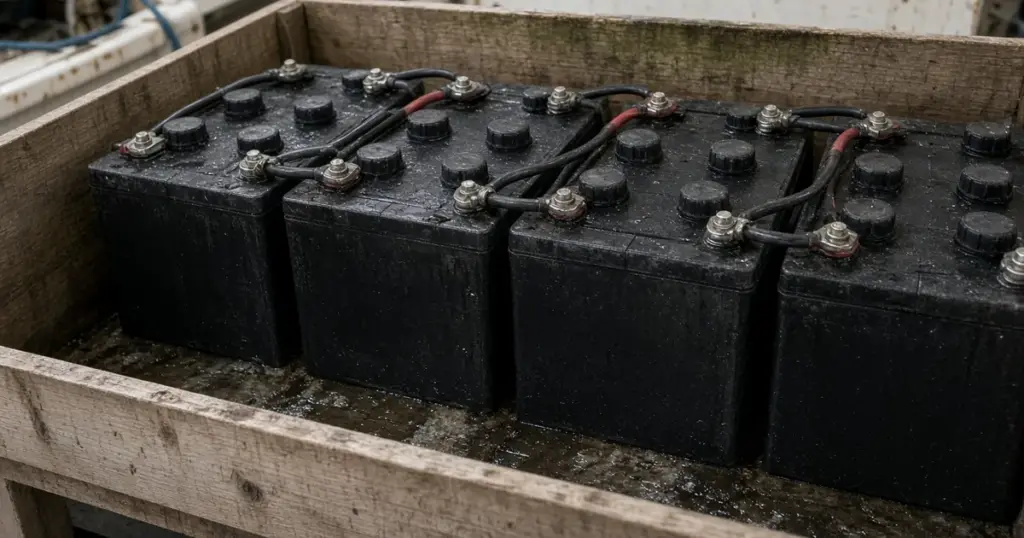
Trojan is best known for deep-cycle lead-acid batteries, the kind used in golf carts, floor scrubbers and renewable energy systems. Boaters use them for house banks and trolling motors, where deep cycling matters more than cranking. This guide covers the Trojan batteries in our store and how they fit marine applications. Specs come from our product listings, which are based on manufacturer information.
Trojan’s lines in our store
AES AGM (sealed)
Trojan’s AES models are sealed AGM deep-cycle batteries: no watering, spill-proof, suited to boats where access is hard or where you want to avoid acid maintenance.
| Model | Group | Capacity (20-hr) | Reserve capacity | Weight |
|---|---|---|---|---|
| 24-AES | 24 | 76Ah | 137 min | 54 lb |
| 27-AES | 27 | 89Ah | 158 min | 66 lb |
| 31-AES | 31 | 104Ah | 180 min | 69 lb |
| T105-AES (6V) | GC2 | 240Ah | 529 min | 89 lb |
Trojan also lists an 8D AGM dual-purpose battery (230Ah, 161 lb) for large boats.
Flooded 12V deep-cycle
| Model | Group | Capacity (20-hr) | Weight |
|---|---|---|---|
| 24TMX | 24 | 85Ah | 47 lb |
| SCS150 | 24 | 100Ah | 50 lb |
| 27TMX | 27 | 105Ah | 55 lb |
| SCS200 | 27 | 115Ah | 60 lb |
| SCS225 | 30H | 130Ah | 66 lb |
6V golf-cart and large-format flooded
| Model | Group | Capacity (20-hr) | Weight |
|---|---|---|---|
| T-605 | GC2 | 210Ah | 58 lb |
| T-105 | GC2 | 225Ah | 62 lb |
| T-125 | GC2 | 240Ah | 66 lb |
| T-145 | GC2H | 260Ah | 72 lb |
| J305 | 902 | 305–360Ah | 83–98 lb |
| L16 | 903 | 355–435Ah | 114–121 lb |
Plus versions of several 6V models are also listed.
Why 6V batteries for house banks
Two 6V batteries wired in series make a 12V bank. Golf-cart 6V batteries have thick plates built for deep cycling, and a pair offers more capacity than most 12V batteries of similar footprint. A pair of T-105s gives a 12V, 225Ah bank, with about 112Ah usable if you stay above 50% discharge. Two pairs in parallel double that. Compare 6V models in Trojan T-105 vs T-125 vs T-145.
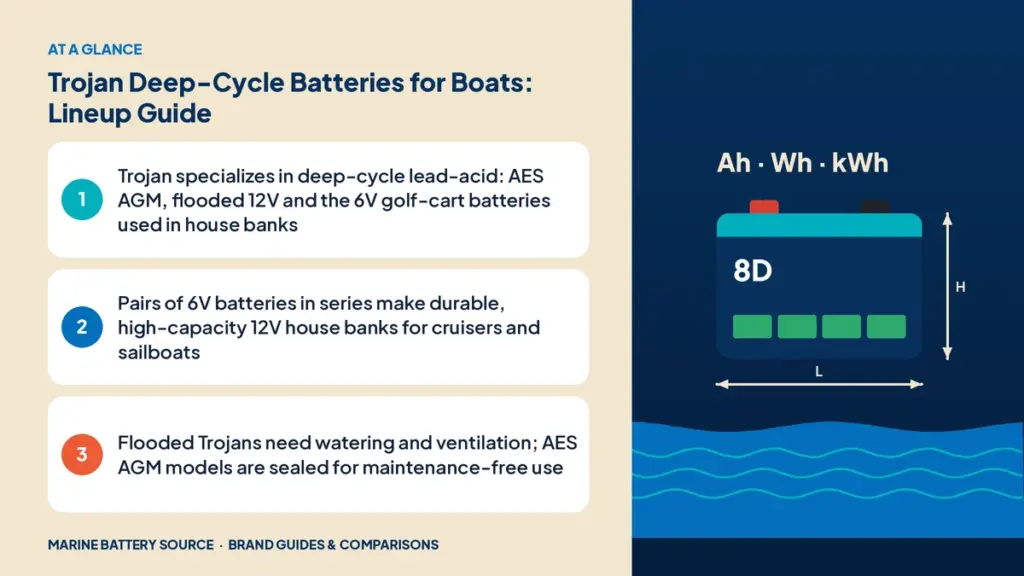
Flooded vs AES AGM
Flooded: lower cost, tolerant of charging variations, but needs regular watering, ventilation and a covered box on a boat. Not ideal where access is difficult or on boats that heel or pound.
AES AGM: sealed, no watering, spill-proof and lower gassing. Costs more and needs an AGM charging profile.
See sealed vs vented batteries for saltwater for a deeper comparison.
Charging Trojan batteries
- Use a charger with the right profile for flooded or AGM.
- Recharge fully after each use; lead-acid left partly charged sulfates.
- Flooded batteries benefit from periodic equalization if the maker recommends it; AGMs generally shouldn’t be equalized unless specified.
- Check water levels in flooded batteries monthly, more often in heat, and top up with distilled water after charging.
Trojan on boats
- Cruisers and sailboats: 6V pairs for big house banks.
- Trolling motors: 12V flooded or AES AGM in series for 24V or 36V.
- Pontoons: a 12V AES AGM as a house battery.
Trojan’s lineup in our store is deep-cycle; use a dedicated cranking battery for engine starting, such as an Interstate starting battery. See the Interstate marine batteries guide.
Trojan vs lithium
Lithium batteries weigh far less and deliver more usable capacity and cycles. Trojan lead-acid costs much less upfront and is simple to charge. If weight and maintenance matter, compare with the ECO Battery and Lithium Rhino guides. If budget matters most, Trojan deep-cycle is a proven choice. Our Allied Lithium chargers guide covers charging for those who move to lithium.
Example setups
Sailboat house bank. Four T-105 batteries, wired as two series pairs in parallel, give a 12V bank of about 450Ah. Staying above 50% discharge leaves about 225Ah usable per day, enough for a fridge, instruments, lights and an autopilot on many coastal cruisers. The bank needs a vented compartment and monthly watering.
36V trolling motor on a budget. Three SCS200 flooded batteries in series deliver a 36V bank with 115Ah at the 20-hour rate. A three-bank charger with a flooded profile keeps them balanced. The bank is heavy and needs watering, but it costs much less upfront than lithium.
Pontoon house battery. A single 31-AES gives a sealed, maintenance-free house battery for a stereo and lights, charged from the engine through an automatic charging relay and from shore power through an onboard charger.
Maintenance tips for flooded Trojans
- Check electrolyte levels monthly, more often in hot weather.
- Add distilled water only after charging, unless plates are exposed.
- Keep battery tops clean and dry to prevent surface leakage.
- Clean terminals and protect them after tightening.
- Ventilate the compartment; flooded batteries release hydrogen while charging.
- Never let them sit discharged.
Reading capacity and reserve capacity
Trojan lists capacity at the 20-hour rate, meaning the amp-hours a battery delivers when discharged evenly over 20 hours. At higher currents, such as a trolling motor on high, lead-acid batteries deliver less. Reserve capacity is the number of minutes a battery can supply 25A before dropping to 10.5V. For trolling motors, reserve capacity is a useful real-world comparison because 25A is close to a typical trolling draw. A 31-AES lists 180 minutes, for example, while a 24-AES lists 137.
Storage
Lead-acid batteries self-discharge over time, faster in heat. Before storing a boat, charge Trojan batteries fully, disconnect them or use a smart maintainer, and recharge every month or two if they sit without one. Flooded batteries should be checked for water level before storage.
Warranty
Our product listings don’t show warranty terms for Trojan batteries. Check Trojan’s current warranty before buying.
Comparisons
See marine battery brands compared and marine battery comparisons.
Shop all Trojan products.
Frequently asked questions
Are Trojan batteries good for boats?
They’re widely used for marine house banks and trolling motors. Use flooded models where you can water and ventilate, or AES AGM for sealed installs.
Can a Trojan battery start my outboard?
The Trojan batteries in our store are deep-cycle. Use a cranking or dual-purpose battery for starting.
Why use two 6V batteries instead of one 12V?
6V golf-cart batteries have thick plates for deep cycling and more capacity per footprint. Two in series make 12V.
Do Trojan AES batteries need water?
No. AES models are sealed AGM.
How long do Trojan batteries last?
It depends on depth of discharge, charging and temperature. Proper charging and avoiding deep discharges extend life.