


CCA vs MCA: Marine Battery Cranking Ratings Explained
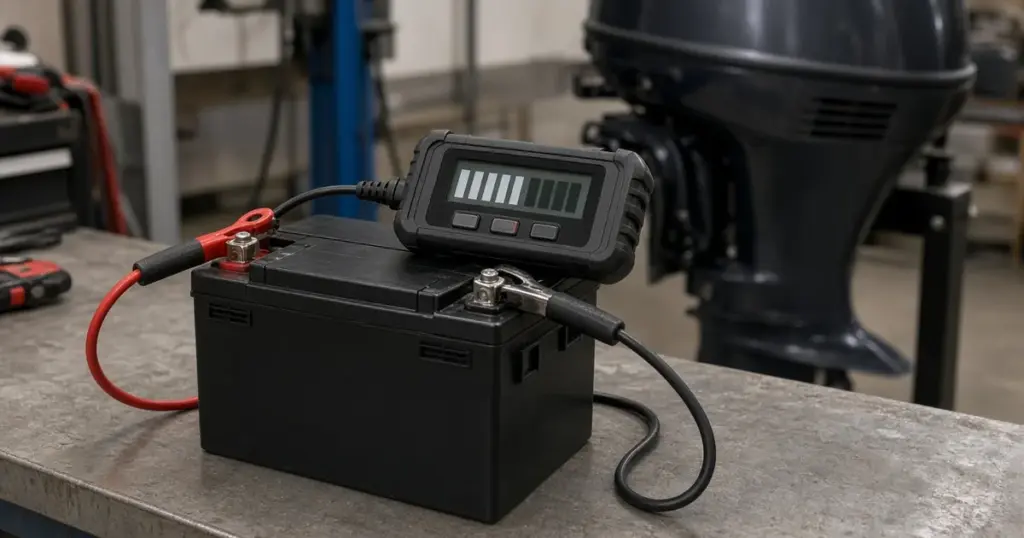
Marine battery labels carry a cluster of ratings, and two of the most important for starting are CCA and MCA. They look similar but are measured differently, and mixing them up can lead you to buy too little cranking power or overpay for more than you need. This guide explains CCA vs MCA, how each is tested, how they relate, and how to use them when choosing a starting battery.
What is CCA?
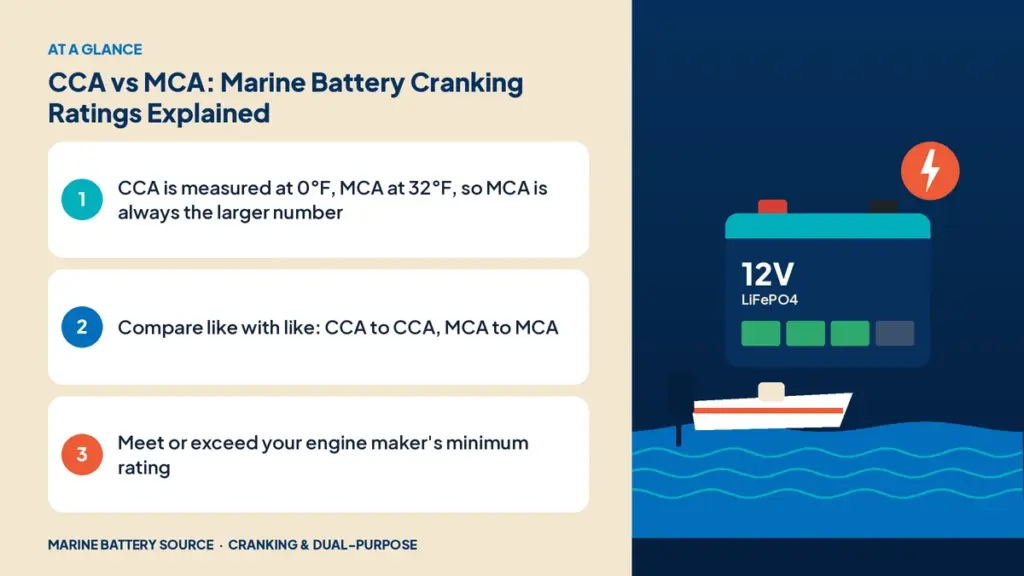
Cold cranking amps (CCA) is the current a fully charged 12V battery can deliver for 30 seconds at 0°F (−18°C) while keeping its voltage at or above 7.2V. The test, defined in industry standards such as SAE J537, simulates starting an engine on a cold morning, when the oil is thick and battery chemistry is sluggish.
CCA is the rating automotive buyers know best, and engine manufacturers often specify a minimum CCA for their engines.
What is MCA?
Marine cranking amps (MCA) use the same basic test, 30 seconds while keeping voltage at or above 7.2V, but at 32°F (0°C). Because batteries deliver more current when warmer, MCA is always higher than CCA for the same battery. It’s sometimes called simply “cranking amps” (CA).
The marine industry adopted MCA because most boating happens well above 0°F. For a boat used in spring through fall, MCA can be the more realistic number.
How much higher is MCA?
There’s no fixed conversion, because it depends on the battery’s design. Looking at real Interstate marine batteries in the store gives a sense of the spread:
| Battery | CCA | MCA | MCA ÷ CCA |
|---|---|---|---|
| Interstate 24M-XHD | 800 | 1000 | 1.25 |
| Interstate 27M-AGM | 850 | 975 | 1.15 |
| Interstate 31M-AGM | 925 | 1190 | 1.29 |
| Interstate HD24-DP | 405 | 505 | 1.25 |
In these examples, MCA runs about 15% to 30% higher than CCA. That’s why you can’t compare one battery’s MCA with another battery’s CCA and draw a fair conclusion.
Other cranking ratings you may see
- HCA (hot cranking amps): measured at 80°F. Higher still, and rarely used for buying decisions.
- PHCA or pulse cranking amps: a very short-duration rating used by some makers, often a few seconds. Not comparable with CCA or MCA.
- Lithium “CCA” claims: some lithium batteries list a cranking or pulse rating. Check the test duration and conditions. The Dakota Lithium DL 12V 60Ah, for example, lists 1000 CCA alongside separate 2-second and 5-second pulse ratings on its listing.
Which rating should you use?
- Start with the engine manual. Outboard and inboard manufacturers usually list a minimum cranking rating, sometimes in CCA, sometimes MCA, and sometimes both, plus a reserve capacity minimum. Our guide to outboard cranking requirements explains how to read those specs.
- Match the unit. If the manual specifies CCA, compare batteries by CCA. If it specifies MCA, compare by MCA.
- Consider your climate. In cold climates or for late-fall and early-spring boating, CCA is the safer number. In warm climates, MCA reflects real conditions better, but meeting the CCA spec still gives margin.
Is more cranking power always better?
A higher rating than the minimum gives margin for cold mornings, aging, and the voltage lost in long cables. But past a point, extra cranking amps don’t make the engine start any faster. They usually come with more weight, bigger cases and higher cost. Beyond starting, consider reserve capacity, which tells you how long the battery can run essential loads if the charging system fails. See reserve capacity explained.
CCA, MCA and battery type
- Starting batteries use many thin plates for high surface area and high current, so they have high CCA for their size.
- Dual-purpose batteries balance cranking with some deep-cycle ability. Their CCA is typically lower than a pure starter of the same size, though some AGM dual-purpose batteries are strong cranking performers.
- Deep-cycle batteries use thick plates for cycling. Many don’t list a CCA at all, or list a modest one.
The differences are explained in our guide to cranking, dual-purpose and deep-cycle batteries.
Cranking ratings and battery health
Ratings apply to a new, fully charged battery. As batteries age, sulfation and plate wear reduce the current they can deliver. A battery that met the spec when new may fall short after a few seasons, especially in cold weather. Battery testers estimate available CCA, which helps you decide when to replace.
Why marine batteries list MCA at all
A boat engine is often started in warmer weather than a car in a northern winter, and marine batteries face different stresses: vibration, deep cycling from accessories, and long idle periods. MCA gives boaters a number that better reflects typical conditions, but it also makes batteries look stronger. Being aware of the difference keeps you from comparing a marine battery’s MCA with an automotive battery’s CCA. Our comparison of marine vs car batteries covers other differences.
Cranking ratings and cable length
The rating describes what the battery can deliver at its terminals. What the starter actually sees depends on the cables between them. Long or undersized cables, corroded lugs and tired battery switches all drop voltage during cranking, and the engine sees less than the battery provides. That’s one reason boats with batteries far from the engine, such as center consoles with batteries in the console, benefit from cranking margin above the minimum and properly sized cable.
If an engine cranks slowly even with a new, well-rated battery, check the cables and connections before buying a bigger battery. A voltage reading at the starter during cranking, compared with the reading at the battery, shows how much is lost in between.
A worked example
Suppose your outboard’s manual calls for a minimum of 650 CCA. You’re comparing a battery listed at 800 MCA and another listed at 750 CCA. The first looks stronger, but 800 MCA might correspond to something around 650 CCA or less. The second clearly meets the spec with margin. Without a CCA figure for the first battery, you can’t be sure it qualifies, so the second is the safer choice.
Practical buying tips
- Write down the engine maker’s minimum rating and the unit.
- Compare only batteries that list the same unit.
- Choose margin above the minimum if you boat in cold weather or have long cable runs.
- Check physical size and terminal type, using our BCI group size guide.
- For PWCs and small engines, see the PWC battery guide.
For a complete walkthrough, read choosing a boat starting battery, and browse the cranking battery category in the store.
Frequently asked questions
What is the difference between CCA and MCA?
CCA is measured at 0°F and MCA at 32°F, both for 30 seconds while keeping voltage at or above 7.2V. Because batteries deliver more current when warmer, MCA is always higher.
Is 800 MCA the same as 800 CCA?
No. A battery rated 800 MCA has a lower CCA, typically around 15% to 30% lower depending on design.
How many CCA do I need for my boat?
Use the minimum listed in your engine’s manual, and add margin for cold weather, battery aging and long cables.
Do lithium batteries have CCA ratings?
Some cranking-capable lithium batteries list CCA or pulse ratings. Check the test conditions and confirm the battery is approved for engine starting.