


Reserve Capacity Explained for Marine Batteries

Reserve capacity is one of the most useful and least understood numbers on a marine battery label. It tells you how long the battery can keep essential equipment running if your charging system quits. For a starting battery it’s a measure of safety margin; for a dual-purpose or deep-cycle battery it’s a quick capacity comparison. This guide explains marine battery reserve capacity, how it’s measured, and how to use it.
What reserve capacity means
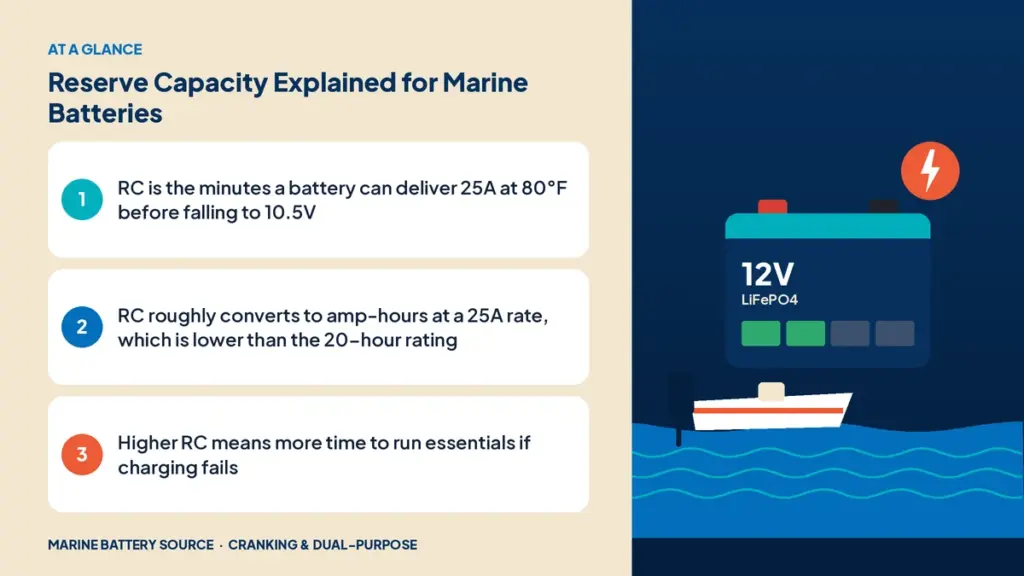
Reserve capacity (RC) is the number of minutes a fully charged 12V battery can deliver a steady 25 amps at 80°F before its voltage falls to 10.5V. A battery with an RC of 140 can supply 25A for 140 minutes under test conditions.
The 25A figure represents a vehicle’s essential loads with the alternator dead: ignition, lights and accessories. On a boat, think navigation lights, VHF, bilge pump, electronics and the ignition.
Reserve capacity vs amp-hours
RC can be converted to an approximate amp-hour figure at the 25A rate:
Ah at 25A ≈ RC × 25 ÷ 60
| RC (minutes) | Approx. Ah at 25A |
|---|---|
| 100 | 42 |
| 140 | 58 |
| 180 | 75 |
| 210 | 88 |
That number is lower than the battery’s 20-hour amp-hour rating, because lead-acid batteries deliver less total capacity at higher current. This is known as the Peukert effect. So RC and 20-hour Ah aren’t interchangeable, but RC is a fair way to compare batteries at a realistic load.
Real examples
The store lists RC for many batteries:
- Interstate SRM-31: 210 minutes, Group 31M deep cycle.
- Interstate 24M-XHD: 135 minutes, Group 24M starting.
- Trojan 27TMX: 175 minutes, Group 27 flooded deep cycle, listed at 1.40 kWh at the 20-hour rate.
- Interstate M-24M-MS: 75 minutes, a compact starting battery.
The range shows how different batteries of similar size can be. A pure starting battery with high CCA may have a modest RC, while a deep-cycle battery of the same group size has more.
Why reserve capacity matters on a boat
Charging failure
If the outboard’s charging system fails, the battery is the only power source for ignition and electronics. A higher RC means more time to get home or wait for help with the radio and lights running.
Engine manufacturer minimums
Many engine makers list a minimum RC alongside cranking amps. A battery that meets the CCA spec but falls short on RC may not be what the engine maker intended. Our guide to outboard cranking requirements covers both.
Running accessories with the engine off
Anglers often sit with the engine off and electronics running. A starting battery with low RC can be drained enough that it won’t crank the engine. Higher RC, a dual-purpose battery, or a separate house battery helps.
RC and lithium batteries
Some lithium marine batteries list an RC figure for comparison. Interstate lists RC for its lithium line: the Li27M 12V 100Ah shows 240 minutes and the Li24M 12V 60Ah shows 135 minutes. Lithium batteries deliver their capacity more evenly at different currents, so the RC-derived amp-hours for lithium are much closer to the battery’s rated capacity. For a starting application, confirm the lithium battery is cranking-rated; see lithium starting batteries for outboards.
Reading RC alongside other ratings
| Rating | What it tells you | Best used for |
|---|---|---|
| CCA / MCA | Short-burst current for starting | Engine starting |
| RC | Minutes at 25A | Safety margin, quick capacity comparison |
| Ah (20-hour) | Total capacity at a low rate | Sizing house and trolling banks |
| kWh | Energy | Comparing across voltages and chemistries |
See CCA vs MCA for more on cranking ratings.
How RC changes with age and temperature
RC is measured at 80°F on a new, fully charged battery. Cold temperatures reduce available capacity in lead-acid batteries, and capacity declines as batteries age. Expect less real-world reserve on a cold morning with an older battery. Testing a battery’s capacity periodically helps you replace it before it lets you down.
Choosing a battery by RC
- Meet the engine maker’s minimum, if one is listed.
- If you run electronics with the engine off, choose a higher RC or add a separate house battery.
- For small boats running everything off one battery, a dual-purpose battery with strong RC is a sensible compromise.
- For long offshore runs, prioritize RC and consider a dedicated emergency starting setup.
Our guide to dual-purpose marine batteries explains when one battery can do two jobs.
RC in a car battery comparison
Car batteries also list RC, often lower than marine batteries of similar size. That’s one of several reasons not to swap a car battery into a boat, covered in marine battery vs car battery.
Estimating your own reserve needs
To decide how much RC you need, think about the worst realistic case: the charging system fails, and you need to get home or wait for assistance.
- List the essentials: ignition, navigation lights, VHF radio, chartplotter and bilge pump.
- Estimate their combined current from manuals or a clamp meter.
- Decide how many hours you’d want them running.
Example: essentials drawing about 8A for three hours need around 24Ah. A battery with an RC of 140 minutes (about 58Ah at 25A, and more at an 8A draw) covers that with margin, provided it’s healthy and fully charged. A battery already partly drained by a morning of electronics may not.
This exercise also shows why many boats separate starting and house duties, so the battery that starts the engine isn’t the one you’ve been drawing down all day.
Quick checklist
- Note your engine’s minimum CCA or MCA and RC.
- Estimate essential loads if the charging system fails.
- Compare batteries by RC at the same test conditions.
- Remember that cold and age reduce real reserve.
For the full buying process, see choosing a boat starting battery and our overview of cranking vs dual-purpose vs deep-cycle batteries. Browse dual-purpose batteries in the store.
Frequently asked questions
What is a good reserve capacity for a marine battery?
It depends on the application. Meet your engine maker’s minimum, and choose higher RC if you run electronics with the engine off. Group 24 to 31 marine batteries commonly range from about 75 to over 200 minutes.
How do I convert reserve capacity to amp-hours?
Multiply RC by 25 and divide by 60 to get approximate amp-hours at a 25A load. This is lower than the 20-hour Ah rating for lead-acid batteries.
Is reserve capacity more important than CCA?
Both matter. CCA ensures the engine starts; RC tells you how long the battery can support essential loads if charging fails.
Do lithium batteries have reserve capacity ratings?
Some manufacturers list RC for lithium batteries to make comparison easier. Lithium delivers its capacity more evenly across loads.