


Marine Battery vs Car Battery: Why You Shouldn’t Swap Them
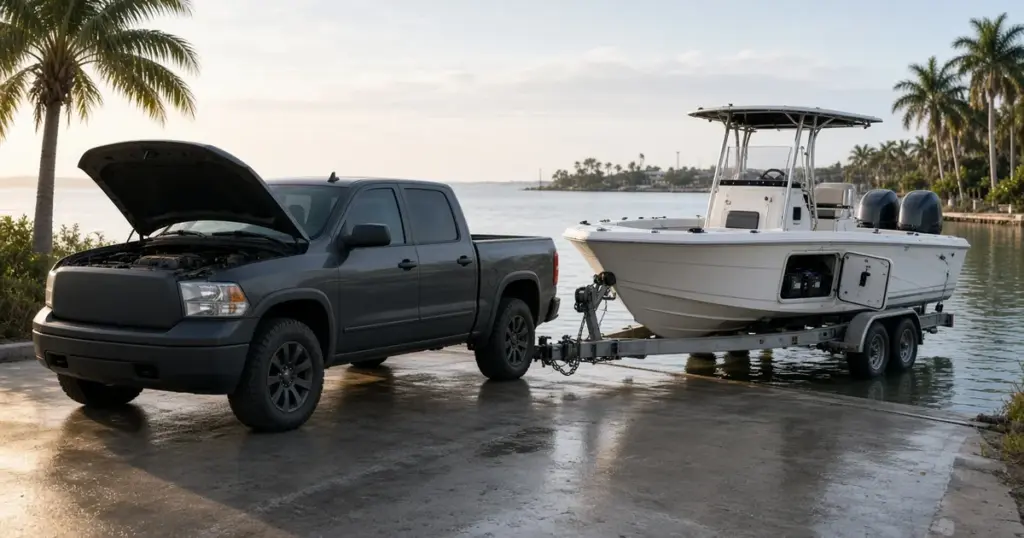
A car battery and a marine battery can look nearly identical on the shelf: same voltage, similar size, similar price. It’s tempting to grab whichever is cheaper. But they’re built for different jobs, and a car battery in a boat usually means a shorter life and a higher chance of a dead battery at the worst moment. This guide explains the marine battery vs car battery differences and why you shouldn’t swap them.
What a car battery is designed to do
A car battery is an SLI battery: starting, lighting and ignition. Its job is to deliver a big burst of current for a few seconds to start the engine. Once the engine runs, the alternator takes over, supplying all the car’s electrical needs and recharging the battery quickly. The battery rarely gets discharged deeply. It sits in a vehicle that’s used frequently, so long idle periods are unusual.
To deliver high current, car batteries use many thin plates. That’s great for cranking, but thin plates don’t tolerate deep discharges well.
What a boat asks of a battery
Boats are different:
- Engine-off loads. Anglers sit for hours with electronics, lights, bilge pumps and stereos running and the engine off.
- Deep cycling. Those loads discharge the battery much more deeply than a car ever does.
- Pounding and vibration. A boat running through a chop shakes a battery far more than a car on pavement.
- Long idle periods. Boats often sit for weeks between uses, and over the off-season.
- Damp, corrosive environments, especially in salt water.
- Different charging. Outboard charging systems can have modest output at low RPM, and many boats rely on shore chargers.
How marine batteries are built differently
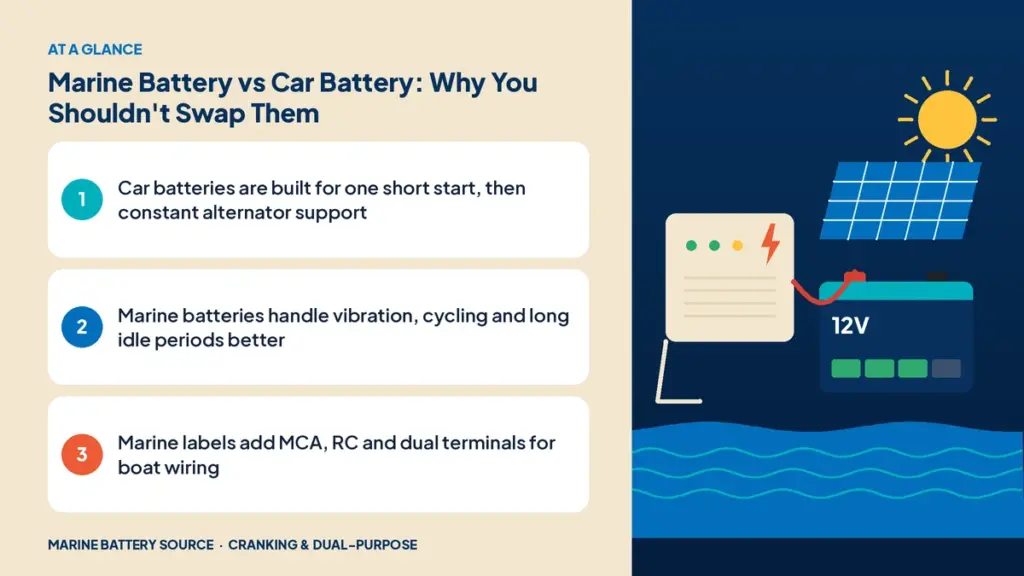
- Plate design. Marine starting batteries are built for cranking, while dual-purpose and deep-cycle marine batteries use thicker plates to handle cycling.
- Vibration resistance. Marine batteries typically use stronger internal construction to hold plates in place. AGM marine batteries are especially resistant.
- Terminals. Many marine batteries have dual terminals: threaded studs for ring terminals plus automotive-style posts. Studs with wing nuts or hex nuts are the norm in boat wiring.
- Ratings. Marine batteries list MCA in addition to, or instead of, CCA, plus reserve capacity. See CCA vs MCA and reserve capacity explained.
Comparing real examples
Interstate’s marine starting and dual-purpose lines in the store illustrate typical marine ratings:
| Battery | Type | CCA | MCA | RC (min) |
|---|---|---|---|---|
| Interstate M-24M-MS | Marine starting, 24M | 400 | n/a | 75 |
| Interstate 24M-XHD | Marine starting, 24M | 800 | 1000 | 135 |
| Interstate M-24M-MDC | Marine dual purpose, 24M | 400 | n/a | 120 |
| Interstate 24M-AGM-A | AGM dual purpose, 24M | 750 | 940 | 140 |
Note the “M” in group sizes such as 24M and 27M. It indicates a marine version of the standard BCI group, often with marine terminals. Our BCI group size guide covers the sizes.
What happens if you use a car battery in a boat
- Shortened life. Engine-off cycling from electronics wears out thin plates.
- Vibration damage. Plates and connections can crack or shed material in rough water.
- Terminal problems. Automotive posts don’t suit ring-terminal boat wiring; adapters add resistance and corrosion points.
- Less reserve. Car batteries often have lower reserve capacity for their size, leaving less margin for running essentials.
- No-start surprises. A car battery that’s been drained by electronics may not crank the outboard to get you home.
Can you ever use a car battery?
In an emergency, a car battery of the right voltage can start an engine. But for regular use, a marine battery suited to your engine and loads is the right choice. For small outboards with modest loads, a marine dual-purpose battery is often the best value. See our dual-purpose battery guide.
What about using a marine battery in a car?
Marine starting and dual-purpose batteries can work in some vehicles if the size, terminals and cranking rating match. But modern cars may have specific battery requirements, such as AGM or EFB batteries for start-stop systems, and some need the battery registered with the car’s computer. Follow the vehicle maker’s specification.
Lithium and the marine-vs-car question
Lithium marine batteries take the differences further. LiFePO4 handles deep cycling well, so a cranking-rated lithium battery can start an engine and run accessories. Automotive lithium starting batteries exist, but many aren’t designed for deep cycling or the marine environment. If you’re considering lithium for a boat, read lithium starting batteries for outboards.
Choosing the right marine battery
- Check your engine’s cranking and reserve requirements.
- Decide whether you need a starting, dual-purpose or deep-cycle battery.
- Choose a group size that fits your tray.
- Pick a chemistry that suits your budget and maintenance preferences.
- Match terminal types to your cables.
Personal watercraft use small powersports batteries rather than car or marine group sizes; see the PWC battery guide. Boats with more than one engine have their own considerations, covered in twin outboard battery setups.
Care tips for any marine battery
- Recharge after each trip with a marine charger.
- Use a battery switch to isolate the battery when the boat sits.
- Keep terminals clean and coated with a protectant.
- Secure the battery with a proper hold-down.
- Store charged over the off-season.
For the full overview, read choosing a boat starting battery and cranking vs dual-purpose vs deep-cycle batteries. Browse Interstate marine batteries and the cranking category in the store.
Frequently asked questions
Can I use a car battery in my boat?
In an emergency, yes, if the voltage matches. For regular use, choose a marine battery designed for vibration, cycling and the marine environment.
What is the difference between a marine battery and a car battery?
Marine batteries are built for vibration, engine-off cycling and long idle periods, with marine terminals and ratings like MCA and reserve capacity. Car batteries are built for short starting bursts with constant alternator support.
Are marine batteries more expensive than car batteries?
Prices overlap. Marine starting batteries can cost about the same as car batteries, while deep-cycle, AGM and lithium marine batteries cost more.
Does a boat need a deep-cycle battery?
If you run electronics or a trolling motor with the engine off, you need some deep-cycle capability, from either a dual-purpose battery or a dedicated deep-cycle battery.