


PWC and Jet Ski Battery Guide
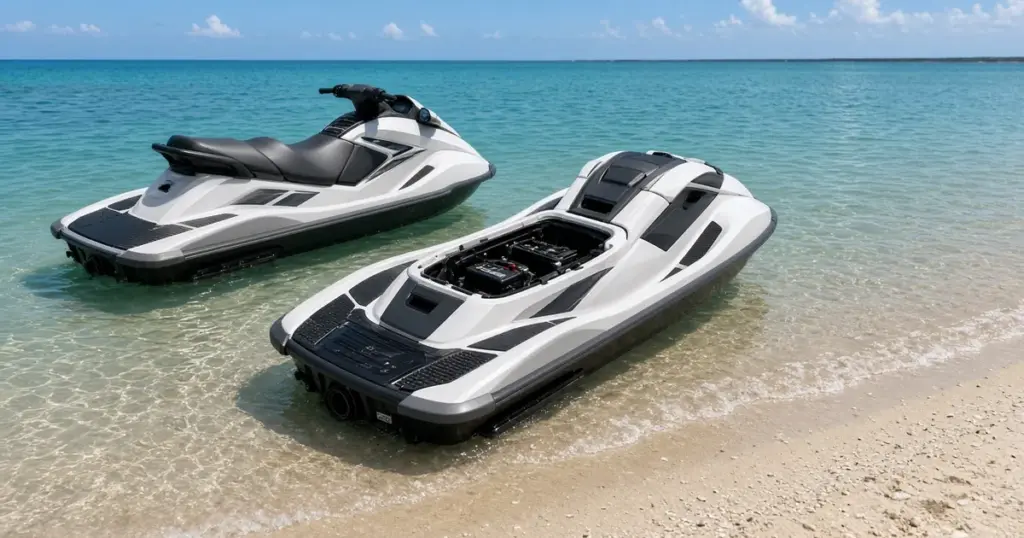
A personal watercraft lives a hard life: short rides, long idle periods, heat, vibration and spray. Its battery is small, and when it’s weak the machine won’t start. This jet ski battery guide covers the types of batteries PWCs use, how to choose a replacement, why PWC batteries fail, and how to charge and store them.
What battery does a jet ski use?
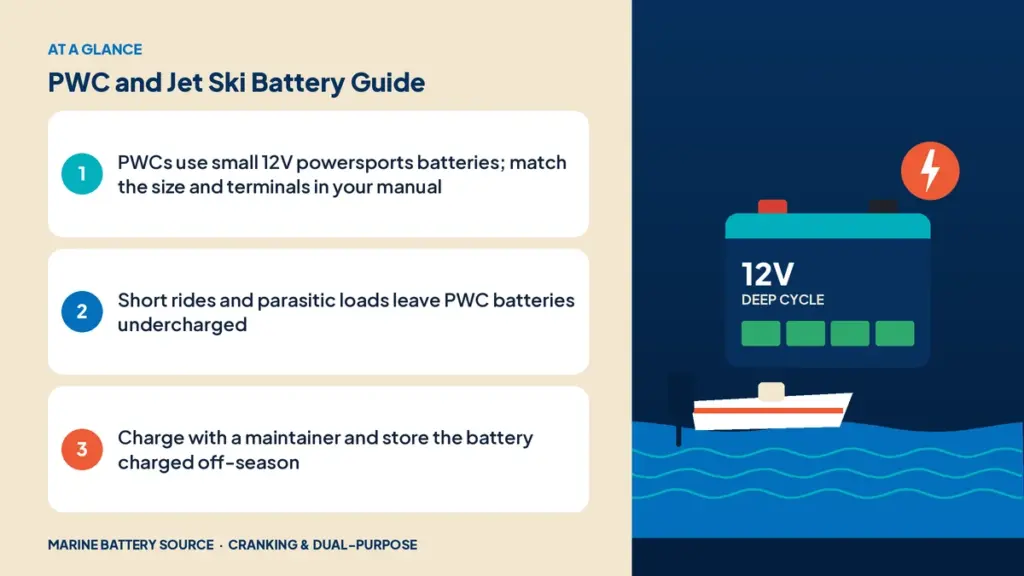
Most PWCs use a 12V powersports battery much smaller than a typical boat battery. Your owner’s manual or the existing battery’s label lists the exact size, cranking rating, and terminal layout. Because PWC battery compartments are tight and terminals sit close to other components, the replacement must match the original’s dimensions and terminal orientation.
Battery types
Sealed AGM powersports batteries
The most common original equipment. Sealed, maintenance-free and spill-resistant. They are generally the default choice.
Flooded powersports batteries
Older machines may use conventional flooded batteries that need electrolyte filling and periodic topping up. They’re less common now and less convenient on a PWC.
Lithium powersports batteries
Lighter, with very low self-discharge, which helps with machines that sit between rides. They need to be rated for starting and matched to the machine’s charging system. Many lithium batteries also shouldn’t be charged below about 32°F unless they have internal heating.
Lithium examples from the store
Dakota Lithium’s small dual-purpose batteries list 300 CCA:
- Dakota Lithium DL 12V 25Ah: 300 CCA, 6.4 lb, 7.12 × 3.03 × 6.69 in, with an 11-year warranty listed.
- Dakota Lithium DL 12V 15Ah: 300 CCA, 3.97 lb.
Dakota Lithium also offers a 12V jet ski battery system with a charging port. Check that any lithium battery’s dimensions, terminals and cranking rating suit your PWC, and that your machine maker doesn’t prohibit lithium. Our guide to CCA vs MCA explains the cranking ratings.
Why PWC batteries die
- Short rides. PWC charging systems have modest output, and a quick ride may not replace the energy used to start.
- Long idle periods. Lead-acid batteries self-discharge, and the machine’s electronics can draw small parasitic currents.
- Heat. Engine compartments get hot, which accelerates aging.
- Vibration and pounding. Loose hold-downs let batteries move and damage internal connections.
- Deep discharge. Leaving accessories on or repeated cranking attempts drain the battery.
Charging a PWC battery
- Use a smart charger or maintainer designed for powersports batteries, with the correct profile for AGM or lithium.
- Choose a low charge rate appropriate for small batteries. A large boat charger can be too much current for a small battery.
- Many riders install a charging port so they can connect a maintainer without opening the battery compartment.
- For lithium, use a lithium-compatible charger.
Storing a PWC over winter
- Fully charge the battery.
- Disconnect it or remove it from the machine.
- Store it in a cool, dry place above freezing.
- Keep a lead-acid battery on a maintainer, or recharge it every month or two.
- For lithium, follow the maker’s storage guidance; many recommend storing at a partial state of charge.
Never let a lead-acid battery freeze while discharged. A discharged battery can freeze at much higher temperatures than a fully charged one.
Installing a replacement
- Remove the seat or access cover per the manual.
- Disconnect the negative cable first, then the positive.
- Remove the hold-down strap and lift out the old battery.
- Install the new battery in the same orientation.
- Connect positive first, then negative.
- Secure the hold-down and check that cables can’t chafe.
- Coat terminals with a protectant.
Checking voltage with a multimeter
A basic multimeter tells you a lot about a PWC battery. Measure across the terminals after the battery has rested for a few hours without charging or use.
| Resting voltage (12V lead-acid/AGM) | Approximate state |
|---|---|
| About 12.7V or higher | Fully charged |
| About 12.4V | Roughly three-quarters charged |
| About 12.2V | Roughly half charged |
| 12.0V or lower | Discharged; charge it promptly |
These are typical values for lead-acid and AGM batteries at room temperature; exact figures vary by design. Lithium batteries hold a much flatter voltage, so a voltmeter is less useful for estimating their state of charge. Use the charger’s indicator or the battery maker’s guidance instead.
Tips for riders who use the machine rarely
If your PWC sits for weeks between rides, a battery maintainer is the single best investment. Connect it whenever the machine is parked at home. If it lives on a lift at the dock, consider a small charging port wired to the battery so you can connect a maintainer without removing the seat. Always switch off accessories, and confirm the lanyard is removed so electronics don’t stay awake.
Saltwater riders
Salt spray accelerates terminal corrosion. After saltwater rides, rinse the machine as the manufacturer recommends, dry the battery compartment, and check terminals for white or green deposits. A thin coat of terminal protectant helps.
PWC vs boat batteries
PWC batteries are smaller and lighter than boat batteries, and they rarely power accessories for long periods. A marine starting battery for an outboard or inboard is a different animal. If you’re curious how ratings compare, see marine battery vs car battery and our guide to inboard starting batteries. On boats with multiple engines, see twin outboard battery setups.
Troubleshooting a no-start
- Clicking or nothing: check battery voltage. A resting voltage well below about 12.4V on a lead-acid battery suggests it’s discharged.
- Battery charged but no start: check terminals, the main fuse, and the lanyard or safety key.
- Battery won’t hold charge: it may be sulfated or failed. Load test it.
When to replace
If a fully charged battery fails a load test, or the machine struggles to start after a few days of sitting, replace it. Lead-acid powersports batteries often last a few seasons; good charging and storage habits extend that.
For more on starting batteries, read choosing a boat starting battery and cranking vs dual-purpose vs deep-cycle batteries. Browse Dakota Lithium and cranking batteries in the store.
Frequently asked questions
What size battery does a jet ski need?
Check your owner’s manual or the existing battery’s label for size, cranking rating and terminal layout. PWCs use small 12V powersports batteries that must fit a tight compartment.
Can I put a lithium battery in my jet ski?
Many riders do. Use a starting-rated lithium battery that fits and matches the terminals, and check your manufacturer’s guidance.
Why does my jet ski battery keep dying?
Short rides, long idle periods, parasitic draws and heat are common causes. A maintainer between rides helps a lot.
How do I store a jet ski battery over winter?
Charge it fully, disconnect or remove it, store it somewhere cool and dry above freezing, and maintain it per the battery maker’s guidance.