


Boat Battery Keeps Dying? How to Find the Cause
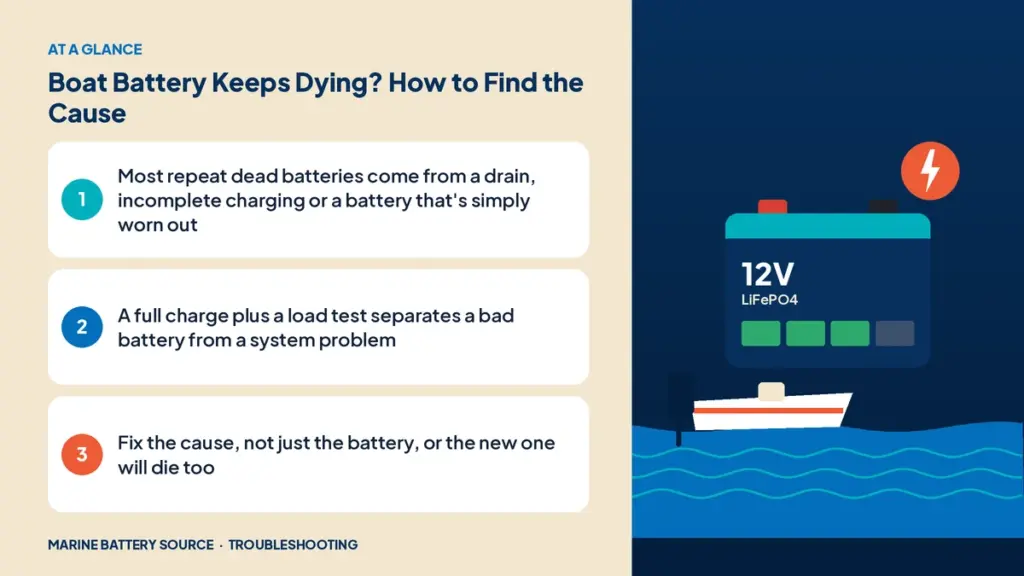
Few things are more frustrating than a boat battery that keeps dying. You charge it, it works for a trip or two, and then you’re back to a click at the ramp. Replacing the battery might fix it, or the new one might die the same way. The key is finding the cause. This guide walks through the most common reasons a boat battery keeps dying and how to track each one down.
The usual suspects
- Parasitic drain: something draws power with the switch off.
- Incomplete charging: the battery never gets fully recharged.
- Worn-out battery: it has lost capacity.
- Wrong battery for the job: a starting battery used for deep-cycle loads.
- Loads exceeding capacity: more draw than the battery can supply.
- Bad connections: corrosion or loose terminals.
- Heat and self-discharge: batteries lose charge faster in heat.
Step 1: Test the battery itself
Charge the battery fully with a known-good charger, let it rest, then load test it. If it fails, it’s the battery. See how to test a marine battery.
If it passes, the battery is probably fine, and something on the boat is draining it or not charging it.
Step 2: Check for parasitic drains
A small, constant draw can flatten a battery in days or weeks. Common culprits:
- Stereo memory
- GPS and chartplotters with standby modes
- Bilge pump float switches (especially if water keeps triggering the pump)
- Battery monitors and Bluetooth modules
- Chargers that draw power when shore power is off
- Wiring faults and corroded connections in the bilge
To find drains, measure current with a multimeter between the negative post and the negative cable with everything off. Our parasitic drain test guide walks through it.
Step 3: Check charging
At the dock
- Is the charger on and showing a charge cycle?
- Is it set to the right battery type?
- Does the battery reach full voltage?
On the water
- Does the engine charge the battery? Measure voltage at the battery with the engine running above idle; for lead-acid, you’ll usually see roughly 13.8–14.6V.
- Is there a charging relay or isolator that might have failed?
If charging is the problem, see boat battery not charging.
Step 4: Look at your loads
Add up what runs during a trip. Livewells, electronics, stereos, lights and fridges can easily use more than a single battery can supply, especially with the engine off. If your day’s loads exceed what the battery can deliver, it will always run flat. A separate house battery or a larger bank is the fix.
Step 5: Check the battery type
A starting battery has thin plates designed for short, high-current bursts. Repeated deep discharge from trolling motors or electronics wears it out quickly. Use deep-cycle or dual-purpose batteries for those loads. A dual-purpose AGM like the Interstate 27M AGM handles both on single-battery boats.
Step 6: Check connections
Corroded or loose terminals act like resistors. They can stop the charger from fully charging the battery and make the battery seem weak under load. Clean, tighten and protect every connection. Use a multimeter to check for voltage drop across connections.
Step 7: Consider heat and storage
Lead-acid batteries self-discharge faster in heat. A boat sitting for three weeks in summer can lose significant charge with no drains at all. Keep it on a smart maintainer or disconnect the battery.
Step 8: Check the bilge pump
An automatic bilge pump is one of the few loads that stays connected when the main switch is off, and it should. But if rain or a slow leak keeps lifting the float switch, the pump cycles all day and night. Each cycle may only run for a short time, but on a boat that sits outside in a rainy week, it adds up quickly. Signs include a damp bilge, a pump that runs when you lift the hatch, and a battery that’s flat after storms but fine in dry weather. Fix the leak, clear cockpit drains and check that the float switch isn’t stuck. A stuck float switch can run the pump continuously, draining the battery and wearing out the pump.
Habits that kill batteries
- Leaving the switch on between trips
- Running the stereo at anchor with the engine off
- Not recharging after every trip
- Using a cheap, unregulated charger
- Letting lead-acid batteries sit discharged
- Mixing old and new batteries in one bank
Fixes that work
- Switch off at the end of every trip.
- Add a smart charger. The EPOCH 4-bank charger maintains several banks on shore power.
- Separate start and house batteries with a battery switch or automatic charging relay.
- Upgrade the house or trolling battery to lithium if you use it heavily. The EPOCH 12V 105Ah LiFePO4 delivers far more usable capacity than a similar-size lead-acid.
- Fix drains or add a disconnect for always-on accessories.
Example
A pontoon owner replaces the battery twice in two seasons. Testing shows the new battery is fine after charging, but a parasitic draw test with everything off reads about 0.3A. Pulling fuses one at a time traces it to a stereo amplifier wired directly to the battery. At 0.3A, that drain uses over 50Ah per week, enough to flatten most single batteries. Rewiring the amp through the battery switch ends the problem.
When it’s the electrical system
If the battery and charging both test fine but things still fail, the problem may be wiring, grounds or switches. See boat electrical problems troubleshooting and the full marine battery troubleshooting guide.
Shop dual-purpose marine batteries.
Frequently asked questions
Why does my boat battery die overnight?
A parasitic drain, a failing battery or a bilge pump cycling are the most common causes. Test the battery first, then measure for drains.
Can a bad alternator cause a dead boat battery?
Yes. If the engine isn’t charging, the battery runs down over successive trips. Measure voltage at the battery with the engine running.
Will a new battery fix my problem?
Only if the old battery was the cause. If a drain or charging problem exists, the new battery will die too.
How long should a boat battery hold a charge?
A healthy battery with no drains should hold a usable charge for weeks. Lead-acid self-discharges faster in heat.
Should I disconnect my boat battery when not in use?
Turning the main switch off is usually enough. Disconnect if you have drains wired directly to the battery or for long storage.