


Boat Battery Not Charging? Causes to Check
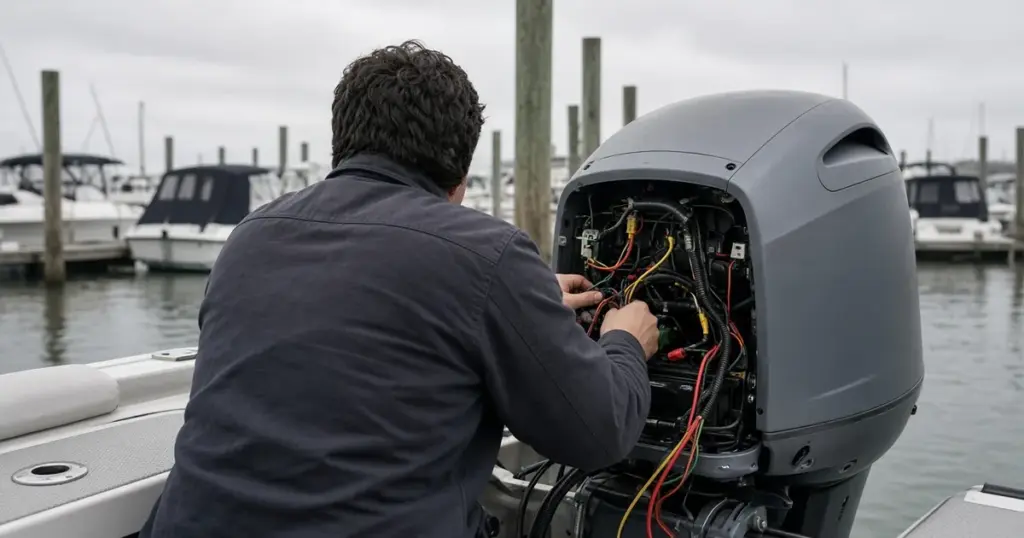
When a boat battery won’t charge, you can’t trust it on the water. Maybe the onboard charger runs all night and the battery is still low, or the engine runs all day and the start battery never seems to recover. The cause might be the charger, the alternator, a relay, a fuse, the wiring or the battery itself. This guide walks through a step-by-step diagnosis.
How boat batteries get charged
- Shore power charger: an onboard or portable charger powered by AC at the dock.
- Engine alternator: charges the start battery and, through a switch, relay, isolator or DC-DC charger, the house and trolling banks.
- DC-DC chargers: charge one bank from another, common with lithium.
- Solar or other sources: added by some owners.
Figure out which source isn’t working before you start replacing parts.
Step 1: Check the battery first
Remove the battery from the equation. Charge it with a known-good charger, let it rest and test it. If it won’t reach full voltage or fails a load test, the battery is the problem. See battery load test vs voltage test for how to tell.
A badly sulfated lead-acid battery may take a charge slowly or not at all. A lithium battery that’s been drained to its BMS cutoff may refuse to charge until reset; see lithium battery BMS shutdown.
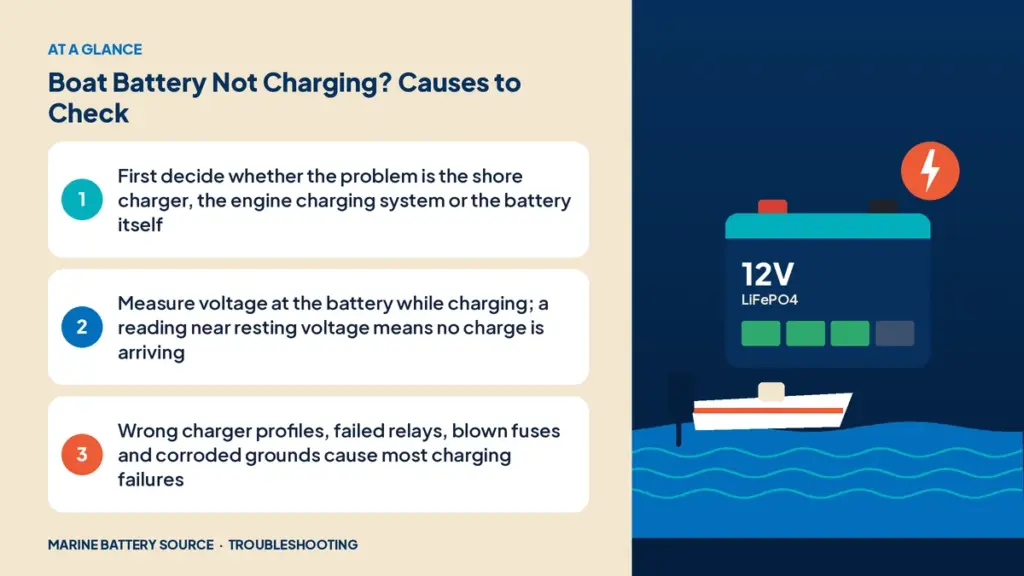
Step 2: Test the shore charger
- Plug in shore power and confirm AC is reaching the charger (check the pedestal breaker, the boat’s AC breaker and the charger’s power light).
- Read the charger’s status lights or display. Many chargers show fault codes.
- Measure voltage at the battery terminals while charging. During bulk charging, a 12V lead-acid battery typically reads well above its resting voltage, often in the 13.5–14.8V range depending on the stage and profile.
- If voltage at the battery is close to resting voltage, no charge is arriving.
- Measure at the charger’s output terminals. If voltage is present there but not at the battery, the problem is in the wiring or a fuse between them.
Common charger problems
- Wrong profile: a charger set for flooded may not fully charge AGM or lithium, or may cut out early.
- Blown output fuse: check inline fuses on each bank.
- Faulty bank: multi-bank chargers can fail one bank at a time.
- Overheating: chargers in hot compartments may reduce output or shut down.
- Lithium battery not detected: some chargers won’t start if the battery reads very low.
For what common status and fault lights mean, see battery charger fault lights, and check your charger’s manual. The marine battery troubleshooting guide covers the broader process.
Step 3: Test the engine charging system
- Measure resting battery voltage with the engine off.
- Start the engine and bring it above idle.
- Measure again at the battery. For a lead-acid start battery, you should usually see roughly 13.8–14.6V.
- If voltage barely rises, the alternator or charging circuit isn’t delivering.
Common engine charging problems
- Loose or corroded alternator connections
- Blown charging fuse (many outboards have one)
- Worn belt on inboards and sterndrives
- Failed voltage regulator or rectifier
- Low RPM: some outboards charge very little at idle
- Poor engine ground
Step 4: Check relays, isolators and switches
On dual-battery boats, the house or trolling bank charges through a battery switch, automatic charging relay (ACR), isolator or DC-DC charger.
- ACR: should combine the banks once the start battery reaches its set voltage. Check its indicator light and measure voltage on both sides.
- Isolator: a diode isolator drops some voltage. If it’s failed, one side won’t charge.
- Switch: some switch positions don’t charge every bank.
- DC-DC charger: check its input voltage, status lights and fuses.
If the start battery charges but the house battery doesn’t, the problem is almost always here.
Step 5: Check wiring and grounds
High resistance stops charging current. Look for:
- Corroded terminals and lugs
- Loose connections on busbars
- Damaged cables
- Bad grounds between engine, battery and charger
Do a voltage-drop test: with the charger or engine running, measure voltage between the charger output and the battery terminal on each side. More than a few tenths of a volt means resistance.
Step 6: Match the charger to the battery
Switching to lithium or AGM without changing the charger profile is a common cause of “not charging” complaints. Lithium needs a LiFePO4 profile. AGM needs an AGM profile. Using the wrong one can leave batteries undercharged or trip the BMS.
Good lithium-capable options include the EPOCH 12V/36V onboard lithium charger for trolling setups and the EPOCH 12V-to-36V DC-DC charger for charging a 36V bank from the engine.
Symptom guide
| Symptom | Likely cause |
|---|---|
| Charger on, battery voltage not rising | Fuse, wiring, failed charger bank |
| Charger cycles on and off | Wrong profile, overheating, battery fault |
| Start battery charges, house doesn’t | ACR, isolator, switch or DC-DC charger |
| Engine running, voltage not rising | Alternator, fuse, regulator, low RPM |
| Lithium won’t charge at all | BMS cutoff, temperature limit, charger can’t detect battery |
| Charges but dies quickly | Battery worn out or a drain |
If the battery charges fine but dies after sitting, read parasitic drain test and boat battery keeps dying.
Temperature and charging
- Lead-acid chargers with temperature sensors reduce voltage in heat; that’s normal.
- Lithium batteries won’t charge below a set low temperature (often around freezing) or above a high limit. Heated lithium batteries handle cold charging.
Example
A bay boat’s trolling bank never gets full on the dock. The charger shows normal lights, but voltage at the batteries only rises a little. Measuring at the charger output shows full charging voltage. Following the wire finds a corroded inline fuse holder in the bilge. Replacing it restores charging.
When to replace the charger
- Fault codes that persist after checking wiring and batteries
- No output on one or more banks
- Physical damage or water intrusion
- It doesn’t support your new battery chemistry
Browse marine battery chargers. If the charging system is fine and the problem is elsewhere, see boat electrical problems troubleshooting.
Frequently asked questions
Why is my boat battery not charging from the engine?
Common causes are a blown charging fuse, loose or corroded connections, a failed regulator or running at too low an RPM. Measure voltage at the battery with the engine running.
Why won’t my onboard charger charge my battery?
Check AC power, the charger’s fault lights, output fuses and the wiring. Also confirm the profile matches your battery type.
Why does my start battery charge but not my house battery?
The ACR, isolator, switch or DC-DC charger between the banks is likely at fault.
Can a bad battery refuse to charge?
Yes. Sulfated lead-acid batteries and lithium batteries in BMS cutoff can both refuse a normal charge.
Do I need a new charger for lithium?
You need a charger with a LiFePO4 profile. Many modern chargers have one; older lead-acid chargers often don’t.