


Battery Load Test vs Voltage Test
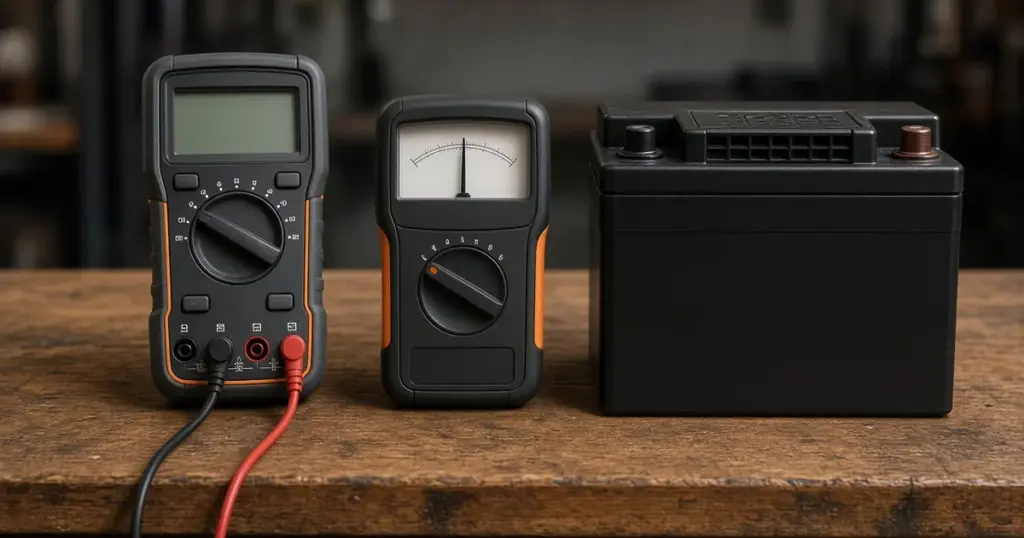
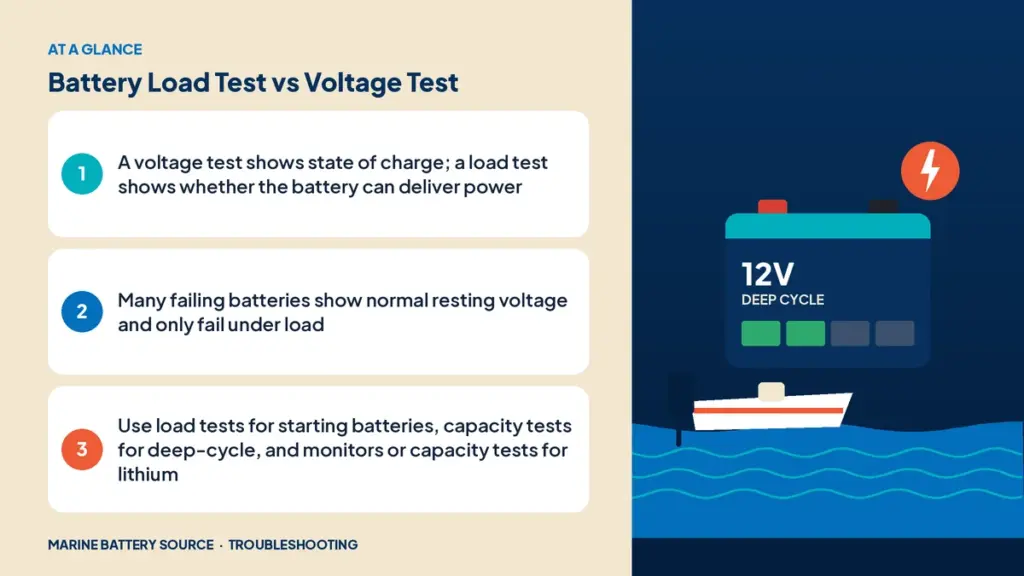
Boaters often check a battery with a multimeter, see 12.6 volts and assume it’s fine. Then the engine clicks at the ramp. That’s because a voltage test and a load test measure different things. Knowing the difference saves you from replacing good batteries and from trusting bad ones.
What a voltage test tells you
A voltage test measures the battery’s open-circuit voltage at rest. For lead-acid, that’s a decent indicator of state of charge. It doesn’t tell you:
- How much capacity the battery has left
- Whether it can deliver high current
- Whether a cell is weak
A battery with sulfated plates or a damaged cell can still show near-normal resting voltage.
See the marine battery voltage chart for resting voltage by chemistry.
What a load test tells you
A load test draws a large current, similar to engine cranking, and watches how far the voltage drops. A healthy battery holds voltage. A weak battery sags. The test reveals:
- Internal resistance problems
- Weak or failed cells
- Lost cranking ability
Comparison
| Voltage test | Load test | |
|---|---|---|
| Measures | State of charge (at rest) | Ability to deliver current |
| Tool | Multimeter | Carbon-pile or electronic tester |
| Finds weak cells | Rarely | Often |
| Speed | Seconds | Seconds to minutes |
| Best for | Quick charge check | Health check of starting batteries |
How to do a voltage test
- Charge fully.
- Rest the battery (several hours for lead-acid).
- Disconnect loads and chargers.
- Measure across the terminals.
- Compare with the chart.
How to do a load test
- Charge fully. A partly charged battery will fail a load test even if healthy.
- Connect the tester per instructions.
- For a carbon-pile tester, apply a load of about half the CCA rating for 15 seconds.
- At room temperature, a 12V battery should stay above about 9.6V at the end.
- If it fails, recharge and retest.
Electronic testers measure conductance or internal resistance and estimate health. They’re fast, safe and good for screening, but read their results as an estimate.
Capacity test: the third option
Deep-cycle batteries aren’t about cranking. A capacity test discharges the battery at a steady rate and measures how many amp-hours it delivers before reaching cutoff voltage. It’s the best way to judge a trolling or house battery’s health. See how to test a marine battery.
Which test for which battery
- Starting battery: load test.
- Dual-purpose: load test plus a capacity check if you use it for deep cycling.
- Deep-cycle lead-acid: capacity test, with a voltage test for state of charge.
- Lithium (LiFePO4): battery app or shunt monitor for state of charge, and a capacity test for health. Lead-acid carbon-pile testers aren’t designed for lithium.
Lithium and voltage tests
LiFePO4 voltage stays nearly flat from about 90% to 20%, so a voltage test says almost nothing about state of charge in that range. That’s why lithium batteries often have Bluetooth monitoring or need a shunt monitor. A sudden shutdown is usually the BMS, not a failed battery. See lithium battery BMS shutdown.
Examples
Good voltage, bad battery
A start battery reads 12.6V after charging. Under a load test, it drops to 8.9V within seconds. It has a weak cell and needs replacing.
Low voltage, good battery
A trolling battery reads 12.1V. After a full charge and rest, it reads 12.7V and passes a capacity test at close to its rating. It was simply discharged.
Charger problem disguised as a bad battery
A house battery keeps testing low on the boat. On the bench, after a full charge from a known-good charger, it passes a load test. The boat’s charger was set to the wrong profile. See boat battery not charging.
Safety
- Load testers get hot; follow the instructions.
- Wear eye protection.
- Don’t load test a battery that’s swollen, leaking or hot. See hot, swollen or smelly batteries.
- Make connections before applying the load to avoid sparks.
Interpreting borderline results
If a battery passes but barely, it’s on its way out. Plan to replace it before peak season or a long trip. Track results in a log to see the trend.
Replacement options
For starting, a high-CCA battery like the Interstate 27M-XHD handles big outboards. For deep-cycle use, a deep-cycle battery like the Interstate SRM-27 or a lithium battery like the EPOCH 12V 105Ah are common replacements. Shop cranking batteries.
For more, see the marine battery troubleshooting guide and boat electrical problems troubleshooting.
Testing tools worth owning
- A decent digital multimeter
- An electronic battery tester for quick health checks
- A shunt-based battery monitor for house and trolling banks
Why surface charge fools voltage tests
Right after charging, a lead-acid battery carries a surface charge that makes its voltage read higher than its true state of charge. A battery that reads 13.0V straight off the charger may settle to 12.4V overnight. If you test too soon, a half-charged or weak battery can look full. Either let the battery rest for several hours or turn on a small load, like the nav lights, for a few minutes before measuring. The same effect works in reverse after heavy use: a battery measured right after running the trolling motor reads lower than its true state of charge until it recovers.
Temperature effects
Cold batteries deliver less current and show lower voltage under load. A battery that barely passes a load test in summer may fail on a cold morning. Hot batteries read slightly higher. When you compare results over time, test at similar temperatures, and remember that a borderline result in mild weather is a warning for colder months.
Where to get a load test
If you don’t own a tester, many auto parts stores and marine shops can load test a battery. Bring it fully charged for an accurate result.
Frequently asked questions
Is a voltage test enough to check a boat battery?
No. Voltage shows state of charge but not health. A load or capacity test shows whether the battery can deliver.
What voltage should a battery hold during a load test?
At room temperature, a 12V lead-acid battery should stay above about 9.6V during a standard 15-second load test.
Can I load test a lithium battery?
Use a capacity test or the manufacturer’s method. Carbon-pile testers are designed for lead-acid.
Why did my battery pass a voltage test but fail to start the engine?
It likely has a weak cell or high internal resistance that only shows under load.
Should I charge before load testing?
Yes. A partly charged battery will fail a load test even if it’s healthy.