


How to Wire a Dual Battery Switch (1-2-Both)
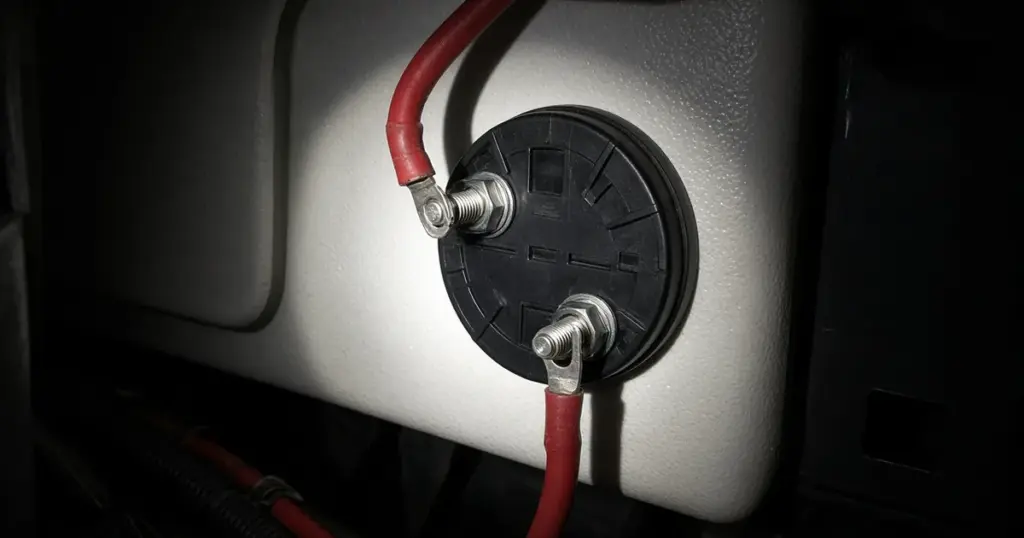
A dual battery setup gives you a spare battery for starting and more capacity for electronics, and the dual battery switch is what ties it together. Wired correctly, it lets you start on one battery, run accessories on the other and combine them in an emergency. Wired wrong, it can leave both batteries flat or cause a dangerous short. This guide covers dual battery switch wiring on a boat, from the classic 1-2-Both-Off switch to modern layouts with an ACR or DC-DC charger.
The 1-2-Both-Off switch
The most common marine dual battery switch is a rotary switch with four positions:
- Off: both batteries disconnected from the boat
- 1: battery 1 connected
- 2: battery 2 connected
- Both: batteries connected in parallel
The switch has three main studs: input 1, input 2 and common. Battery 1 positive goes to input 1, battery 2 positive goes to input 2, and the common stud feeds the engine starter and the boat’s loads. Our marine battery switch basics explains the switch types in more detail.
What you need
- A marine dual battery switch rated for your engine’s cranking current
- Two batteries, mounted and secured
- Properly sized tinned copper cable and crimped lugs
- Fuses or breakers for each battery positive. A terminal-mounted fuse like an MRBF fuse works well.
- Heat-shrink, terminal covers and labels
- Optional: an ACR or DC-DC charger to charge both batteries automatically
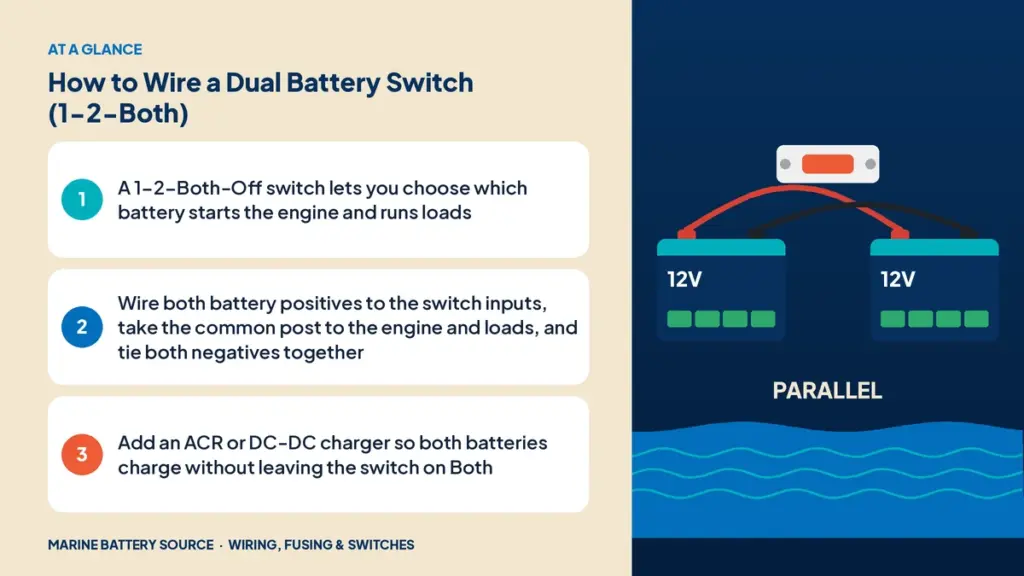
Step-by-step wiring
- Disconnect both batteries and make sure the switch is off.
- Mount the switch in an accessible spot near the batteries, away from spray, with short cable runs.
- Battery 1 positive to switch input 1. Fuse this cable close to the battery.
- Battery 2 positive to switch input 2. Fuse this cable close to its battery as well.
- Switch common to the engine. Run a cable from the common stud to the starter solenoid or the engine’s positive connection.
- Switch common to the loads. Run a fused cable from the common stud to the fuse block or breaker panel that feeds the boat’s accessories.
- Tie the negatives together. Connect both battery negatives to a common negative bus or the engine negative, using cables the same size as the positives.
- Torque all connections, fit covers and label every cable.
- Reconnect and test each switch position.
Charging both batteries
The engine’s alternator output usually connects to the switch common. That means it charges whichever battery is selected. In the classic setup, you’d run on Both while the engine runs, then switch to 1 or 2 when you stop. That works, but it depends on remembering to switch.
Better options:
- Automatic charging relay (ACR): connects the two batteries when the charging battery reaches a set voltage, then separates them when the voltage drops. Your starting battery stays protected, and both charge while running.
- DC-DC charger: charges the second battery with a proper charge profile from the first. This is the right choice when the second battery is lithium and the starting battery is lead-acid.
- Onboard multi-bank charger: charges each battery separately on shore power, regardless of switch position.
Dual battery switch with lithium
If one battery is lithium and the other is lead-acid, avoid the Both position. Paralleling different chemistries can push large currents between them and overcharge or undercharge one of them. In mixed-chemistry systems:
- Use the switch for selection only, never Both, or use a switch that doesn’t have a Both position.
- Charge the lithium battery through a DC-DC charger.
- Fuse every cable close to its battery, with a high enough interrupt rating for lithium. Large lithium banks may need a Class T fuse.
Alternative: a two-switch layout
Many modern boats use separate on/off switches for the starting battery and house battery instead of one rotary switch, plus an emergency parallel switch. This makes it clear which battery runs what:
- Switch 1: start battery to engine
- Switch 2: house battery to loads
- Emergency parallel switch: joins the batteries only when the start battery is dead
Separate on/off switches are also covered in our battery disconnect switch guide.
Fusing the dual battery system
Each battery’s positive cable needs overcurrent protection near the battery. Size each fuse for the cable it protects. The starter cable is a common exception, since many standards allow it to stay unfused because of its very high current, but follow your engine and boat builder’s guidance. Breakers vs fuses for each circuit are compared in circuit breaker vs fuse on a boat. Hardware such as the marine-rated 300A battery fuse and the MRBF fuse block handles the main feeds.
Never switch to Off while the engine is running
Turning the battery switch to Off while the engine is running disconnects the alternator from its load, which can cause a voltage spike that destroys the alternator’s diodes or damages electronics. Some switches include an alternator field disconnect to prevent this. The safe habit is simple: only turn the switch to Off after the engine is stopped. Moving between 1, 2 and Both is fine on most make-before-break switches.
Common wiring mistakes
- Wiring the loads directly to one battery, bypassing the switch, so they can’t be turned off.
- Leaving the switch on Both all the time. A dead accessory battery drags the starting battery down with it.
- Undersized cables to the switch, causing hard starts.
- No fuses on the battery positives.
- Forgetting the negative connection between batteries, so the second battery can’t start the engine.
- Mixing lithium and lead-acid on Both.
Choosing batteries for a dual setup
A typical layout pairs a cranking or dual-purpose battery for starting with a deep cycle battery for accessories. A dual-purpose lithium like the EPOCH 12V 172Ah dual-purpose LiFePO4 can serve both roles on many boats. Browse our dual-purpose marine batteries to compare options. For the full system, see our marine battery wiring guide.
Frequently asked questions
How do I wire a 1-2-Both battery switch?
Battery 1 positive goes to input 1, battery 2 positive to input 2, and the common stud feeds the engine and the boat’s loads. Both battery negatives connect together at a common negative bus or the engine negative.
Should I leave my battery switch on Both?
Not all the time. It’s fine while the engine runs and charges both batteries, but at anchor or overnight, select one battery so you always have a charged battery for starting. An ACR handles this automatically.
Can I use a dual battery switch with lithium?
Yes, but don’t combine lithium and lead-acid on Both. Use the switch to select batteries and charge the lithium battery through a DC-DC charger.
Do I need an ACR with a dual battery switch?
It’s not required, but it’s a big convenience. The ACR charges both batteries while the engine runs and separates them when it stops, so you don’t have to remember to switch.
Is it safe to switch batteries while the engine runs?
Moving between 1, 2 and Both is usually fine. Never switch to Off while the engine is running, as it can damage the alternator.