


Why You Should Separate Starting and House Batteries
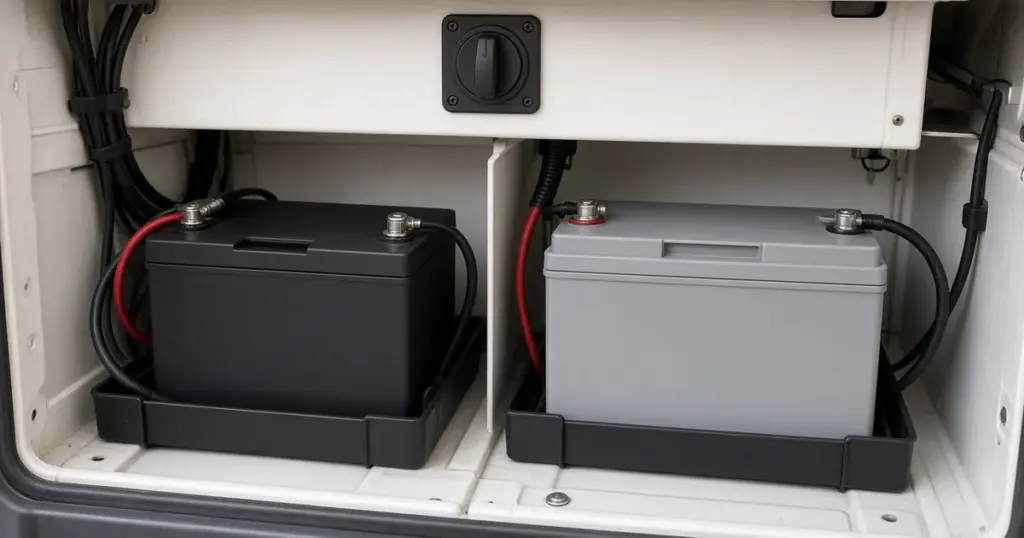
The single best electrical upgrade for many boats is separating the starting battery from the house battery. When electronics, lights, pumps and refrigerators run from their own battery, the engine battery stays charged and ready, and each battery can be chosen for its job. This guide explains why you should separate starting and house batteries and how to do it.
Why separate them?
Reliable starts
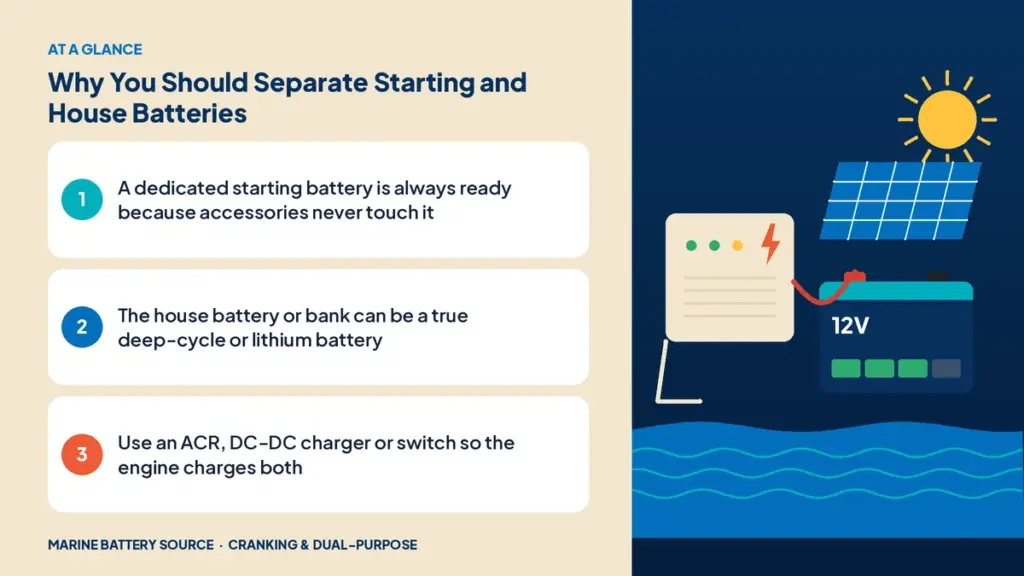
If accessories never draw from the starting battery, you can drain the house battery all afternoon and still start the engine. That’s the main reason.
Better battery life
Starting batteries are built for short, high-current bursts. Deep cycling from accessories wears them out. Deep-cycle and lithium batteries handle cycling but aren’t always optimized for cranking. Giving each battery the job it’s built for helps both last longer.
Easier sizing
You can size the house battery for your energy needs without worrying about cranking specs, and size the starting battery to the engine.
Typical configurations
Two batteries with a 1-2-Both switch
The classic arrangement. Position 1 uses battery one, position 2 uses battery two, Both parallels them. It works, but relies on the operator: leaving the switch on Both while running electronics with the engine off defeats the purpose.
Dual circuit plus switch
A switch that keeps the starting circuit on one battery and the house circuit on the other, with a combine position for emergencies. Less room for operator error.
Automatic charging relay (ACR)
An ACR connects the batteries when it senses charging voltage, so the engine charges both, then disconnects them when voltage drops, so house loads can’t drain the starting battery. Works well when both batteries are lead-acid. Dakota Lithium offers an outboard dual battery isolator and ACR accessory kit for this kind of setup.
DC-DC charger
A DC-DC charger takes power from the starting battery while the engine runs and charges the house battery with a controlled profile. It’s the preferred method for lithium house batteries, because it limits current and applies the correct charge profile. See charging on the water for more.
Choosing the starting battery
Meet the engine’s cranking and reserve requirements. A pure starting battery or a dual-purpose battery both work. The Interstate 24M-XHD lists 800 CCA and 1000 MCA in a Group 24M case, for example. AGM starting batteries are popular for their vibration resistance; see AGM starting batteries for boats.
Choosing the house battery
Size it from your energy use: add up each accessory’s current and hours, then size for the chemistry’s usable depth. Examples:
- Lead-acid deep cycle, such as the Trojan 31-AES, listed at 1.38 kWh at the 20-hour rate.
- Lithium, such as the EPOCH 12V 105Ah Essential, listed at 1.34 kWh, 22.1 lb, with Bluetooth and heating.
Lithium gives more usable energy per pound and handles deep discharge well, which makes it a popular house battery.
Wiring overview
- Starting battery positive to the engine’s starter via a battery switch.
- House battery positive through a switch and main fuse to the accessory distribution panel.
- Charging link between them: ACR, DC-DC charger or switch combine position.
- Common negative returns per the builder’s design.
- Fuse every positive conductor near its battery, as ABYC requires.
Label everything, and keep a wiring diagram aboard.
Emergency starting
Separating batteries doesn’t remove the need for a backup. If the starting battery fails, you want a way to start from the house battery or a jump pack. A combine position, an emergency parallel switch or a portable jump starter all work. See emergency starting options.
Lithium house with lead-acid start
This is a very common modern setup: a lead-acid or AGM starting battery that the engine charges directly, and a lithium house battery charged through a DC-DC charger. It combines reliable starting with lightweight, deep-cycling house power. If you’re considering lithium for the starting battery too, read lithium cranking batteries and outboard charging systems.
Shore charging
A multi-bank onboard charger with independent outputs can charge each battery with its own profile. If the batteries use different chemistries, make sure each output can be set separately.
Is this overkill for a small boat?
Not always. Even on small boats, separating the batteries means you can fish all day with electronics and still start. But on very small boats with limited space and light loads, a single dual-purpose battery plus a jump pack is a reasonable choice. See running a small boat on one battery.
Mistakes to avoid
- Leaving a 1-2-Both switch on Both. With the engine off, accessories then drain both batteries, and you lose the protection of a separate starting battery.
- Connecting a lithium house battery directly to the alternator without a DC-DC charger or equipment the battery maker approves. Lithium accepts high current, which can stress some charging systems.
- Putting accessories on the starting side. A single stray circuit on the engine battery, such as a stereo or bilge pump wired directly to it, can drain it over time. Bilge pumps are an exception many builders wire to be always available; know how yours is wired.
- Mismatched chargers. If the two batteries use different chemistries, a single-profile charger can’t charge both correctly.
- No labels. Months later, nobody remembers which switch does what. Label everything.
How much house capacity do you need?
Make a simple list of house loads and estimate amp-hours per day. A fish finder, VHF and lights for a day of fishing may need 20 to 40Ah. A cooler-style refrigerator, stereo and lights for an overnight trip can need far more. Size the house battery so your typical use stays within its comfortable depth of discharge: about half for lead-acid and about 80% for lithium, with some reserve.
Step-by-step upgrade
- Measure space for a second battery and tray.
- Choose the house battery chemistry and capacity.
- Choose a charging link: ACR for lead-acid, DC-DC charger for lithium.
- Install switches and fuses.
- Move accessory circuits to the house side.
- Test: run accessories with the engine off, then confirm the engine still starts and both batteries charge when running.
For more, read our pillar on choosing a boat starting battery and cranking vs dual-purpose vs deep-cycle batteries. Browse the store’s house bank batteries.
Frequently asked questions
Do I need separate starting and house batteries?
If you run accessories with the engine off, separating them is the most reliable way to ensure the engine always starts.
What is an automatic charging relay?
A device that connects batteries when charging voltage is present and disconnects them when it drops, so the engine charges both while house loads can’t drain the starting battery.
Can I use a lithium house battery with a lead-acid starting battery?
Yes. A DC-DC charger is the usual way to charge the lithium house battery from the engine side.
Can I start the engine from the house battery?
With a combine or parallel switch, yes, in an emergency, if the house battery can deliver enough cranking current.