


Emergency Starting Options: Jump Packs, Parallel Switches and Spares
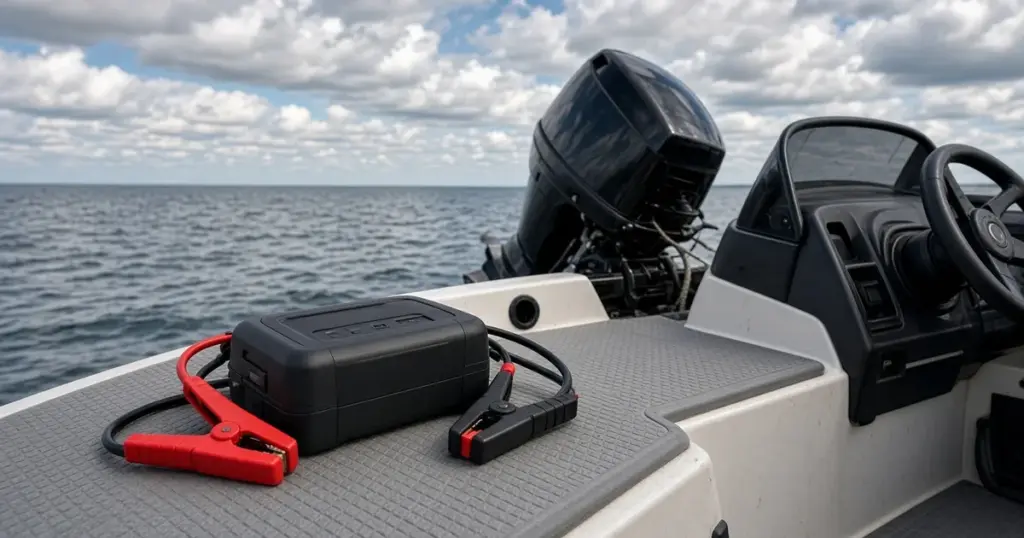
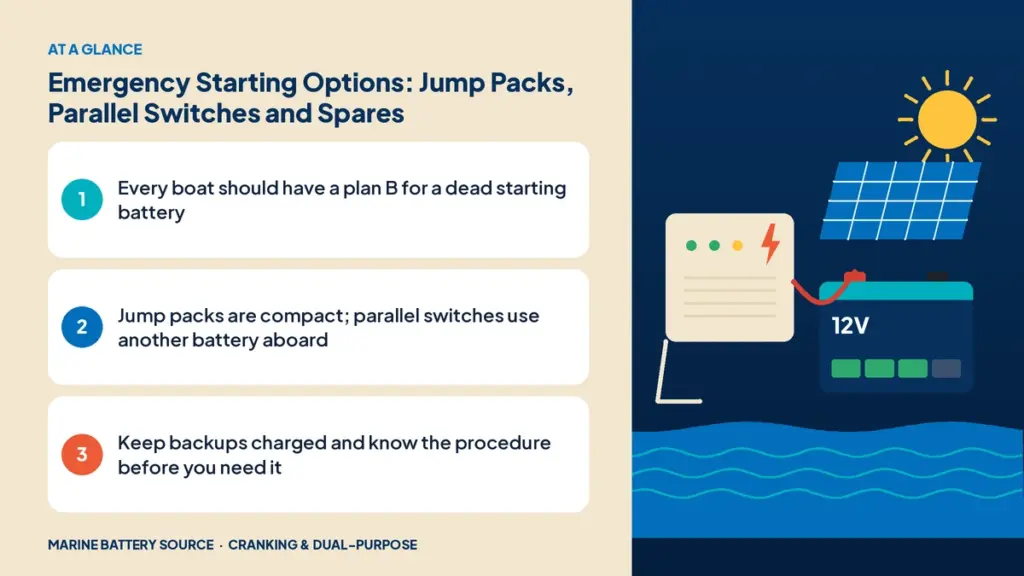
A dead starting battery is one of the most common reasons boaters call for a tow. The fix is usually simple, as long as you planned for it. A boat jump starter, a parallel switch, a spare battery or even a pull cord can get you home. This guide compares the emergency starting options, explains how to use each one safely, and helps you pick the right backup for your boat.
Why starting batteries fail on the water
- Electronics, livewells or stereos ran with the engine off and drained the battery.
- The battery was aging and finally fell below the engine’s cranking requirement.
- A loose or corroded connection prevented enough current from reaching the starter.
- A cold morning reduced available cranking power. See how temperature affects cranking.
- A lithium battery’s BMS shut it off for protection.
Knowing the cause helps you choose the right fix. If the battery is simply drained, any backup works. If it’s a connection problem, a jump pack clamped to the battery terminals won’t help until you fix the connection.
Option 1: Portable jump pack
Modern jump packs use lithium cells in a compact case with clamps attached. They’re the most popular backup for small and mid-size boats.
Pros:
- Compact and portable.
- Doesn’t depend on any other battery aboard.
- Many include USB charging and a flashlight.
Cons:
- Must be kept charged. A dead jump pack is no help.
- Must be rated for your engine. Big outboards and inboards need a higher-capacity unit.
- Not waterproof unless specified. Store it in a dry place.
Using a jump pack safely:
- Turn off all accessories and the ignition.
- Connect the red clamp to the battery’s positive terminal and the black clamp to the negative terminal or an engine ground, as the jump pack’s instructions say.
- Switch on the pack if it has a switch.
- Start the engine. Limit cranking to short bursts with rest periods.
- Once running, disconnect the pack, black clamp first.
- Recharge the pack when you get home.
Option 2: Parallel or combine switch
Boats with two or more batteries can connect them during an emergency. A 1-2-Both switch set to Both, a dedicated parallel switch, or a combine position on a dual circuit switch lets a healthy battery help start the engine.
Pros:
- Always aboard and always connected.
- Uses capacity you already carry.
Cons:
- Only works if the other battery is healthy and charged.
- If both batteries ran down together, it doesn’t help.
- Needs careful operation. Leaving batteries paralleled can drain both.
Separating starting and house batteries makes this option far more reliable, since the house battery can be drained while the starting battery stays full, and vice versa. Read why to separate starting and house batteries.
Option 3: Spare battery
Some boaters carry a small spare battery and jumper cables. It works, but a spare battery takes space, must be secured, and needs charging. Today, a jump pack usually does the same job more conveniently.
Option 4: Manual start
Many small outboards have a pull-start or an emergency starter rope. Learn how to use it on your engine before you need it. Larger outboards rarely have this option.
Choosing the right backup
| Boat | Typical best backup |
|---|---|
| Small outboard, one battery | Jump pack, plus manual start if available |
| Mid-size outboard, two batteries | Parallel or combine switch, plus a jump pack |
| Twin or triple outboards | Parallel switch across starting batteries, plus a house bank |
| Inboard or cruiser | Parallel switch, dedicated house bank, and a large jump pack |
Jump packs and lithium batteries
If your boat has a lithium starting battery that has shut off due to its BMS, follow the battery maker’s guidance. Some batteries reconnect once the fault clears, and some recommend specific wake-up procedures. Jump packs can usually start the engine through the cables, but the battery itself may need to recover before charging. If you’re considering lithium for starting, review lithium cranking batteries and charging systems first. Cranking-rated lithium options include the Dakota Lithium DL 12V 60Ah, listed at 1000 CCA.
Preventing the need for a jump
The best emergency start is the one you never need.
- Separate starting and house loads.
- Size a dual-purpose battery generously if you run electronics from it; see sizing a dual-purpose battery for electronics.
- Test the starting battery before the season and replace it when it no longer meets the engine’s spec.
- Keep connections clean and tight.
- Use the battery switch to isolate batteries when the boat sits.
A strong battery that meets your engine’s spec with margin is the foundation. Examples in the store include the Interstate 27M-XHD at 800 CCA and 1000 MCA, and the Interstate 31M-AGM at 925 CCA and 1190 MCA.
Safety notes
- Never connect clamps in reverse polarity.
- Keep sparks away from batteries, especially flooded batteries that may have vented hydrogen during charging, and from fuel vapors on gasoline boats.
- Run the blower before starting a gasoline inboard or sterndrive.
- Don’t crank continuously for long periods; give the starter time to cool.
- Wear eye protection when working near batteries.
Practice before you need it
Find your battery switch and parallel switch, label them clearly, and walk through the emergency procedure at the dock. Make sure everyone who runs the boat knows how to use the jump pack. A two-minute rehearsal turns a stressful situation into a routine one.
After an emergency start
Once the engine is running, keep it running long enough to recharge the battery, or head in. When you get back, recharge the battery fully with a shore charger, find out why it failed, and test it. A battery that needed a jump once may be telling you it’s near the end of its life. Our guide to choosing a boat starting battery covers replacement, and cranking vs dual-purpose vs deep-cycle batteries explains the options. Browse cranking batteries in the store.
Frequently asked questions
Can I jump start a boat with a car?
It’s possible at the ramp with a vehicle and proper jumper cables if the voltage matches, but a portable jump pack is far more practical on the water.
What size jump starter do I need for my boat?
Choose a jump pack rated for your engine’s size and type. Larger outboards and inboards need higher-capacity units. Check the jump pack maker’s engine size guidance.
Is it safe to leave a boat battery switch on Both?
While running, it can be, depending on your setup. With the engine off, Both lets accessories drain all batteries, so switch back to a single battery or off.
Will a jump pack work if my battery terminals are corroded?
Clamping to corroded terminals may not deliver enough current. Clean the terminals or clamp to clean metal on the cable lugs, per the jump pack’s instructions.