


How to Install an Automatic Charging Relay
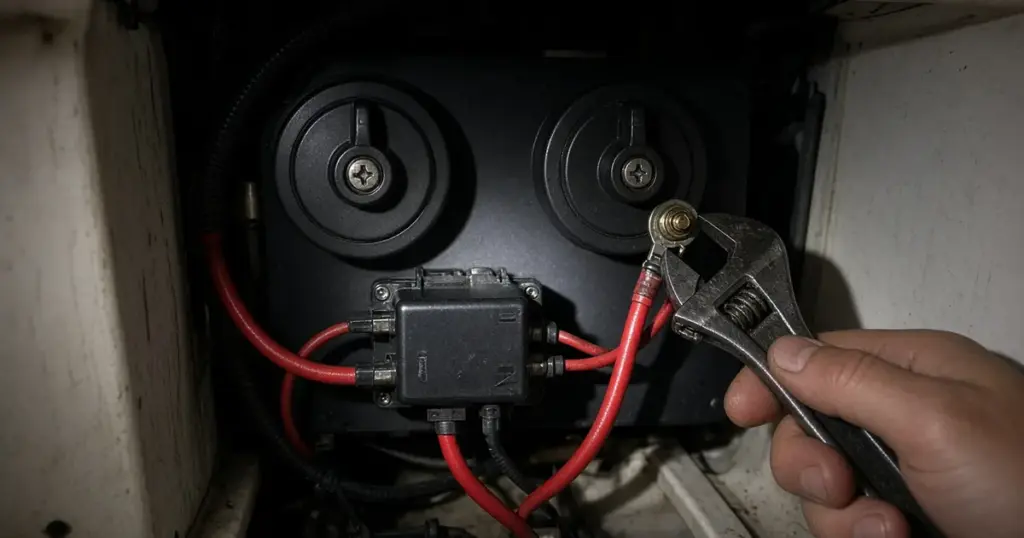
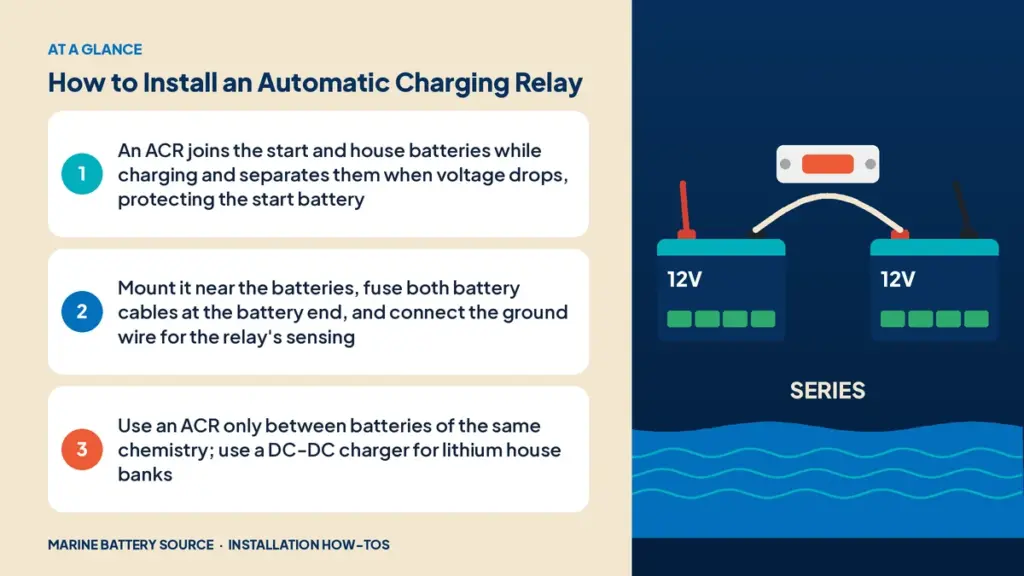
An automatic charging relay, or ACR, is the simplest way to charge two batteries from one alternator without having to remember to turn a switch. When the engine charges the start battery and its voltage rises, the ACR connects the house battery so both charge. When the engine stops and voltage falls, the ACR disconnects them, so running the stereo or fridge can never drain the start battery. This guide explains how to install an ACR on a boat.
How an ACR works
An ACR is a voltage-sensing relay connected between two batteries:
- Combine: when either battery reaches a set voltage, typically around 13.0V to 13.3V for a set time, the relay closes and connects the batteries.
- Separate: when voltage drops below a lower threshold, around 12.75V, the relay opens.
- Bi-directional: many ACRs sense both batteries, so a shore charger on the house battery can also charge the start battery.
- Start isolation: some ACRs open during engine cranking to protect sensitive electronics on the house side.
When an ACR is the right choice
- Two lead-acid batteries (flooded, AGM or a mix of similar lead-acid types)
- A single engine and alternator charging both batteries
- Owners who want hands-off charging management
When it isn’t
- Lithium house bank with a lead-acid start battery. Lithium’s low resistance can pull very high current from the alternator through the ACR, overheating the alternator. Lithium also needs a different charge profile. Use a DC-DC charger instead.
- Long cable runs between batteries, where voltage drop makes a DC-DC charger more effective.
Sizing the ACR
Choose an ACR with a continuous rating above your alternator’s maximum output. A 120A ACR suits most outboards and small inboards; larger alternators need larger ACRs.
Tools and materials
- ACR and mounting screws
- Cables sized for the alternator output and run length
- Fuses or breakers for each battery cable
- Ring terminals and heat-shrink
- Small wire for the ground and optional start-isolation lead
- Multimeter
Step 1: Disconnect power
Turn off the battery switches and disconnect both battery negatives.
Step 2: Mount the ACR
Mount it close to the batteries, in a dry, ventilated spot on a solid surface. Many owners mount it near the battery switches.
Step 3: Wire the battery cables
- Run a cable from the start battery positive (or the battery side of its switch) to one ACR stud.
- Run a cable from the house battery positive (or the battery side of its switch) to the other ACR stud.
- Fuse each cable close to its battery, sized for the cable.
Step 4: Connect the ground
Most ACRs need a small ground wire to the negative bus to power their sensing circuit. Without it, the relay won’t operate.
Step 5: Optional connections
- Start isolation lead: connects to the starter solenoid’s trigger so the ACR opens during cranking.
- Remote LED or switch: some ACRs offer a remote indicator or manual override.
Step 6: Reconnect and test
- Reconnect the battery negatives and turn on the switches.
- Start the engine and measure voltage at both batteries.
- Within a minute or so, the ACR should combine and both batteries should show charging voltage.
- Turn off the engine. After voltage falls, the ACR should separate.
- Turn on house loads and confirm the start battery voltage doesn’t drop.
Using an ACR with a battery switch
A typical layout uses two on/off switches (start and house) plus an emergency parallel switch, with the ACR between the batteries. The ACR handles charging; the parallel switch is only for emergency starting from the house battery.
Using an ACR with an onboard charger
If your shore charger only has one output, connect it to the house battery. A bi-directional ACR will combine the batteries when the house battery reaches combine voltage, charging the start battery too. Better yet, use a multi-bank charger with an output for each battery.
Common mistakes
- Missing ground wire, so the ACR never combines.
- No fuses on the battery cables.
- Undersized ACR for the alternator.
- Using an ACR with lithium and a lead-acid start battery.
- Mounting far from the batteries with long, thin cables.
Documenting the install
Label the ACR cables and add the ACR to your wiring diagram. See boat wiring labeling and documentation.
Related installs
For lithium house banks, see installing a sailboat house bank. For inverter systems, see how to install an inverter on a boat. Before you finish, run through our marine battery installation checklist.
For general guidance, see how to install a marine battery, DIY vs professional installation and the trolling motor power system guide.
Batteries for ACR systems
Matched lead-acid batteries work best with an ACR. A common pairing is a starting battery like the Interstate 27M-XHD starting battery with a deep cycle house battery like the Interstate SRM-27 deep cycle. If you’re moving the house side to lithium, choose a DC-DC charger instead and browse our house bank batteries.
Troubleshooting an ACR
- Never combines: check the ground wire, the combine voltage, and whether the alternator actually raises voltage high enough. Some outboards at idle never reach combine voltage.
- Clicks on and off repeatedly: called cycling. Often caused by a deeply discharged house battery that pulls voltage down as soon as it connects. Let the alternator run at higher RPM, or charge the house battery from shore first.
- Gets hot: loose terminals or an ACR undersized for the alternator.
- Start battery drains at anchor: the ACR may be stuck closed. Test it by checking voltage on both sides with the engine off.
Frequently asked questions
What does an ACR do on a boat?
It automatically connects the start and house batteries while charging and separates them when charging stops, protecting the start battery.
Can I use an ACR with a lithium battery?
Not with a lithium house bank and lead-acid start battery. Use a DC-DC charger instead.
Where should I mount an ACR?
Close to the batteries in a dry, ventilated spot, often near the battery switches.
Why won’t my ACR combine?
Check the ground wire, connections and whether the charging voltage reaches the combine threshold.
Do I still need a battery switch with an ACR?
Yes. Switches let you isolate each battery, and an emergency parallel switch lets you start from the house battery if needed.