


Lithium Battery Shut Off? BMS Protection Modes Explained
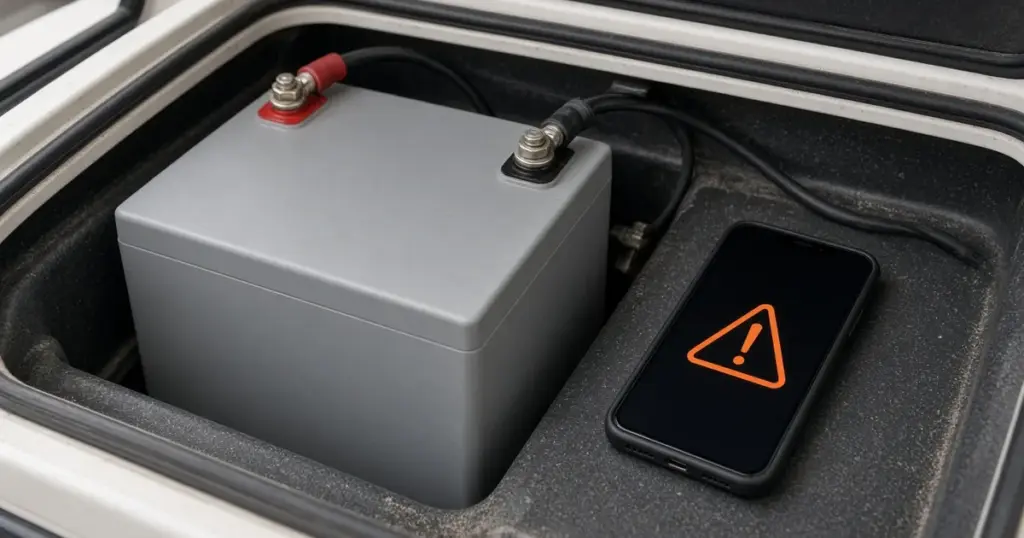
One moment the trolling motor is running, the next the lithium battery reads zero volts. Or the engine cranks, the electronics go dark and nothing comes back. On a lithium battery, that’s almost always the battery management system (BMS) doing its job: disconnecting the battery to protect the cells. Understanding why the BMS shut down tells you how to bring the battery back and how to prevent it from happening again.
What the BMS does
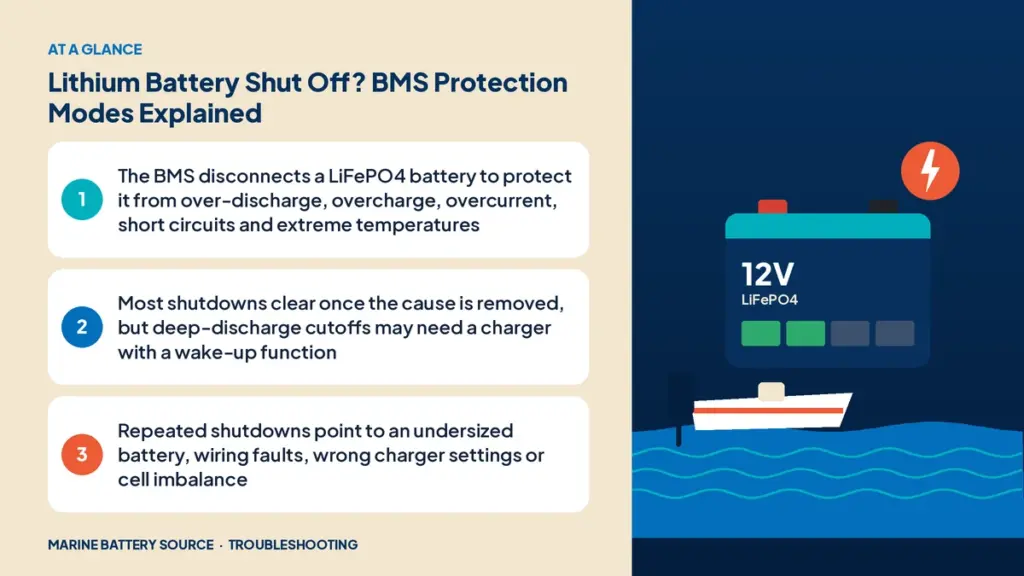
Every LiFePO4 battery has a BMS that monitors cell voltages, current and temperature. When any value goes outside safe limits, it opens an internal switch and disconnects the battery from the terminals. Typical protections:
- Low-voltage cutoff: prevents over-discharge
- High-voltage cutoff: prevents overcharge
- Overcurrent: disconnects if current exceeds the rated limit
- Short-circuit protection: disconnects almost instantly on a short
- Temperature: stops charging when too cold or too hot, and may stop discharging at extremes
- Cell balancing: keeps cells at similar voltages; imbalance can trigger cell-level cutoffs
Common causes of BMS shutdown on boats
1. Running the battery flat
The most common cause. A lithium battery holds voltage until it’s nearly empty, then drops fast, and the BMS cuts off. It feels sudden because there’s little warning from voltage.
2. Too much current
A trolling motor on high in wind, an inverter running a big load, or a lithium battery used for engine starting without enough current rating can exceed the BMS limit.
3. Charging in the cold
Most LiFePO4 batteries won’t accept charge below about freezing. The BMS blocks charging until the cells warm up. Heated batteries solve this.
4. Heat
In hot compartments, the BMS may stop charging until cells cool.
5. Overcharge
A charger with the wrong profile or high voltage can push a cell past its limit.
6. Cell imbalance
If one cell reaches its limit before the others, the BMS cuts off even though the battery isn’t truly full or empty.
7. Wiring faults
A short, a bad connection or a loose terminal can cause current spikes and trigger protection.
How to tell which protection tripped
- Bluetooth app or display: many batteries show the fault directly.
- Context: what was happening when it shut off? Heavy load, cold morning, charging, sitting for weeks?
- Voltage at terminals: often zero or very low when the BMS has disconnected.
- Battery monitor history: state of charge just before shutdown.
Read marine battery voltage chart for why lithium voltage tells you so little until near empty.
How to reset a BMS
Procedures vary by manufacturer, so check the manual. General approaches:
- Overcurrent or short circuit: remove the load, fix the cause, and the BMS often resets automatically after a short time or when a charger is connected.
- Low-voltage cutoff: connect a charger. Many lithium chargers have a wake-up or recovery mode that applies a small current to reactivate the BMS. Some lead-acid chargers won’t start on a battery reading zero volts.
- Temperature: let the battery warm or cool to within range.
- High-voltage cutoff: disconnect the charger, apply a small load briefly, and correct the charger settings.
Don’t try to bypass the BMS or jump the battery from another source unless the manufacturer specifically allows it.
When the BMS won’t reset
- The battery was deeply discharged and left for a long time
- A cell is damaged
- The BMS itself has failed
Contact the manufacturer. Many lithium batteries carry long warranties that require following their procedures.
Preventing shutdowns
Size the battery for the load
If the BMS trips on overcurrent, the battery is too small for the load. Check the continuous and peak current ratings. For a heavy 36V trolling motor, a EPOCH 36V 100Ah provides more current headroom than a smaller pack.
Don’t run it to zero
Use a battery monitor or app and stop before you hit the cutoff. Leave a reserve.
Use the right charger
A charger with a LiFePO4 profile, like the EPOCH 12V 50A lithium charger, charges to the right voltage and can wake a battery from low-voltage cutoff.
Watch temperature
In cold climates, choose a heated battery or charge only when the battery is warm enough. In hot compartments, improve ventilation.
Keep connections tight
Loose terminals cause arcing and current spikes. Torque to spec.
Fix parasitic drains
A drain can quietly run a lithium battery down to cutoff while the boat sits. See parasitic drain test.
Lithium for engine starting
Not every lithium battery is designed for engine starting. Starting draws high current briefly. Use a battery rated for cranking, like the EPOCH 12V 172Ah dual-purpose, and follow the engine manufacturer’s guidance about alternator charging of lithium.
Charging from the alternator
Alternators can be stressed by lithium batteries, which accept high current. A DC-DC charger limits current and applies the right profile. If the BMS trips when the engine is running, the alternator may be pushing too much voltage or current. See boat battery not charging.
Diagnosing shutdowns step by step
- Note the conditions: load, temperature, state of charge.
- Check the app or monitor for fault codes.
- Remove loads and connect a lithium-compatible charger.
- If it resets, review what caused the trip.
- If it doesn’t, check the manual and contact the manufacturer.
- Test the battery with a capacity test once it’s running. See battery load test vs voltage test.
For the broader troubleshooting process, see the marine battery troubleshooting guide and boat electrical problems troubleshooting. Regular checks belong in the marine battery maintenance guide. Shop lithium marine batteries.
Frequently asked questions
Why did my lithium battery suddenly stop working?
The BMS probably disconnected it to protect the cells from low voltage, high current, short circuit or temperature.
How do I reset my lithium battery BMS?
Remove the load and connect a lithium-compatible charger. Many chargers have a wake-up mode. Follow your battery’s manual.
Can I jump-start a lithium battery?
Don’t, unless the manufacturer explicitly allows it. Use the recommended charger recovery method instead.
Why won’t my lithium battery charge in the cold?
The BMS blocks charging below about freezing to protect the cells. Warm the battery or use a heated model.
Do repeated BMS shutdowns damage the battery?
Occasional trips are normal protection. Repeated deep discharges or overcurrent events point to a problem you should fix.