


Choosing a Boat Starting Battery: The Complete Guide
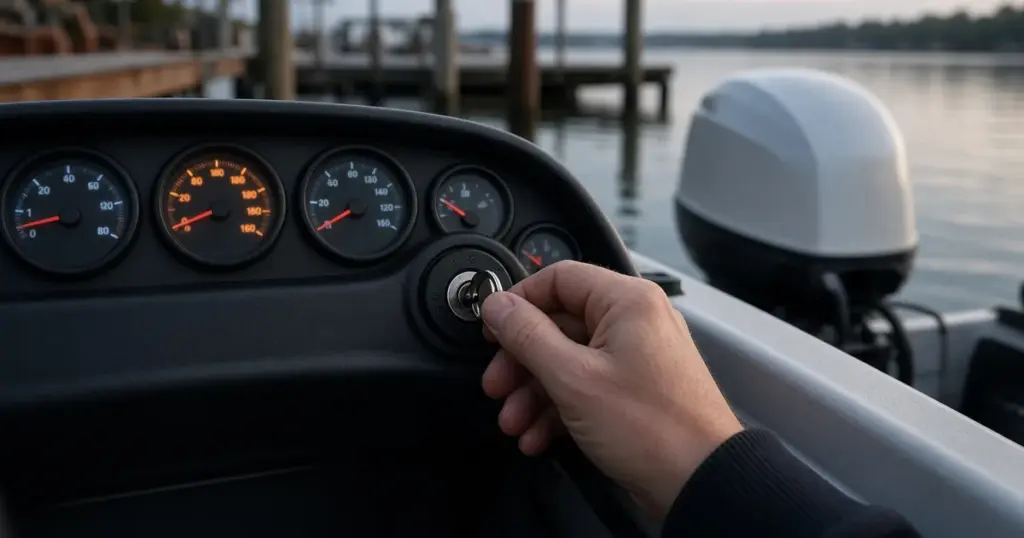
Your boat starting battery has one critical job: get the engine running every time, including after a long day of electronics, a cold morning or a few weeks at the dock. When it fails, you’re stuck. This complete guide covers how to choose a boat starting battery, from reading the engine’s spec to picking a chemistry, planning backups and knowing when to replace it. Each section links to a deeper guide.
Step 1: Know your engine’s requirements
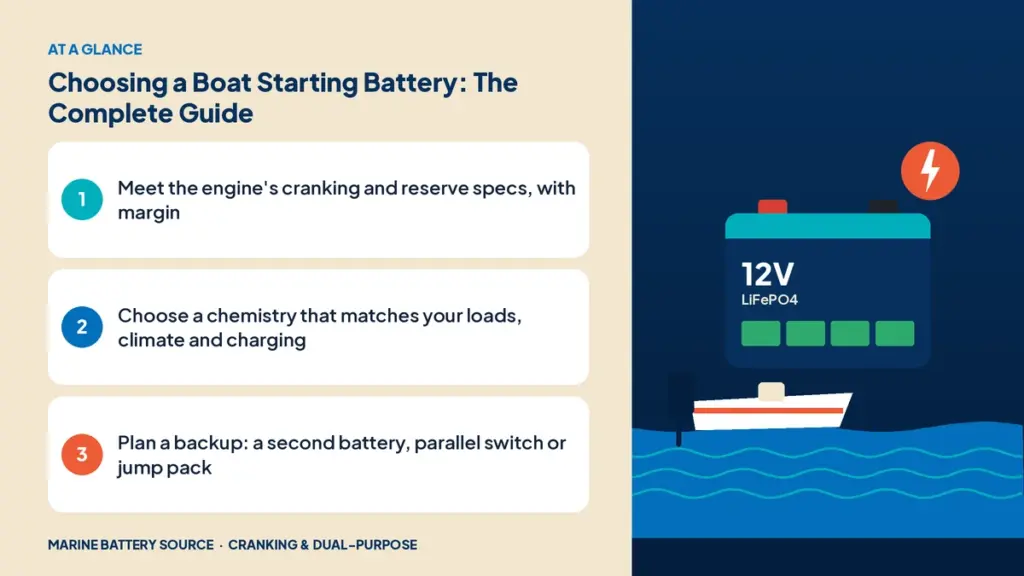
Engine manufacturers list battery requirements in the owner’s manual: minimum cranking amps (CCA, MCA or both), minimum reserve capacity, and sometimes a recommended type. Meet both the cranking and reserve figures. See our guide to cranking, dual-purpose and deep-cycle batteries for the basics.
Cold weather matters. Batteries deliver less current when cold, while engines get harder to turn over. If you boat early in spring or late into fall, choose margin. Our article on cold-weather cranking explains why.
Step 2: Decide what the battery must power
- Starting only: a pure starting battery, with the house loads on a separate battery.
- Starting plus light accessories: a dual-purpose battery.
- Starting plus heavy accessories: separate starting and house batteries.
Running a small boat on one battery is common but has risks; read running a small boat on one battery. If you’re sizing a single battery to cover both jobs, see sizing a dual-purpose battery for starting and electronics. For many boats, the best answer is to separate starting and house batteries.
Step 3: Choose a chemistry
| Chemistry | Strengths | Trade-offs |
|---|---|---|
| Flooded | Lowest cost, strong cranking per dollar | Needs watering and ventilation; less tolerant of cycling and vibration |
| AGM | Sealed, vibration-resistant, strong cranking | Higher cost; sensitive to overcharging |
| Lithium (cranking-rated) | Very light, low self-discharge, handles cycling | Highest cost; check engine and charging compatibility; cold-charging limits |
AGM is a popular upgrade for boats that take a pounding; see AGM starting batteries for boats. Lithium starting batteries need special consideration of the engine’s charging system; see lithium cranking batteries and outboard charging systems.
Step 4: Pick the size and terminals
Starting batteries for boats are commonly Group 24, 27 or 31, with 4D and 8D batteries on large boats. Choose a size that fits the tray and hold-down. Marine batteries often have threaded studs for ring terminals; make sure they match your cables. Store examples:
- Interstate 24M-XHD: 800 CCA, 1000 MCA, 135 minutes RC.
- Interstate 27M-AGM-A: 750 CCA, 900 MCA, 175 minutes RC.
- Dakota Lithium DL 12V 60Ah: 1000 CCA listed in a Group 24 size at 16.5 lb.
Step 5: Plan charging
Your outboard or inboard charges the starting battery while running. At the dock, a shore-power charger with the correct profile keeps it topped up. If the boat has other batteries, the charging system needs to handle all of them: automatic charging relays, DC-DC chargers and multi-bank onboard chargers are the usual tools.
Step 6: Plan a backup
A single starting battery is a single point of failure. Options include:
- A second battery with a battery switch.
- A parallel or emergency switch that combines batteries for starting.
- A portable jump pack.
Each has pros and cons, explained in emergency starting options.
Generators and other engines
Boats with generators usually give the generator its own starting battery. See generator starting batteries on boats. Multi-engine boats need one starting battery per engine, plus a plan for charging and switching.
Step 7: Install it correctly
- Disconnect negative first and reconnect it last.
- Secure the battery with a hold-down rated for its weight.
- Cover the positive terminal.
- Tighten terminals to spec and coat them with a protectant.
- Check that cables are in good condition and properly sized.
Step 8: Maintain it
- Recharge after use.
- Keep terminals clean.
- Check flooded electrolyte levels.
- Use the battery switch to isolate the battery when the boat sits.
- Store charged over the off-season.
Step 9: Know when to replace it
Slow cranking, failing a load test, or a battery that won’t hold a charge are signs it’s time. Read when to replace a marine starting battery for details. Replacing before peak season is cheaper than a tow.
Common starting battery mistakes
- Buying by price or MCA alone. A cheap battery that barely meets the spec when new may fall short after a season or two. Compare the unit your engine maker uses.
- Running electronics from the starting battery all day. That’s how boaters end up needing a tow. If you fish with the engine off, add a house battery or choose a dual-purpose battery with plenty of reserve.
- Ignoring connections. Corroded lugs and loose terminals cause slow cranking that looks like a weak battery.
- Mismatched chargers. A charger set for flooded batteries may not charge an AGM correctly, and a lead-acid profile isn’t right for lithium.
- Leaving the boat switched on. Small parasitic loads drain a battery over a few weeks at the dock.
Testing before the season
Before the first trip of the year, fully charge the starting battery and have it load-tested or tested with a conductance tester. Compare the result with the engine’s cranking requirement. Clean the terminals, check the cables for cracks or swelling under the insulation, and make sure the hold-down is tight. A quick test in spring is far cheaper than a dead battery at the ramp on opening weekend.
Starting batteries in hot climates
Heat shortens lead-acid battery life more than cold does. Boats in Florida, the Gulf Coast and other hot regions often see batteries fail sooner than the same model would in a cooler climate. Ventilate the battery compartment, keep batteries out of direct sun where possible, and test more often.
Quick decision guide
- Small outboard, few electronics: one dual-purpose battery, plus a jump pack.
- Mid-size outboard with electronics: separate starting and house batteries, or two dual-purpose batteries with a switch.
- Offshore twin or triple outboards: one starting battery per engine plus a house bank.
- Weight-sensitive boat: consider a cranking-rated lithium battery, if the engine maker allows it.
Browse the store’s cranking batteries and dual-purpose batteries to compare options.
Frequently asked questions
What kind of battery do I need to start my boat?
A marine starting or dual-purpose battery that meets your engine’s minimum cranking and reserve capacity specs, in a size that fits your tray.
How long should a boat starting battery last?
It depends on chemistry, climate, charging habits and use. Lead-acid starting batteries often last several seasons with good care; lithium can last much longer if used within its limits.
Can I use a deep-cycle battery to start my boat?
Some deep-cycle batteries can crank small engines, but they may not meet the cranking spec of larger engines. Use a starting or dual-purpose battery rated for your engine.
Should I carry a jump pack on my boat?
A jump pack is a sensible backup, especially on boats with one battery. Choose one rated for your engine size.