


Sizing a Dual-Purpose Battery for Starting and Electronics
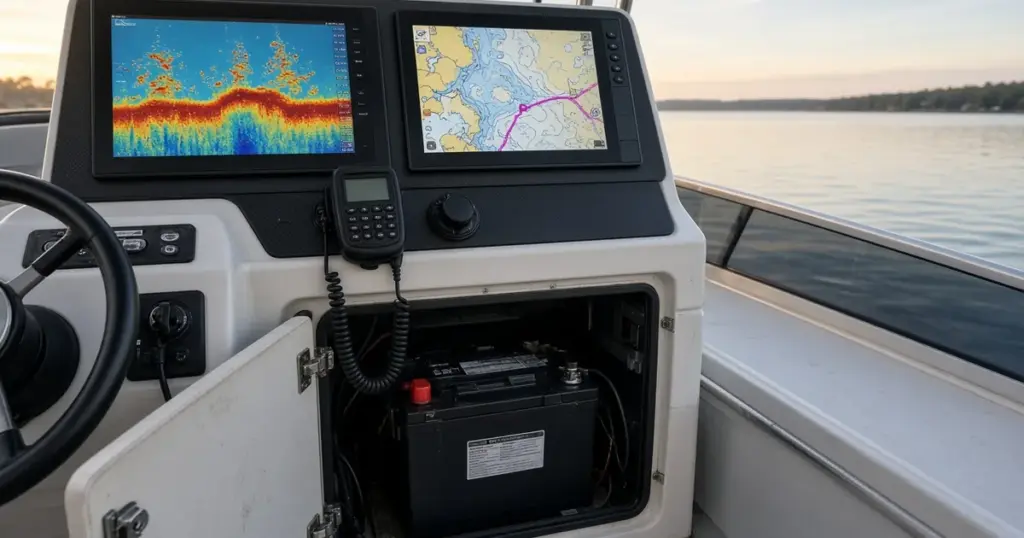
On many boats, one battery has to do two jobs: start the engine and power the electronics. A dual-purpose battery is the usual answer, but picking the right size takes a little math. Too small, and you risk a no-start after a long day with the graphs running. Too big, and you’ve paid for weight and capacity you’ll never use. This guide shows how to size a dual-purpose battery for starting and electronics, with worked examples.
Two requirements, one battery
A dual-purpose battery must satisfy both:
- Starting: meet or exceed the engine’s minimum cranking rating and reserve capacity.
- Electronics: deliver the energy your accessories use between charges, while leaving enough to start the engine.
Start with the engine’s spec. Then work out the electronics budget.
Step 1: List your electronics
Write down every device that runs with the engine off, with its current draw. Use manuals for accurate figures; a clamp meter on the battery cable gives the total. Typical categories include:
- Chartplotter or fish finder displays.
- Sonar modules, including forward-facing sonar.
- VHF radio, mostly on standby with occasional transmission.
- Stereo.
- Livewell and bilge pumps, which cycle on and off.
- Navigation and anchor lights.
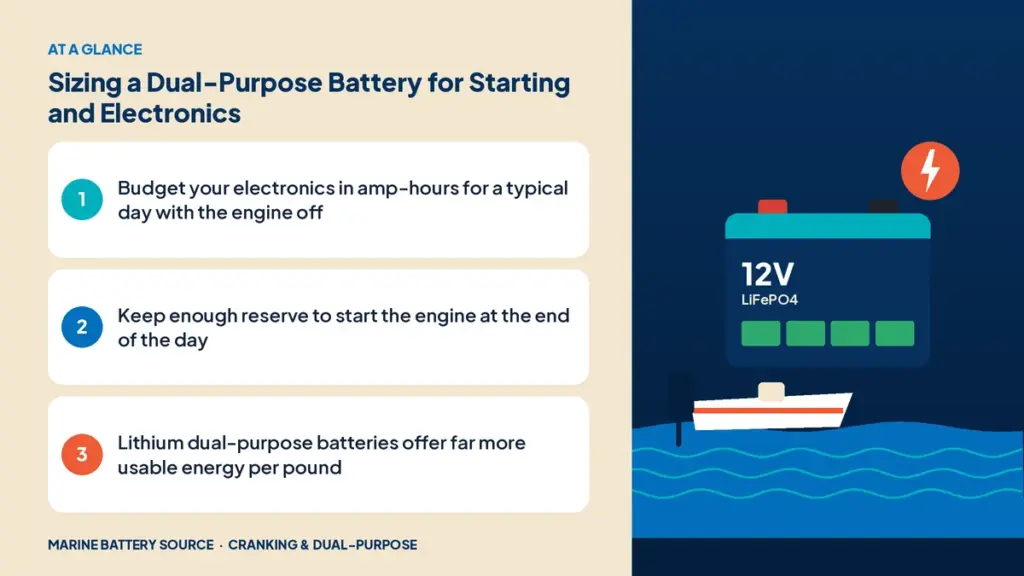
Step 2: Estimate hours and amp-hours
Multiply each device’s average current by the hours it runs with the engine off. Pumps that cycle need an estimate of their duty cycle.
Example budget
| Device | Average draw | Engine-off hours | Amp-hours |
|---|---|---|---|
| Fish finder display | 1.5A | 5 | 7.5 |
| Sonar module | 1.0A | 5 | 5 |
| VHF (standby) | 0.5A | 5 | 2.5 |
| Livewell pump (half the time) | 1.5A avg | 5 | 7.5 |
| Stereo | 2.0A | 2 | 4 |
| Total | 26.5Ah |
These numbers are illustrative; use your own devices’ figures.
Step 3: Add starting reserve
You must still be able to start the engine after drawing down the battery. With lead-acid, starting power falls as state of charge drops, especially in cold weather. A sensible approach is to keep a lead-acid dual-purpose battery above roughly half charge, and preferably higher, before cranking. For lithium, the voltage stays steady, but you should still leave a healthy reserve.
Step 4: Size by chemistry
Lead-acid dual purpose
If your electronics use 26.5Ah and you want to stay above about half charge, the battery’s usable capacity at a light load should comfortably exceed 26.5Ah, leaving room for starting. Reserve capacity gives a rough guide: RC × 25 ÷ 60 approximates amp-hours at a 25A rate, and lighter loads deliver more.
- The Interstate 27M-AGM-A lists 175 minutes RC (about 73Ah at 25A), 750 CCA and 900 MCA.
- The Interstate 31M-AGM lists 200 minutes RC (about 83Ah at 25A), 925 CCA and 1190 MCA.
Either would handle the example budget, with the Group 31 giving more margin.
Lithium dual purpose
Lithium can be discharged more deeply without damage and delivers its capacity more evenly.
- The Dakota Lithium DL 12V 60Ah lists 720 Wh and 1000 CCA at 16.5 lb. Using 26.5Ah leaves more than half the battery for reserve.
- The Dakota Lithium DL 12V 135Ah heated lists 1,620 Wh and 1000 CCA at 27.2 lb, ample for heavier electronics.
- The EPOCH 12V 172Ah dual purpose lists 1000 CCA in a Group 31 size at 40 lb.
Check the engine maker’s guidance before using lithium for starting.
Worked example 1: small bay boat
A 90 hp outboard and a single 9-inch display with sonar, used about 6 hours a day with frequent engine starts. Engine-off use is perhaps 3 hours, so the budget is around 8 to 10Ah. A Group 24 or 27 dual-purpose battery meeting the engine’s cranking spec is plenty.
Worked example 2: tournament-style fishing with forward-facing sonar
Two large displays plus forward-facing sonar running for 8 hours, mostly with the engine off, can add up to 50Ah or more. A lead-acid dual-purpose battery would be deeply cycled every trip and wear out quickly. A large lithium dual-purpose battery, or a separate electronics battery, is the better answer. See our starting battery guide for how to restructure the system.
Worked example 3: weekend cruising runabout
Stereo, lights and a small cooler for an afternoon at a sandbar. Stereo use can be significant, and the cooler adds a constant draw. If the budget exceeds what a dual-purpose battery can deliver while keeping starting reserve, add a house battery.
When to move to two batteries
If your budget is more than about a third of a lead-acid dual-purpose battery’s capacity, or you regularly fish many hours with the engine off, a second battery makes more sense than a bigger dual-purpose battery. Our guide to separating starting and house batteries explains how.
Cold weather and aging
Electronics budgets don’t change much with temperature, but cranking power does. A dual-purpose battery that’s comfortable in July may be marginal in October. Read cold-weather cranking. Batteries also lose capacity with age; see when to replace a starting battery.
Monitoring on the water
A voltage readout on the chartplotter, a battery monitor, or a Bluetooth lithium battery app helps you know where you stand. If the reading approaches your reserve threshold, start the engine to recharge or turn off non-essential loads.
Charging between trips
Running the outboard recharges a dual-purpose battery, but short runs between spots may not fully replace what electronics used. Recharge at the dock or at home after every trip.
Backup plan
Even with a well-sized battery, carry a jump pack. See emergency starting options. Generators have their own needs; see generator starting batteries.
For background on battery types, read cranking vs dual-purpose vs deep-cycle batteries, and browse dual-purpose batteries in the store.
Frequently asked questions
Can a dual-purpose battery run my fish finder all day?
Usually, if you size it for your amp-hour budget and keep enough reserve to start the engine. High-draw sonar setups may need a separate battery.
How do I calculate my electronics amp-hour budget?
Multiply each device’s average current by its engine-off hours, then add them up.
Is lithium better for a dual-purpose battery?
Lithium offers more usable capacity per pound and tolerates deep cycling. Use a cranking-rated model and check your engine maker’s guidance.
How much reserve should I leave for starting?
For lead-acid, try to stay above roughly half charge before cranking, more in cold weather. For lithium, leave a healthy reserve per the battery maker’s guidance.